Fragrance Notes Are Layers Of Scent That Are Layered To Form The Final Fragrance. Fragrance Notes Are Categorised Into Three Main Elements Based On How Long They Take To Evaporate, And How Long They Typically Last Following Application: Top Notes, Heart Notes And Base Notes.
Arctic Bramble
Arctic Bramble in perfumery offers a nuanced, delicate scent profile. It features notes that are fresh, slightly tart, and berry-like, often evoking the crispness of Nordic forests. It has a sweet, jammy quality akin to raspberries, blended with green, leafy undertones and a subtle, floral facet, contributing a light, slightly wild fruitiness to compositions, typically in the top or middle notes.

Origin & Extraction Of Arctic Bramble
Arctic Bramble (Rubus arcticus) is a modern and specialized note in perfumery, largely absent from classic fragrance history due to the difficulty in extracting its delicate aroma and its primary use in naturalistic or niche compositions. Historically, perfumery focused on more robust or readily available European fruits and florals. However, as the industry developed synthetic and headspace technologies in the late 20th and early 21st centuries, perfumers gained the ability to accurately capture the fresh, tart, and subtle berry profile of hard-to-source wild fruits, allowing Arctic Bramble to emerge as an exotic accent.
Its primary relevance in contemporary perfumery is to evoke a sense of place—specifically, the cool, pristine landscapes of Nordic forests. It is used to provide a sophisticated, airy fruitiness that avoids the heavy sweetness of typical red berries. Arctic Bramble's inclusion often signals a fragrance aiming for naturalism, crispness, or a 'wild' element, sitting in the top or heart notes of modern fresh, aquatic, and light woody-floral compositions to offer a unique, refined lift.
Historically, aromatic compounds from the arctic bramble were obtained through traditional methods such as cold pressing or solvent extraction of the wild-harvested fruit. Because the berries are rare and contain a complex, delicate mixture of aromatic compounds, these methods were often labor-intensive and yielded limited quantities of essential oil, frequently lacking a standard commercial CAS number. Traditional propagation also relied heavily on manual cuttings or root stalk separation, which made large-scale production of raw materials for extraction difficult.
Modern extraction and production have evolved to include advanced biotechnologies and synthetic recreations to meet the demands of the perfume industry. Current techniques utilize cell suspension cultures and bioreactors to produce phenolic compounds and specific aromatic profiles under controlled conditions, often stimulated by elicitors like methyl jasmonate. In commercial perfumery, the scent is frequently provided by nature-identical concentrates manufactured through a heating process applied to the berries to extract specific components. Furthermore, genetic transformation using Agrobacterium tumefaciens and clonal micropropagation are employed to ensure a steady, high-quality supply of genetically homogeneous plant material for the extraction of its exclusive, tart, and fruity essence.
Arctic Bramble, known for its delicate, tart, and wild berry-like profile, is utilized in modern perfumery to introduce a sense of Nordic freshness and nuanced fruitiness. While not a classic mainstream note, it appears in contemporary and niche creations seeking an uplifting, slightly wild, and sophisticated touch. One prominent example featuring this note is the feminine fragrance, Valkyrie by Faberlic, launched in 2019, where the berry aroma contributes to a light and spirited composition.
- Valkyrie (Faberlic, 2019) is a notable example of a mainstream fragrance using the Arctic Bramble note for a fresh, feminine appeal.
- The note often works best in compositions where its natural crispness can be highlighted, such as clean musks or light florals.
Another fragrance that utilizes the unique scent of Arctic Bramble is Blur by FUMparFUM, a unisex offering from 2016. In niche and artisanal perfumery, this note is prized for its complexity, providing a blend of raspberry-like sweetness, tartness, and green, leafy undertones, perfectly capturing the delicate essence of the wild fruit without being overly sugary or heavy. Its inclusion helps ground the scent in a natural, forest-like freshness.
Looking ahead, the note continues to be explored in modern concepts, demonstrating its versatility across gendered scents. For instance, the upcoming unisex fragrance Ortie Blanche Eau de Parfum by L'Occitane en Provence, set for release in 2025, is listed as containing Arctic Bramble. This suggests the note is evolving as a sophisticated component for creating airy, green, and subtly fruity accords that evoke natural landscapes and enduring freshness.
Sustainability Of Arctic Bramble
Sustainability of Arctic Bramble
- Promoting forest-positive outcomes through regenerative forestry programs and a commitment to grow two trees for every one required for production
- Advancing a circular economy model based on sharing and reusing resources to reduce environmental impact and improve supply chain efficiency
- Implementing zero-waste initiatives by diverting product waste from landfills and using upcycled or recycled content in plastic products
- Reducing carbon footprint through energy-efficient operations, smarter logistics, and a commitment to net-zero greenhouse gas emissions by 2040
- Supporting social responsibility by establishing safe, inclusive workplaces and partnering with local communities through food rescue and reforestation projects
Trivia
The arctic bramble was described by the 18th-century botanist Carl von Linné as a berry that surpasses all others in Europe due to its exquisite smell and taste.
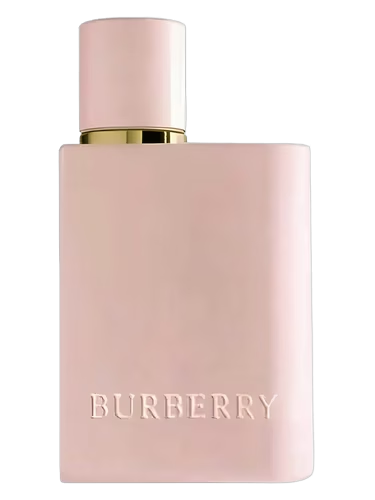
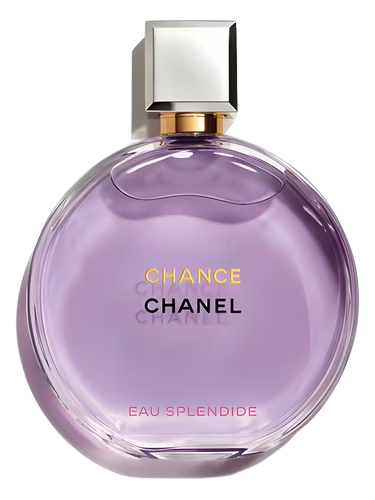
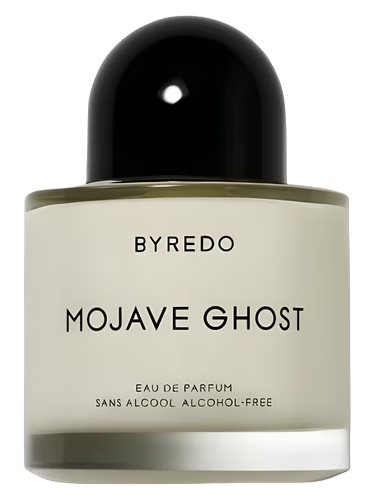
Most Popular Scents Using Arctic Bramble
What is Arctic Bramble?
Arctic Bramble, or Rubus arcticus, is a wild berry native to the subarctic and alpine regions of the Northern Hemisphere, used in modern perfumery to evoke a sense of crisp, Nordic freshness.What does Arctic Bramble smell like?
It offers a fresh, slightly tart, and berry-like aroma with a sweet, jammy quality akin to raspberries, blended with green, leafy undertones and a subtle floral facet.How is Arctic Bramble essence extracted?
While historically obtained via cold pressing or solvent extraction, modern production utilizes advanced biotechnologies, cell suspension cultures, and nature-identical concentrates to capture its delicate profile.What are some top perfumes featuring Arctic Bramble?
Notable fragrances include Faberlic Valkyrie, FUMparFUM Blur, Bjork and Berries Shady Garden, and L'Occitane en Provence Ortie Blanche.When is Arctic Bramble in season?
The plant typically blooms in June and July, with the highly aromatic berries ripening for harvest from mid-July through September.