Fragrance Notes Are Layers Of Scent That Are Layered To Form The Final Fragrance. Fragrance Notes Are Categorised Into Three Main Elements Based On How Long They Take To Evaporate, And How Long They Typically Last Following Application: Top Notes, Heart Notes And Base Notes.
Yuca Cassava
Yuca Cassava offers a nuanced, complex, and comforting aroma. It presents a distinctive starchy, mildly sweet, and earthy profile with creamy, nutty undertones. Its subtle character can lend a unique vegetal depth and soft texture to a fragrance's heart, moving beyond typical white florals or sharp citrus notes.

Origin & Extraction Of Yuca Cassava
Yuca Cassava, or Manioc (Manihot esculenta), is a root vegetable with a long history of cultivation in South and Central America, where it is a staple food. Its historical relevance in traditional fragrant preparations is minimal, as classic perfumery notes were dominated by volatile extracts from flowers, fruits, and resins, particularly those available in Europe. The use of Yuca or Cassava in fine fragrance is a decidedly contemporary and niche development, stemming from a modern perfumery trend that seeks unique, comforting, and naturalistic aromatic profiles outside of the traditional floral or citrus families.
The note has gained relevance as perfumers explore gourmand, earthy, and textural elements in compositions. Yuca's starchy, subtly sweet, and creamy/nutty facets are valued for their ability to add a unique vegetal depth and soft, persistent texture to the heart or base of a fragrance. This sophisticated usage moves beyond standard gourmands, offering a subtle, grounding warmth and an exotic, culturally nuanced element that appeals to contemporary audiences seeking unusual and authentic fragrance concepts.
Extraction Methods of Yuca (Cassava)
The extraction of starch from yuca, also known as cassava, is a liquid-solid process that has evolved from labor-intensive manual techniques to highly automated industrial systems. Historically, the traditional method involved manual peeling and washing of the tuberous roots, followed by grating the flesh into a pulp using hand-held tools. This pulp was then mixed with water and filtered through cloth or mats to separate the fibrous residue from the starch milk, which was then allowed to settle in tanks before the water was decanted and the resulting starch cake was sun-dried.
Modern commercial production utilizes a more efficient, multi-stage automated process known as wet milling or wet processing. This typically involves seven to nine discrete steps: cleaning through dry sieves, counter-current washing in paddle machines, and high-speed crushing using advanced raspers or impact mills to break down the root into a fine slurry. The separation of fiber and starch is achieved through centrifugal sieves, followed by purification and concentration in hydrocyclone stations to remove proteins and cell sap. The final stages include mechanical dehydration using peeler centrifuges and instantaneous drying in flash dryers with negative pressure cooling systems, ensuring high starch recovery rates, uniform moisture content, and improved product purity.
The Yuca Cassava (or Mandioca) note is still emerging in mainstream fine perfumery, making its appearance notable when it occurs. One unexpected, though debated, inclusion is in **Flowerbomb** by Viktor&Rolf. While the presence of Yuca may not be explicitly listed in all official note breakdowns, many enthusiasts and critics suggest its starchy, creamy texture contributes to the signature sweet, warm, and comforting 'gourmand' character that underpins the explosive floral bouquet.
- ***
In the world of niche perfumery, where unique and culturally specific notes are highly prized, the starchy, earthy, and slightly nutty facets of Yuca Cassava are intentionally utilized to create textural depth and exotic warmth. KISMET OLFACTIVE, for example, has centered the theme around culturally rich concepts, and scents like Wedding In Oaxaca and Nympheas often leverage unique vegetal and gourmand undertones, where Yuca can lend a distinctive, grounding texture.
- ***
As perfumers continue to explore gourmand and root-based notes for their longevity and soft earthiness, Yuca Cassava is poised to appear in more contemporary and artisanal compositions. Its ability to bridge sweet notes with a dry, persistent woodiness makes it a sophisticated base or heart note. For instance, while not officially confirmed, fragrances seeking an authentic, South American tropical depth—moving beyond coconut or vanilla—may subtly incorporate Yuca to achieve a truly unique, creamy foundation.
Sustainability Of Yuca Cassava
Sustainability of Yuca (Cassava)
- Enhancing food security by providing a resilient, carbohydrate-rich energy source that thrives in arid soils and harsh environmental conditions
- Promoting regenerative agriculture by using robust root systems to prevent soil erosion, revive degraded land, and improve soil health as an imitation fallow
- Adopting climate-resilient farming practices due to the plant's high drought tolerance and ability to produce yields with minimal water and chemical inputs
- Supporting a circular economy by upcycling processing by-products like peels and pulp into animal feed and utilizing starch for biodegradable industrial applications
- Empowering smallholder farmers through low-input cultivation methods and the establishment of sustainable cooperatives that provide reliable income and socio-economic stability
- Implementing zero-waste and energy-efficient processing technologies, including solar-powered refining and advanced water recycling systems that reclaim over 70% of production water
Trivia
Yuca cassava is not only a primary food source for millions but is also the origin of tapioca, and in its raw form, it contains cyanogenic glycosides that can release cyanide if not prepared correctly.
Most Popular Scents Using Yuca Cassava


What is Yuca Cassava?
Yuca Cassava, also known as Manioc, is a root vegetable native to South and Central America that has become a contemporary niche fragrance note valued for its unique, comforting, and naturalistic profile.What does Yuca Cassava smell like?
It presents a distinctive starchy, mildly sweet, and earthy profile with creamy, nutty undertones, providing a unique vegetal depth and soft, persistent texture to a fragrance.How is Yuca Cassava essence extracted?
The essence is derived through a wet milling process where the roots are cleaned, crushed into a slurry, and then processed through centrifugal sieves and flash dryers to recover pure starch.What are some top perfumes featuring Yuca Cassava?
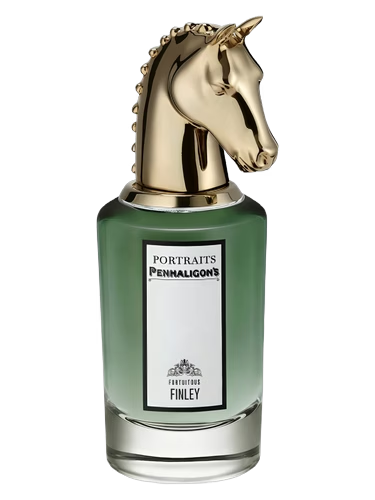
Notable fragrances include Ricardo Ramos Perfumes de Autor The Smell of Guava, Oliver Fragrance Co. Yucca Palm, and Buttonscarves Yuccavalley.When is Yuca Cassava in season?
As a food source, the tubers are primarily in season from September through December, while the ornamental varieties typically bloom from late spring through summer.