Fragrance Notes Are Layers Of Scent That Are Layered To Form The Final Fragrance. Fragrance Notes Are Categorised Into Three Main Elements Based On How Long They Take To Evaporate, And How Long They Typically Last Following Application: Top Notes, Heart Notes And Base Notes.
Wolfberry
Wolfberry (Goji Berry) offers a tart, tonic, and slightly dried fruity note, prized for its complex, unique character in perfumery. It blends aspects of dried red fruits with a subtle, earthy-herbal undertone, providing an uplifting and savory-sweet dimension often used to add depth and an exotic twist to compositions.

Origin & Extraction Of Wolfberry
The Wolfberry, commonly known as Goji Berry, has a history rooted deeply in traditional Asian medicine and cuisine, where it has been prized for centuries for its nutritional and purported health benefits. However, its use in Western fine perfumery is a very recent and contemporary phenomenon. Unlike classic fragrance ingredients like citrus or floral notes which date back to antiquity, the Wolfberry note emerged in the late 20th and early 21st centuries as perfumers began exploring more exotic, unique, and savory-sweet aromatic profiles outside the traditional European palette. Its inclusion often signals a modern composition that seeks to blend sweet, fruity notes with a subtle, earthy, or tonic complexity.
Wolfberry gained relevance in perfumery as part of a trend toward "gourmand" and "exotic fruit" categories, providing a unique tart and slightly dried red fruit nuance that is distinctly different from notes like cherry or raspberry. It is utilized strategically to add depth, a savory-sweet brightness, and an intriguing twist to compositions, particularly those aiming for a contemporary, vibrant, and uplifting feel. Because of its complex and slightly earthy undertone, the Wolfberry note works well to bridge the fresh top notes of a fragrance with its deeper, warmer heart and base notes.
Extraction Methods of Wolfberry
Historically, the extraction of wolfberry (Goji berry) has centered on traditional methods such as sun-drying the fruit followed by hot water infusion. This "hot water brew" preparation has been used for centuries in Asian traditional medicine to capture bioactive polysaccharides. Other traditional techniques include maceration and fermentation, where the fruit is soaked in alcohol or fermented with yeast to produce wolfberry wine, a process that helps release compounds from the fruit skin into the liquid.
Modern extraction techniques have evolved to improve yield and preserve the integrity of heat-sensitive compounds like anthocyanins and flavonoids. Contemporary methods include ultrasound-assisted extraction (UAE) and microwave-assisted extraction (MAE), which use physical energy to rupture cell walls more efficiently than simple heating. Advanced industrial processes also utilize enzymatic extraction—using enzymes like pectinase or cellulase to break down plant tissues—and supercritical CO2 extraction or subcritical water extraction, which employ high pressure to capture delicate fat-soluble substances and antioxidants with high purity and minimal environmental impact.
The Wolfberry (Goji Berry) note, appreciated for its unique tart, tonic, and dried fruit profile, is predominantly found in contemporary fragrances, especially those aiming for a modern, exotic, or gourmand twist. One of the most commercially successful fragrances to feature this note is Bvlgari's **Omnia Coral**, where the goji berries contribute a juicy, vibrant tartness to the opening, complementing the tropical floral heart and grounding the scent with a hint of red fruit complexity. This utilization showcases how the wolfberry can inject a lively, uplifting sweetness that avoids the heavier cloy of traditional sweet fruit notes.
- *
Another area where the Wolfberry note shines is in the niche and artisanal market, providing a refined sophistication. Fragrances like The House of Oud’s **Wonderly** leverage the tart-sweet complexity of Goji Berries to balance richer ingredients, giving the composition a bright, intriguing lift. Similarly, scents such as **Stubborn 妥协尽头** by DOCUMENTS 闻献 integrate this unique fruit to bridge sparkling top notes with deeper, sometimes earthy or woody heart notes, maximizing the longevity and depth of the fruity facet.
- *
Beyond mainstream and niche fragrances, the Wolfberry note appears in playful, youthful compositions that highlight its vibrant and sweet-tart nature. Examples include scents like **Like a Girl's Night Out** by essence or **Pink Rush** by Paris Hilton, where the Goji Berry helps establish an immediate, energetic, and sweet opening, catering to modern trends that favor bright, uplifting, and slightly unconventional fruity accords. In these contexts, the wolfberry provides a fresh, juicy alternative to common berries or citrus, ensuring the fragrance remains lively and invigorating.
Sustainability Of Wolfberry
Sustainability of Wolfberry
- Adopting organic farming and low-carbon initiatives to establish cleaner production systems and reduce the environmental impact of synthetic fertilizers and pesticides
- Implementing advanced irrigation techniques and precision water management to optimize water use efficiency and reduce the high energy consumption associated with water lifting
- Promoting a circular economy by upcycling pruning waste, such as branches and leaves, into livestock forage to reduce resource waste and environmental pollution
- Utilizing hyperspectral remote sensing and machine learning for non-destructive monitoring of nitrogen levels to enable precise, eco-friendly fertilization and prevent soil pollution
- Establishing sustainable agricultural models like integrated free-range poultry production within plantations to enhance biodiversity and local socio-economic resilience
Trivia
Wolfberry, more well known as goji berry, is considered a super-food due to its high level of micronutrients and is traditionally used as a tart note in tonic soups, herbal teas, and various wines.
Most Popular Scents Using Wolfberry
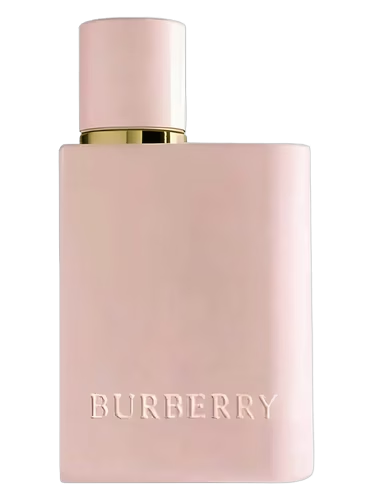
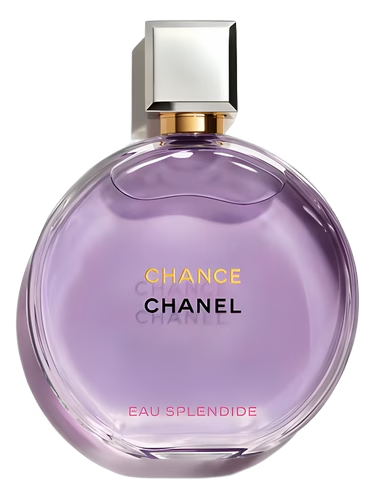

What is Wolfberry?
Wolfberry, commonly known as Goji Berry, is an exotic fruit native to East Asia and the Himalayas, prized for centuries in traditional medicine and now used in modern perfumery for its unique tart-sweet profile.What does Wolfberry smell like?
It offers a tart, tonic, and slightly dried fruity aroma with subtle earthy-herbal undertones, providing a savory-sweet dimension that adds depth and an exotic twist to fragrances.How is Wolfberry essence extracted?
While traditionally used in hot water infusions, modern perfumery utilizes advanced techniques like ultrasound-assisted extraction, microwave-assisted extraction, and supercritical CO2 extraction to capture its delicate aromatic compounds.What are some top perfumes featuring Wolfberry?
Notable fragrances include Bvlgari Omnia Coral, Voluspa Goji & Tarocco Orange, The House of Oud Wonderly, and Documents Stubborn 0000.When is Wolfberry in season?
The plant typically blooms in spring, with the primary harvest for its bright red berries spanning from late spring through autumn, generally peaking between May and October.