Fragrance Notes Are Layers Of Scent That Are Layered To Form The Final Fragrance. Fragrance Notes Are Categorised Into Three Main Elements Based On How Long They Take To Evaporate, And How Long They Typically Last Following Application: Top Notes, Heart Notes And Base Notes.
Williams Pear
Williams Pear offers an intensely juicy, authentic aroma with pronounced green freshness. It includes subtle melon nuances and a distinct ethereal quality that adds lift and diffusion, often featuring a complex fruity musk dry down.

Origin & Extraction Of Williams Pear
The Williams Pear, or Bartlett Pear, is a popular fruit whose history is primarily agricultural, dating back to 18th-century England. However, the direct use of a distinct "Williams Pear" note in perfumery is a relatively modern phenomenon. Unlike traditional fruit essences that could be easily distilled (like citrus), the delicate, juicy, and intensely fresh aroma of pear is challenging to extract naturally and maintain stability in a volatile fragrance composition. Consequently, its presence in perfumery relies heavily on modern synthesis and headspace technology, which allows perfumers to recreate the authentic, slightly green, and musky aroma of the ripe fruit.
The note gained significant traction in contemporary perfumery, particularly in the late 20th and early 21st centuries, as fragrance houses sought out fresher, more realistic, and unique fruity accords outside of the traditional berry and peach profiles. Williams Pear is now frequently used to lend a juicy, luminous, and slightly ethereal opening to modern compositions, bridging the gap between volatile top notes and more persistent floral or musky hearts. Its prominent use in designer and niche fragrances solidifies its role as a key ingredient for modern fruity-gourmand and fresh compositions.
Extraction Methods of Williams Pear
Historically, the aromatic essence of the Williams pear was captured through basic maceration in spirits or simple distillation of fermented fruit mashes, a process rooted in the production of traditional fruit brandies like Poire Williams. In early food preservation, residues from canning were often processed through air drying or simple mechanical pressing to recover juice and fiber. Traditional manual methods focused on capturing the fruit's volatile profile by steeping the pulp in solvents to create infusions for culinary and medicinal use.
In modern perfumery and flavor chemistry, the essence is primarily obtained through cold pressing of the fruit or specialized distillation techniques to preserve its delicate, juicy profile. Advanced industrial methods utilize convective thin-layer drying followed by precise milling and sieving to transform canning residues into stable, nutrient-rich powders. Furthermore, sophisticated techniques such as supercritical CO2 extraction and ultrasound-assisted extraction are increasingly employed to capture complex aroma compounds like ethyl (E,Z)-2,4-decadienoate without the heat degradation associated with traditional steam distillation.
Williams Pear, celebrated for its intensely juicy, authentic, and slightly green aroma, has become a hallmark in contemporary fragrances, moving beyond traditional citrus openings to offer a luminous and sophisticated fruity lift. Its use provides compositions with a modern freshness that is both uplifting and enduring. One of the most commercially successful fragrances to feature this note prominently is Jo Malone London's English Pear & Freesia, where the King William pear’s luscious quality is expertly paired with the delicate floral scent of freesia to create a globally recognized, best-selling scent.
- Other notable examples that showcase the elegance of the pear note include fragrances such as Sparkling Jo by Vilhelm Parfumerie and Michel - French Pear & Queen's Lilac by Michel Germain.
The complexity of the Williams Pear note allows it to bridge various fragrance families, lending a subtle, ethereal sweetness to modern fruity-gourmand compositions while also providing a crisp, green facet to fresh and floral scents. It is often utilized to add a realistic, mouth-watering texture to the opening, ensuring the fragrance feels vibrant and contemporary. This versatility has secured its place in collections from major designer houses like Parfums de Marly and Versace, and contemporary niche brands exploring unique fruit accords.
The increasing popularity of Williams Pear reflects a trend in perfumery toward capturing high-definition, realistic fruit aromas that are less sharp than traditional citruses. Fragrances such as Vera Wang's Embrace Green Tea And Pear Blossom highlight the note’s compatibility with clean, delicate structures, while others, like those from Hinode (Empire Woman), may leverage its juicy sweetness for a warmer, more impactful female composition.
Sustainability Of Williams Pear
Sustainability of Williams Pear
- Adopting Integrated Pest Management (IPM) strategies, such as using pheromones and encouraging natural predators within orchards to reduce pesticide reliance
- Implementing organic farming methods and minimal intervention approaches to eliminate synthetic residues and protect local biodiversity
- Optimizing resource management through precision irrigation and the use of soil moisture sensors to conserve water and maintain soil health
- Developing climate-resilient cultivation techniques, including agrivoltaic systems that provide solar energy while protecting trees from extreme weather
- Supporting circular economy principles by upcycling side-streams and waste from pear processing into high-value purees, brandies, and natural fertilizers
- Advancing genetic research and mutation breeding programs to develop new cultivars with enhanced resistance to diseases like fire blight and brown spot
Trivia
The Williams pear is often recognized for its unique ability to change color as it ripens, shifting from a bright green to a beautiful golden yellow.
Most Popular Scents Using Williams Pear
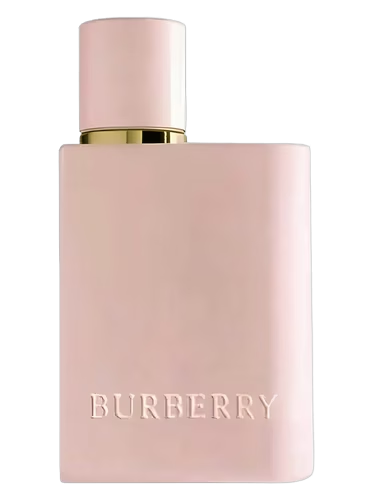
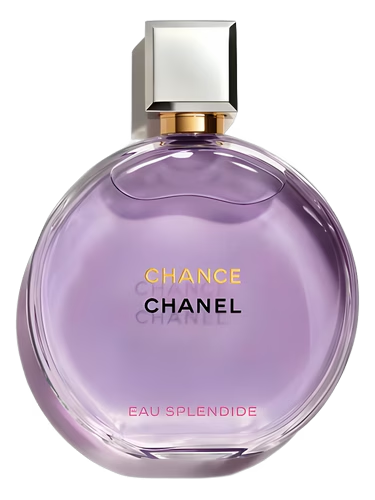
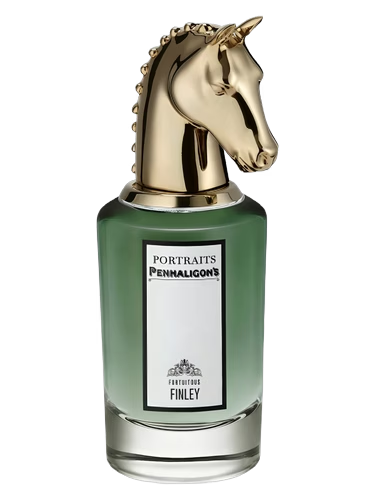
What is Williams Pear?
Williams Pear, also known as the Bartlett pear, is a popular fruit variety whose scent is captured in perfumery for its intensely juicy, authentic, and fresh profile.What does Williams Pear smell like?
It offers a sweet, crisp, and slightly green aroma with subtle floral and melon nuances and a distinct ethereal, musky dry down.How is Williams Pear essence extracted?
In modern perfumery, the note is typically created synthetically or via headspace technology, though advanced methods like supercritical CO2 extraction can also be used to capture its complex aroma.What are some top perfumes featuring Williams Pear?
Notable fragrances include Jo Malone London English Pear & Freesia, Vilhelm Parfumerie Sparkling Jo, and Juliette Has A Gun Pear Inc.When is Williams Pear in season?
The fruit is typically harvested in late summer through early autumn, with trees blooming in mid-to-late spring.