Fragrance Notes Are Layers Of Scent That Are Layered To Form The Final Fragrance. Fragrance Notes Are Categorised Into Three Main Elements Based On How Long They Take To Evaporate, And How Long They Typically Last Following Application: Top Notes, Heart Notes And Base Notes.
Wild Strawberry
Wild Strawberry offers a rich, intensely flavored, and foresty sweet fruity aroma. It is distinct from conventional strawberry notes, focusing on a natural tartness and a fresh, green, and slightly vegetal essence, capturing the scent of the fruit amidst its foliage. This profile provides a realistic and sophisticated fruity lift.

Origin & Extraction Of Wild Strawberry
The history of strawberry notes in perfumery initially revolved around synthetics, as capturing the true scent of the ripe fruit proved highly challenging through natural extraction. Early fragrance uses often employed compounds like ethyl methylphenylglycidate (known commercially as "strawberry aldehyde") to create sweet, sometimes artificial, renditions of the fruit's aroma. The specific "Wild Strawberry" note emerged later as perfumers sought a more nuanced, natural, and complex interpretation of the fruit. This note distinguishes itself by incorporating green, earthy, and slightly tart facets, moving away from the purely saccharine scent of conventional strawberry towards a more photorealistic experience that suggests the fruit found naturally in a forest setting.
The Wild Strawberry note gained relevance in contemporary fine perfumery as part of a broader trend emphasizing sophisticated, naturalistic fruity and gourmand accords. It is utilized today to provide a sparkling yet grounded top or heart note, often bridging fresh openings with more complex floral or woody foundations. While general citrus notes have a history dating back centuries, the Wild Strawberry note represents a modern evolution, prized by niche and designer houses for its ability to convey vibrant freshness and subtle vegetal complexity, offering a refined, less cloying sweetness to modern compositions.
Extraction Methods of Wild Strawberry
Historically, the aromatic compounds of wild strawberry (Fragaria vesca) were difficult to isolate using traditional techniques like steam distillation or cold expression because the fruit has a very low volatile oil content and its delicate scent molecules are easily destroyed by heat. Instead, early attempts to capture the fruit's essence relied on maceration and infusion, where fresh or slightly dried strawberries were soaked in solvents like alcohol or carrier oils for several weeks to create tinctures or fragranced oils. These methods were often used for medicinal or culinary purposes rather than fine perfumery, as the resulting scent was frequently faint and prone to becoming rancid quickly due to the fruit's high water and sugar content.
Modern extraction techniques have expanded the ability to study and capture wild strawberry metabolites, though it remains a challenge in commercial perfumery. Researchers now utilize advanced methods such as steam and xylene distillation to compare essential oil yields from different cultivars. Furthermore, headspace extraction (HE) coupled with gas chromatography-mass spectrometry (GC-MS) allows for the analysis of the fruit's volatile profile without needing to physically extract a liquid oil. In the fragrance industry, because a "true" essential oil is not commercially viable, perfumers typically create strawberry notes as "accords" using individual aromachemicals, such as Aldehyde C-16, or specialized CO2 extracts that can better preserve the fruit's natural, fresh-picked aroma compared to traditional heat-based methods.
The Wild Strawberry note, valued for its complex profile that balances natural tartness with a foresty sweetness, is increasingly utilized in modern luxury perfumery to provide a refined fruity lift. One of the most prominent recent examples is **Miss Dior Parfum (2024)**, where the note is incorporated to add a fresh, slightly green, and sophisticated dimensionality to the classic Dior floral composition. This usage moves beyond simple sweetness, leveraging the wild facet of the strawberry to convey elegance and a natural, sun-kissed vibrancy in the opening.
- Wild Strawberry offers a less saccharine, more nuanced alternative to conventional fruit notes, making it ideal for contemporary sophisticated fragrances.
Another successful deployment of the Wild Strawberry note is found in fragrances aiming for a cheerful and romantic signature, such as **Coach Love Eau de Parfum**. Here, the bright, juicy, yet slightly vegetal character of the note provides an invigorating top accord that supports the heart of the fragrance, ensuring the scent feels modern, uplifted, and energetic without becoming overly heavy. This application demonstrates the note's versatility in bridging fresh, fruity openings with deeper, creamy bases.
- The inherent complexity of Wild Strawberry, which includes green and slightly tart undertones, prevents the composition from feeling simple or juvenile.
In the realm of celebrity and accessible designer fragrances, the Wild Strawberry note has been used to inject a playful, youthful energy, as seen in scents like **SJP NYC Eau de Parfum** by Sarah Jessica Parker. This fragrance uses the vibrant, uplifting sweetness of the note to create an immediate burst of fresh fruitiness. Its ability to be both distinctly recognizable as strawberry yet offer a cleaner, more herbaceous edge makes it a compelling choice for fragrances designed to be fun, sparkling, and highly wearable.
Sustainability Of Wild Strawberry
Sustainability of Wild Strawberry
- Adhering to ethical foraging practices by leaving ample berries for local wildlife and picking only from large, established colonies to prevent patch depletion
- Promoting biodiversity through the conservation of natural habitats around farms, which reduces crop damage costs and supports beneficial bird and insect populations
- Implementing Integrated Pest Management (IPM) strategies, such as using natural predators like ladybugs and mechanical tools like bug vacuums to minimize synthetic pesticide use
- Adopting organic farming techniques, including the use of compost, biochar, and natural fertilizers to enhance soil microbial diversity and carbon sequestration
- Utilizing water-efficient technologies like drip irrigation and soil moisture sensors to optimize resource consumption and maintain soil health
- Supporting local socio-economic resilience through community empowerment programs and agrotourism initiatives that educate the next generation on sustainable agriculture
Trivia
Wild strawberries do not produce a natural essential oil; therefore, their scent in perfumery is always a creative reconstruction using other notes or synthetic accords to mimic the fruit's unique green-leaf sharpness and intense sweetness.
Most Popular Scents Using Wild Strawberry
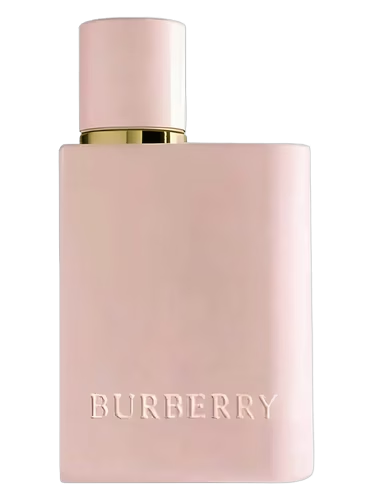
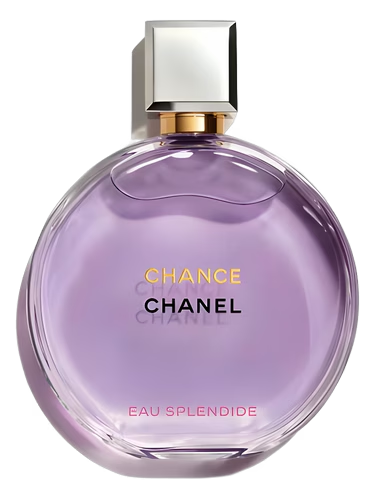
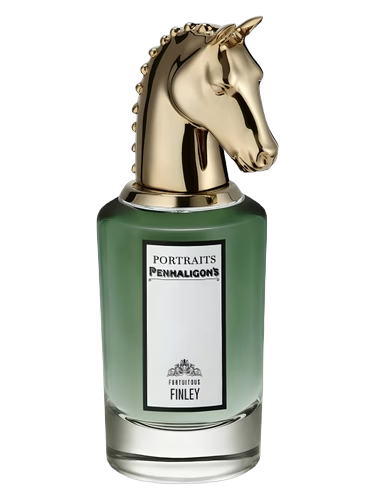
What is Wild Strawberry?
Wild Strawberry, or Fragaria vesca, is a forest-growing fruit note in perfumery prized for its realistic, intensely sweet, and slightly tart profile that incorporates green and earthy nuances.What does Wild Strawberry smell like?
It offers a rich, foresty, and sweet aroma that is more aromatic than cultivated strawberries, featuring a natural tartness and fresh, green, vegetal facets that capture the fruit amidst its foliage.How is the Wild Strawberry note extracted?
Because wild strawberries do not yield a natural essential oil, the note is a synthetic reconstruction or "accord" created by perfumers using aroma molecules like Aldehyde C-16 or specialized CO2 extracts.What are some top perfumes featuring Wild Strawberry?
Popular fragrances containing this note include Miss Dior Parfum (2024), Molton Brown Bluebell and Wild Strawberry, Marc Jacobs Daisy, and Coach Love.When is Wild Strawberry in season?
Wild strawberries typically bloom from April to June, with the fruit reaching peak harvest and maturity between May and October depending on the climate and region.