Fragrance Notes Are Layers Of Scent That Are Layered To Form The Final Fragrance. Fragrance Notes Are Categorised Into Three Main Elements Based On How Long They Take To Evaporate, And How Long They Typically Last Following Application: Top Notes, Heart Notes And Base Notes.
White Mulberry
White Mulberry offers an earthy, complex, and gently sweet aroma, brightened by green and herbaceous facets. It blends the mild fruitiness of mulberry with refreshing notes of lemon, basil, and thyme, balanced by leafy greens, creating a sophisticated scent reminiscent of a cool, vibrant woodland.

Origin & Extraction Of White Mulberry
White Mulberry, derived from the Morus alba tree, does not share the long, classical heritage in Western perfumery held by traditional notes like rose or jasmine. Historically, the plant was primarily significant in East Asia for silk production (as its leaves feed silkworms) and for medicinal and culinary uses. Its use as a distinct, isolated fragrance note is a relatively modern phenomenon, gaining traction as perfumers began exploring more nuanced, photorealistic, and complex fruit and botanical profiles outside of the conventional European palette in the late 20th and early 21st centuries.
In contemporary fine fragrance, the White Mulberry note is valued for its sophisticated aromatic complexity, which balances mild, earthy sweetness with bright, green, and herbaceous undertones (often involving facets of lemon, basil, and leafy greens). This profile allows it to act as an elegant, non-cloying fruit note, lending a vibrant, natural freshness that helps bridge sparkling top notes with deeper, more complex heart and base accords, typically appearing in niche or artisanal compositions seeking a unique, cool, and woodland-inspired feel.
Extraction Methods of White Mulberry
Historically, white mulberry leaves were processed using traditional maceration and simple water infusions, where the leaves were soaked in solvents or boiled to create medicinal teas. Maceration remains a foundational technique, involving the soaking of powdered leaves in solvents like ethanol or methanol for extended periods to release phytochemicals such as flavonoids and alkaloids. Traditional extraction often concluded with basic filtration and evaporation to concentrate the active components.
Modern commercial and industrial production has advanced to more efficient and selective methods. Water extraction is now often optimized using twin-screw continuous extractors and vacuum evaporation to preserve heat-sensitive compounds like 1-deoxynojirimycin (DNJ). Furthermore, innovative non-conventional techniques have emerged, including ultrasound-assisted extraction (UAE) and microwave-assisted extraction (MAE), which significantly reduce extraction time and energy consumption while increasing yields. For high-purity applications, supercritical CO2 extraction is utilized, often with ethanol as a cosolvent, to capture delicate bioactive molecules without leaving toxic solvent residues. Recent developments also include the use of ultrafiltration and nanofiltration membranes to decolorize and concentrate extracts while retaining essential active components.
The White Mulberry note is an emerging star in modern perfumery, valued for its ability to balance mild, earthy sweetness with bright, green, and herbaceous facets. Because the note is newer to the Western perfumer's palette, it often appears in niche or artisanal compositions seeking a sophisticated, unique fruit accord that avoids the typical sweetness of more common fruits. Its complex profile allows it to blend seamlessly into various categories, lending a vibrant, natural freshness to compositions.
One notable use of the White Mulberry note can be found in the fragrance **Morus Alba** by Laboratorio Olfattivo. This composition is dedicated entirely to the subtle complexity of the mulberry tree, utilizing the note's delicate fruitiness and green undertones to create a luminous, cool, and refined scent. The fragrance emphasizes the white mulberry's inherent freshness, often pairing it with musks and light woods to ensure its ephemeral quality endures.
Another fragrance where this note provides a subtle, sophisticated twist is **Eau de Camille** by Annick Goutal. While this scent focuses on notes like honeysuckle and foliage, some contemporary interpretations or variations feature a white mulberry accord to enhance the soft, green, and slightly sweet woodland feeling. This use demonstrates the white mulberry's versatility, acting as a supporting note that bridges green accords with a whisper of gentle, non-cloying fruitiness, contributing to an overall sense of natural elegance.
Sustainability Of White Mulberry
Sustainability of White Mulberry
- Promoting sustainable cultivation as trees are resilient, thrive in various climates, and require minimal water and pesticide use
- Enhancing soil health through nitrogen-fixing properties which reduce the need for synthetic fertilizers
- Supporting biodiversity by providing essential habitat and food sources for various birds and insects
- Aligning with zero-waste and circular economy principles by utilizing the entire plant, from leaves for silkworms and livestock fodder to bark for durable paper and timber for implements
- Managing invasive tendencies and hybridization risks with native species to protect local ecological balance and preserve native biodiversity
Trivia
White mulberry is the primary species used to breed silkmoth caterpillars (Bombyx mori) for silk production, and despite its name, the tree's juicy fruits are actually more commonly purple than white.
Most Popular Scents Using White Mulberry
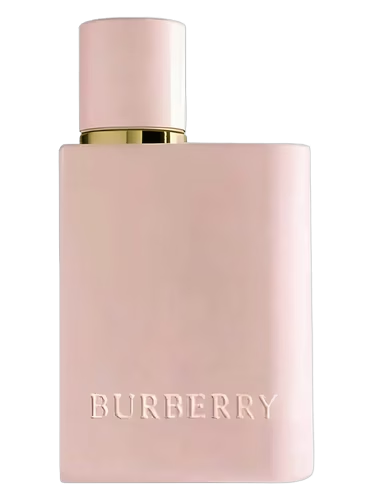
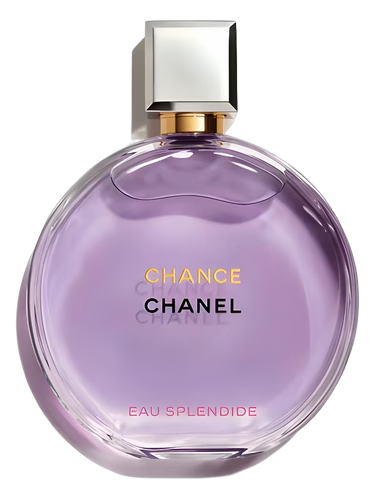
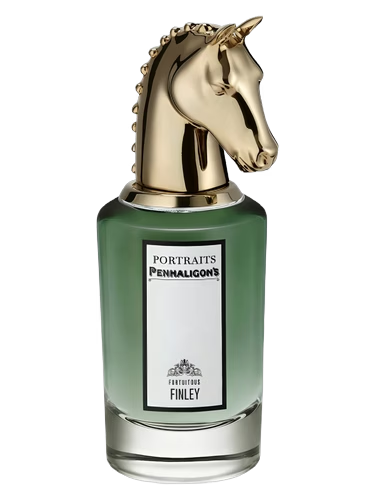
What is White Mulberry?
White Mulberry, or Morus alba, is a deciduous tree native to China that is traditionally associated with silk production and has recently emerged as a sophisticated fragrance note in niche and artisanal perfumery.What does White Mulberry smell like?
It offers a complex, earthy, and gently sweet aroma with refreshing green and herbaceous facets of lemon, basil, and thyme, reminiscent of a cool woodland.How is White Mulberry essence extracted?
The essence is primarily obtained through distillation, though modern methods like ultrasound-assisted extraction and supercritical CO2 extraction are also used to capture its delicate bioactive molecules.What are some top perfumes featuring White Mulberry?
Notable fragrances include Laboratorio Olfattivo Morus Alba, Floris London Mulberry Fig, Neesh White Mulberry, and Annick Goutal Eau de Camille.When is White Mulberry in season?
The tree typically blooms in spring from April to May, with the fruit reaching its peak ripeness and aromatic potential during the early summer months of June and July.