Fragrance Notes Are Layers Of Scent That Are Layered To Form The Final Fragrance. Fragrance Notes Are Categorised Into Three Main Elements Based On How Long They Take To Evaporate, And How Long They Typically Last Following Application: Top Notes, Heart Notes And Base Notes.
Walnut
Walnut offers a distinctive, rich nutty aroma combined with prominent woody facets, often carrying a slightly bitter, dry aftertaste. This sophisticated note adds depth, warmth, and an autumnal texture to compositions, bridging gourmand and woody fragrance families with its complex, earthy character.

Origin & Extraction Of Walnut
While the walnut tree has a long history, particularly in Eurasia, where it has been cultivated for centuries for its wood, edible nuts, and medicinal properties, its dedicated use as a distinct aromatic note in fine perfumery is relatively modern. Historically, perfumery focused primarily on essential oils derived from flowers, resins, and classic spices. Walnut's complex profile—combining rich nuttiness with dry, woody, and slightly bitter facets—made it challenging to isolate or replicate convincingly in earlier fragrance technologies. It gained prominence as perfumers began exploring more abstract and realistic gourmand (edible) and woody-oriental compositions in the late 20th and early 21st centuries.
The relevance of the Walnut note today lies in its ability to add a unique, sophisticated texture to compositions, bridging the gap between edible gourmands and traditional woody bases. It is rarely the central theme but instead functions as an accent note, lending a warm, autumnal, and slightly dry depth to fragrances. In modern perfumery, particularly niche and artisanal houses, walnut is valued for introducing an element of realism and complexity, often supporting notes like cedar, vanilla, tobacco, or dark spices, offering a dry counterpoint to sweetness and enhancing a sense of cozy refinement.
Extraction Methods of Walnut
The primary commercial method for extracting walnut oil is cold expression (pressing), a mechanical process where shelled walnut kernels are squeezed to release their oil. Historically, this was a manual, low-tech endeavor involving the use of heavy rocks or clay bowls to crush and grind nuts that had been pre-soaked or boiled. Traditional "folk methods" also included simmering crushed walnut meal in water to allow the oil to rise to the surface for skimming, or using simple hand-operated screw or hydraulic presses after the nuts were lightly roasted to enhance yield and flavor.
Modern extraction has advanced to include highly efficient industrial techniques such as supercritical carbon dioxide (CO2) extraction, which utilizes pressurized gas to dissolve and separate the oil at low temperatures, preserving its delicate omega-3 fatty acids and vitamins. Other contemporary methods include ultrasonic-assisted extraction and Soxhlet extraction using food-grade solvents like petroleum ether or bio-based alternatives to maximize oil recovery. While hot pressing is also used to increase yield, cold pressing remains the preferred method for high-quality culinary and perfumery oils to avoid the thermal degradation of its characteristic nutty aroma and nutritional profile.
The Walnut note, valued for its complex blend of dry woodiness and rich, bitter nuttiness, is primarily utilized in modern perfumery to add sophisticated depth to gourmand, oriental, and woody compositions. Contemporary niche houses frequently employ it to achieve a photorealistic, autumnal texture, contrasting sweetness with a subtle dryness. This use allows the fragrance to bridge traditionally separate families, lending warmth and a cozy, refined feeling.
- *
Several notable fragrances showcase Walnut's versatility. In the niche space, **Yesterday Haze** by Imaginary Authors uses the creamy fig and walnut combination to create a distinctive, hazy, and comforting scent profile. Similarly, **Extrait** by Sora Dora highlights a spicy, nutty delight where the walnut note contributes to a rich, dark gourmand experience, appealing to those who seek evocative and deep compositions.
- *
More widely recognized examples also feature this complex note, often subtly supporting other prominent elements. Fragrances like Bvlgari's **Eau Parfumée au Thé Rouge** integrate walnut to enhance the deep, slightly earthy character of the red tea, giving the composition a layer of dry warmth. The note is essential for providing structure and longevity, ensuring the fragrance opens with complexity and settles into a sophisticated, enduring base, as seen in scents like **Leather Forever Royal Arabian Edition** by De Gabor.
Sustainability Of Walnut
Sustainability of Walnut
- Implementing environmental stewardship practices including research and innovation in water conservation, soil health, and air quality
- Promoting a circular economy by upcycling by-products, such as using cast-off branches for essential oil production and repurposing shells for industrial use
- Adopting regenerative agroforestry systems and organic farming practices, such as cover cropping and no-till farming, to enhance biodiversity and tree health
- Supporting socio-economic resilience by ensuring fair pricing and long-term economic stability for smallholder farming communities and multi-generational family farms
- Utilizing energy-efficient extraction technologies and renewable energy sources, like solar and wind power, to reduce the carbon footprint of processing operations
Trivia
Walnut is a fantasy note in perfumery because the nut itself does not yield a commercial extract; instead, perfumers must reconstruct its scent from scratch using a specific 1:1 ratio of two molecules—sotolon, which smells like fenugreek, and nonatrienal, which smells like oatmeal.
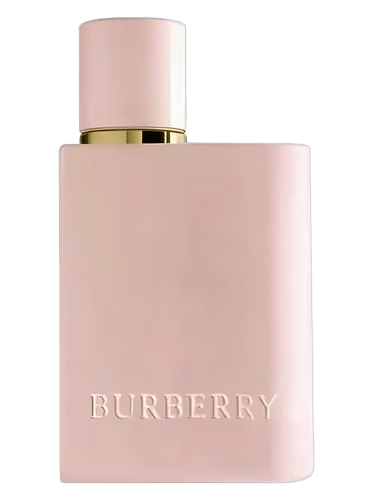
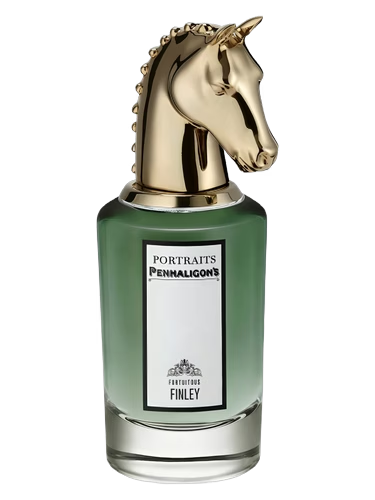
Most Popular Scents Using Walnut

What is the Walnut note in perfumery?
Walnut is considered a fantasy note because the nut itself does not yield a commercial aromatic extract; perfumers must reconstruct its scent from scratch using specific aroma molecules.What does Walnut smell like?
It offers a rich, nutty, and woody aroma with a slightly bitter, dry aftertaste and earthy undertones, often adding a warm, autumnal texture to compositions.How is the Walnut scent reconstructed?
Perfumers typically use a specific ratio of molecules such as sotolon, which smells like fenugreek and caramel, and nonatrienal, which possesses an oatmeal-like scent, to mimic the nut's character.What are some top perfumes featuring Walnut?
Notable fragrances include Imaginary Authors Yesterday Haze, Sora Dora Red, Bvlgari Eau Parfumée au Thé Rouge, and Banana Republic Black Walnut.When is Walnut in season?
The walnut tree follows a seasonal cycle where the fruit matures over the summer and reaches peak harvest and availability from September through November.