Fragrance Notes Are Layers Of Scent That Are Layered To Form The Final Fragrance. Fragrance Notes Are Categorised Into Three Main Elements Based On How Long They Take To Evaporate, And How Long They Typically Last Following Application: Top Notes, Heart Notes And Base Notes.
Vegetal Notes
Vegetal notes are typically green, aquatic, or earthy accords that lend naturalness, freshness, and a rustic quality to fragrances. They evoke the scent of plants, leaves, and damp earth, providing an immediate sense of clean, transparent vitality in a composition.

Origin & Extraction Of Vegetal Notes
Vegetal Notes, as a distinct category emphasizing green, earthy, and transparent naturalness, gained prominence in the mid-20th century. Prior to this era, dominant fragrance trends favored heavy, opulent, and animalic scents. The shift towards lighter, fresher compositions began after World War II, signaling a new direction in perfumery.
The embrace of these natural, green compositions was pioneered by fashion houses, with the couturier Pierre Balmain being one of the first to introduce these "green notes." This movement aligned with a broader cultural trend seeking renewed freshness and vitality. Today, vegetal notes are essential for lending a clean, transparent, and rustic quality to contemporary fragrances, evoking the photorealistic scent of leaves, plants, and damp earth.
Extraction Methods of Vegetal Notes
Vegetal notes in perfumery are primarily obtained through traditional methods such as maceration and infusion, where plant materials like leaves, stems, or roots are soaked in solvents—historically alcohol, oils, or even honey—to capture their green, earthy, or savory aromatic compounds. Ancient techniques often involved decoction, where plant parts were boiled in water to extract heat-stable essences, or simple mechanical pressing for succulent materials. These historic methods focused on slow diffusion and manual filtration to separate the fragrant liquid from the solid botanical marc.
In modern production, extraction has evolved to include more efficient and precise technologies like steam distillation and molecular distillation, which allow for the isolation of specific volatile molecules while removing undesirable "dirty" or muddy top notes. Advanced contemporary methods also utilize ultrasound-assisted extraction (sonication) and microwave-assisted extraction to break down plant cell walls more effectively, significantly reducing processing time and solvent usage. Furthermore, supercritical CO2 extraction is increasingly employed to capture the most delicate, true-to-nature vegetal scents without the risk of thermal degradation or solvent residue.
Vegetal notes, capturing the essence of green leaves, stalks, and damp earth, are critical for lending transparency and photorealism to modern perfumery. One of the earliest and most iconic fragrances to champion this green shift was **Vent Vert** by Balmain (1947), often cited as the first true "green" perfume. While not explicitly listed as 'Vegetal Notes,' its revolutionary use of galbanum and other powerful green elements set the stage for compositions that moved away from heavy florals toward natural, crisp vitality. This trend continued with fragrances like **Chanel No 19**, which uses intensely green facets to create a scent profile that is simultaneously clean, aristocratic, and fiercely verdant.
- These notes are frequently utilized in fragrances aiming for a fresh, post-modern aesthetic, prioritizing naturalistic accords over traditional structures.
In contemporary perfumery, vegetal and green notes are essential in creating the illusion of a full, living landscape. For instance, in niche houses, compositions often focus on a single note taken from nature, such as fig leaf, which possesses a creamy, green, and slightly coconut-like vegetal quality. **Diptyque Philosykos** famously captures the entire fig tree—wood, fruit, and the intensely green, savory vegetal notes of the crushed leaves—offering a highly sophisticated and rustic freshness that has become a benchmark for the genre.
- The use of specific vegetal components allows perfumers to bypass generic "fresh" notes, delivering scents with greater texture, complexity, and longevity.
Vegetal notes also play a key supporting role in modern masculine and unisex compositions, providing a sharp, clean counterpoint to woody and earthy bases. In fragrances that emphasize mineral or aquatic elements, a subtle vegetal backbone is necessary to anchor the composition and prevent it from becoming too synthetic. A prime example is **L'Eau d'Issey Pour Homme**, which utilizes crisp, airy vegetal and green elements alongside Yuzu to create a distinct, transparent freshness, demonstrating how these notes can provide structure and modernity to classic fresh styles.
Sustainability Of Vegetal Notes
Sustainability of Vegetal Notes
- Utilizing renewable botanical resources and natural oils that offer a greener, more sustainable alternative to synthetic fragrance components
- Reducing environmental footprints through the use of biodegradable ingredients that require fewer chemical processes than fossil-based synthetics
- Implementing upcycling technologies like SymTrap to extract high-quality perfume materials from food industry side-streams and waste
- Supporting ethical sourcing and social responsibility by partnering with local farms that utilize fair trade and regenerative agriculture practices
- Adopting eco-friendly extraction methods, such as solvent-free extraction or steam distillation, to minimize chemical usage and carbon emissions
- Promoting cruelty-free and vegan standards by replacing animal-derived ingredients with plant-based, vegetable-derived stabilizers and essences
Trivia
The first green fragrance to feature vegetal notes, Sisley's Eau de Campagne in 1976, was revolutionary for incorporating the scent of tomato leaves, a note previously unheard of in high-end perfumery.
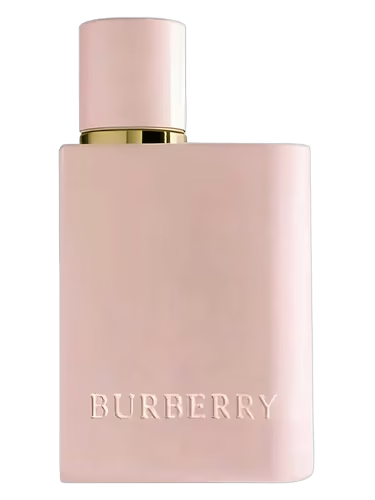
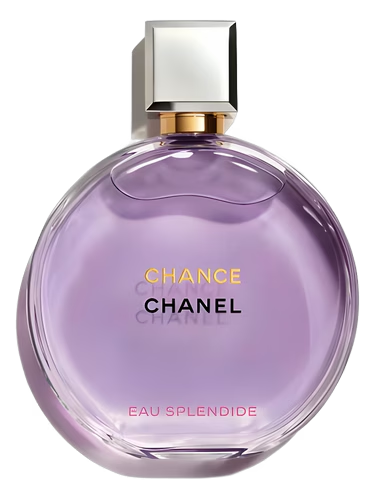
Most Popular Scents Using Vegetal Notes

What are Vegetal Notes in perfumery?
Vegetal notes are green, aquatic, or earthy accords that mimic the scent of plants, leaves, and damp earth to provide a natural, rustic freshness to fragrances.What do Vegetal Notes smell like?
They offer a crisp, clean, and transparent aroma, often described as dewy foliage, freshly mowed grass, or the photorealistic scent of crushed leaves.How are Vegetal Notes extracted?
Historically obtained through maceration and infusion, modern extraction includes steam distillation, molecular distillation, and supercritical CO2 extraction to capture delicate, true-to-nature scents.What are some top perfumes featuring Vegetal Notes?
Iconic examples include Sisley L'Eau de Campagne, Diptyque Philosykos, Chanel No. 19, and Hermès Un Jardin sur le Nil.Are Vegetal Notes sustainable?
Yes, they often utilize renewable botanical resources, biodegradable ingredients, and upcycling technologies like SymTrap to repurpose food industry waste into high-quality fragrance materials.