Fragrance Notes Are Layers Of Scent That Are Layered To Form The Final Fragrance. Fragrance Notes Are Categorised Into Three Main Elements Based On How Long They Take To Evaporate, And How Long They Typically Last Following Application: Top Notes, Heart Notes And Base Notes.
Taro
Taro offers a uniquely sweet, creamy, and nutty gourmand profile, often blended with notes of black tea and rich dairy like condensed milk, creating an aroma reminiscent of a Taro Milk Tea. It provides a comforting, slightly starchy sweetness and a smooth, mellow base for contemporary fragrances.

Origin & Extraction Of Taro
Taro, derived from the root vegetable common across Asian, Pacific, and African cultures, has a history primarily rooted in culinary and traditional medicine, not classical European perfumery. As an aromatic note, its use in fragrance is entirely contemporary, emerging in the late 20th and 21st centuries. This development aligns with the rise of the gourmand category and the increasing influence of global food trends, particularly Asian desserts and bubble tea culture, which popularized the unique sweet, creamy, and nutty profile of Taro.
In fine perfumery, Taro is valued as an imaginative gourmand element, allowing perfumers to create comforting, creamy, and slightly starchy textures that are distinctive from common vanilla or caramel notes. Its specific association with "Taro Milk Tea" makes it a niche but sought-after note for fragrances that aim to evoke modern, comforting, and exotic dessert experiences, providing a smooth, mellow base or heart note in contemporary compositions.
Extraction Methods of Taro
Historically, the extraction of components from taro, particularly its mucilage and starch, relied on simple manual processes. The most traditional method involves washing and peeling the rhizomes, followed by grinding them with water in a blender and filtering the mixture through a polyester mesh or muslin bag. For starch, the resulting suspension is allowed to decant for several hours, after which the supernatant is removed and the moist starch cake is dried at low temperatures. In some traditional medicinal contexts, taro was crushed with acidic solutions like hydrochloric acid (spirit of salt) to facilitate precipitation and the removal of impurities.
Modern extraction techniques have evolved to improve yield, purity, and environmental sustainability. For mucilage, cold-water extraction followed by ethanol precipitation is now considered an effective and cost-efficient industrial standard. Latest advancements include "green" technologies such as ultrasound-assisted extraction (UAE), microwave-assisted extraction (MAE), and the use of natural deep eutectic solvents (NaDESs) to isolate antioxidants from taro leaves. Furthermore, innovative cellular extraction and supercritical CO2 extraction are increasingly employed to capture delicate aromatic molecules and phyto-compounds without the use of toxic organic solvents.
As a non-traditional and highly specialized gourmand note, Taro is not found in historical classical perfumery but has gained traction in modern and niche segments seeking exotic, comforting food aromas. Its creamy, nutty, and starchy sweetness, evocative of "Taro Milk Tea," is prized for lending a unique, mellow texture to fragrance compositions that stand apart from common sweet notes like vanilla or caramel. One example of a fragrance that captures this modern dessert aesthetic is **Bubble Tea** by The Perfume Oil Factory, where the Taro note provides a soft, warm foundation.
- *
The contemporary appeal of Taro lies in its ability to bridge Asian food culture with high-end scent design. Because it is still a relatively rare note, fragrances featuring Taro often belong to niche houses or limited-edition collections that emphasize unique gourmand experiences. These compositions often pair Taro with creamy white florals, soft musks, or other milky notes to enhance its characteristic smoothness, resulting in scents that are comforting and surprisingly sophisticated, appealing to a modern, adventurous fragrance consumer. Another notable use of this profile can be found in certain artisanal blends, such as **Taro Latte** by a variety of indie perfumers, highlighting its milky quality.
- *
While the Taro note is not yet ubiquitous among major designer labels, its significance is growing within the broader gourmand trend. It serves as an imaginative ingredient for perfumers aiming to create photorealistic, comforting aromas. Fragrances that highlight Taro emphasize its distinct blend of starchy sweetness and nuttiness. For instance, in the realm of complex sweet scents, the note is sometimes interpreted as part of a larger dessert accord, similar to the profile captured in **Sweet Taro Delights**, contributing depth and an unexpected creamy layer to the heart or base of the fragrance.
Sustainability Of Taro
Sustainability of Taro
- Preserving water quality and ecosystems by using taro patches (lo'i) to filter rainwater and prevent sediment from entering streams and oceans
- Supporting global food security by utilizing taro as a climate-resilient, low-input alternative crop that thrives in marginal and waterlogged soils unsuitable for other staples
- Enhancing biodiversity and soil health through traditional polyculture, integrated pest management, and the use of natural mulches like banana leaves and coconut fronds
- Promoting a circular economy and zero-waste practices by utilizing the entire plant for food, medicine, and the manufacture of biodegradable plastics
- Empowering local communities and smallholder farmers through the conservation of heirloom varieties and the establishment of community seedbanks and farmer field schools
Trivia
The perfume note Taro is a tribute to the German-Jewish photojournalist Gerda Taro, who was the first female photographer to die while reporting from the front lines of a war.
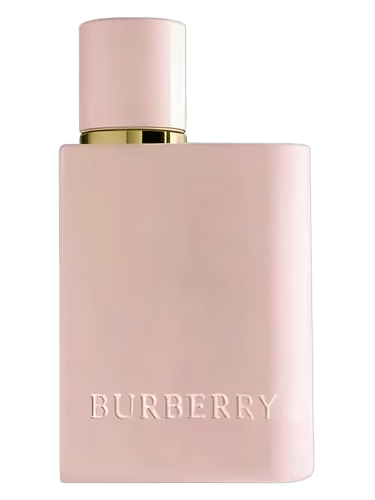
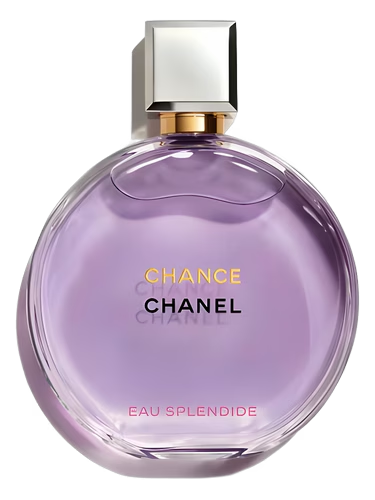
Most Popular Scents Using Taro

What is Taro?
Taro is a starchy root vegetable native to South and Southeast Asia, used in modern perfumery as a contemporary gourmand note to evoke exotic dessert experiences like Taro Milk Tea.What does Taro smell like?
It offers a uniquely sweet, creamy, and nutty profile with a comforting, slightly starchy texture reminiscent of roasted grain, toasted coconut, or steamed basmati rice.How is the Taro note created in perfumery?
Because no natural essential oil or absolute exists, Taro is a "fantasy note" reconstructed by perfumers using aroma chemicals to approximate the warm, nutty scent of the cooked corm.What are some top perfumes featuring Taro?
Notable fragrances include Botanicae Taro, One Day Taipei, Piper & Perro Froth, Mochiglow Taro Ice Cream, and Damask Haus Taro Boba Tea.When is Taro in season?
In tropical regions, taro can be harvested year-round, while in temperate climates it is typically planted in the spring and harvested in the fall before the first frost.