Fragrance Notes Are Layers Of Scent That Are Layered To Form The Final Fragrance. Fragrance Notes Are Categorised Into Three Main Elements Based On How Long They Take To Evaporate, And How Long They Typically Last Following Application: Top Notes, Heart Notes And Base Notes.
Strawberry
Strawberry is a bright, juicy, and playful synthetic note used to impart a fruity sweetness. It delivers an immediate burst of scent that can be crisp and tart (fresh), rich and syrupy (jam), or green and herbaceous. Commonly a top note, it adds youthful, vibrant energy to compositions, complementing florals and gourmands.

Origin & Extraction Of Strawberry
The use of a strawberry note in perfumery relies almost entirely on synthetic chemistry, as natural strawberry essence is highly volatile and difficult to extract into a stable form suitable for fine fragrance. The historical demand for fruity, sweet notes grew significantly in the 20th century, particularly with the rise of younger and gourmand-leaning compositions. Early strawberry accords were often simple and slightly artificial, primarily featuring compounds like ethyl butyrate and ethyl maltol to achieve a recognizable, juicy sweetness.
In modern perfumery, the strawberry note has become more sophisticated, moving beyond simple candy-like sweetness to include nuances of tartness and green freshness, often achieved by combining complex molecules that evoke the scent of the leaves and soil. This note is widely used in contemporary designer and celebrity fragrances to create playful, vibrant, and youthful openings, and it remains a popular complement to white florals and vanilla-based gourmands, adding a bright, immediately recognizable fruity lift.
Extraction Methods of Strawberry
In modern perfumery, the scent of strawberry is almost exclusively recreated using synthetic aroma chemicals, such as ethyl methylphenylglycidate (strawberry aldehyde), because the fruit’s high water content makes traditional essential oil extraction nearly impossible. However, contemporary laboratory techniques utilize headspace technology to capture the "living" aroma of ripe strawberries, allowing perfumers to analyze and reconstruct the complex volatile profile with high precision. Advanced methods also include CO2 extraction, which uses pressurized carbon dioxide at low temperatures to produce a strawberry "extract" or "concrète" that retains the authentic, seedy, and jammy nuances of the fruit better than heat-intensive processes.
Historically, capturing the essence of strawberry was a significant challenge for early natural perfumers. Traditional methods like enfleurage—soaking fruit or petals in fats—were occasionally attempted but yielded poor results due to the fruit's rapid fermentation and low oil yield. Instead, historical "strawberry" notes were often achieved through tinctures or macerations of the fruit in alcohol, which were used more for medicinal or culinary spirits than fine fragrance. In scientific and educational contexts, a popular modern demonstration involves mechanical lysis (smashing) combined with a detergent and salt solution to break down cell membranes, followed by precipitation with cold isopropyl alcohol to isolate visible strands of strawberry DNA.
The Strawberry note is frequently utilized in modern perfumery to introduce a vibrant, juicy, and often youthful sweetness, serving as a bright counterpoint to floral or gourmand structures. A prominent example of its use is in **Yves Saint Laurent Mon Paris Eau De Parfum**, where the berry note provides an initial, sparkling rush of fruitiness that contrasts with the deep floral heart of the fragrance, establishing a luminous and romantic character.
- * * *
Contemporary fragrances often explore the multifaceted nature of strawberry, moving beyond simple candy sweetness. **Burberry Her Eau De Parfum Intense**, for instance, uses the strawberry note to achieve a richer, more profound fruity signature, blending it with deep woods and amber to create a sensual, nighttime fragrance. Similarly, niche and designer brands like Kayali, with their **Kayali Yum Boujee Marshmallow | 81 Eau De Parfum Intense**, leverage the sweet, syrupy facet of strawberry to enhance their gourmand profiles, making the opening instantly delectable and inviting.
- * * *
For those seeking a fresher, less syrupy take, the strawberry note can be expertly blended to evoke the natural, crisp quality of the fruit. Fragrances like **Clean Classic Strawberry Fields Eau de Parfum** focus on a bright, airy interpretation, often incorporating green and herbaceous nuances to suggest fresh-picked fruit rather than jam. Other popular fragrances that showcase the versatile appeal of this note include **Phlur Strawberry Letter Eau de Parfum** and **Dolce & Gabbana L'Imperatrice**, cementing strawberry's role as an uplifting and recognizable element in today's fragrance landscape.
Sustainability Of Strawberry
Sustainability of Strawberry
- Implementing organic farming practices, such as the use of compost, cover crops, and crop rotation, to enhance soil health and reduce reliance on synthetic pesticides and fertilizers
- Promoting integrated pest management (IPM) and biological controls to protect beneficial insect habitats and minimize environmental contamination
- Adopting precision irrigation and water-efficient systems to manage high water requirements and reduce the environmental footprint of cultivation
- Encouraging the use of biodegradable mulches and sustainable planting systems to decrease plastic waste and energy consumption compared to intensive plasticulture
- Supporting local and seasonal consumption to reduce carbon emissions associated with long-distance transportation and refrigerated storage
- Developing circular economy initiatives by repurposing agricultural side-streams and fruit by-products into high-value secondary materials
- Enhancing social sustainability through educational programs and community empowerment initiatives that advocate for fair labor practices and environmental stewardship
Trivia
Strawberries cannot produce a natural essential oil for perfumery, so their scent is synthetically recreated using aroma molecules or by upcycling water discarded during the production of juice and baby purées.
Most Popular Scents Using Strawberry
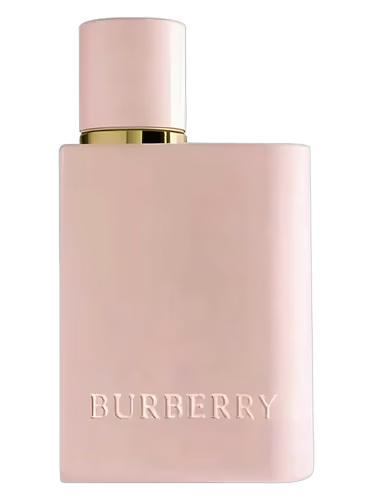
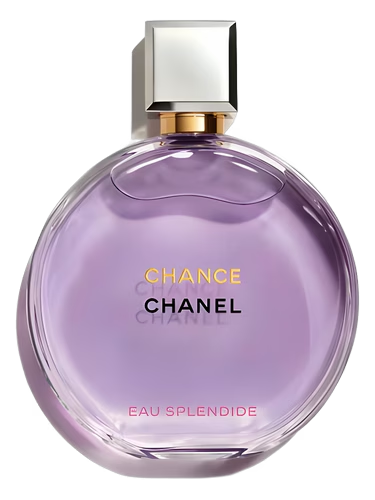
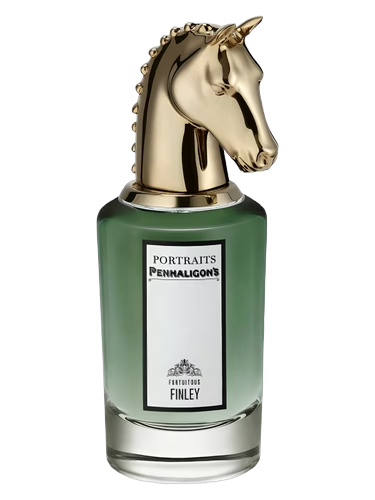
What is the Strawberry note in perfumery?
Strawberry is a bright, juicy, and playful synthetic note used to impart a fruity sweetness, ranging from crisp and tart to rich and jammy.What does Strawberry smell like?
It possesses a sweet, fruity, and slightly tangy aroma often accompanied by green, leafy undertones or creamy, gourmand facets depending on the composition.Is Strawberry a natural or synthetic ingredient?
Strawberry is almost exclusively a synthetic note because the fruit's high water content makes traditional essential oil extraction nearly impossible.How is the scent of Strawberry recreated?
Perfumers use synthetic aroma chemicals like strawberry aldehyde or headspace technology to analyze and reconstruct the complex volatile profile of the living fruit.What are some top perfumes featuring Strawberry?
Popular fragrances showcasing this note include Burberry Her, YSL Mon Paris, Marc Jacobs Daisy, and Phlur Strawberry Letter.When is the Strawberry note best worn?
While its freshness is a hallmark of spring and summer, its sweet and warm facets make it a versatile choice for year-round wear and layering.