Fragrance Notes Are Layers Of Scent That Are Layered To Form The Final Fragrance. Fragrance Notes Are Categorised Into Three Main Elements Based On How Long They Take To Evaporate, And How Long They Typically Last Following Application: Top Notes, Heart Notes And Base Notes.
Snowberry
Snowberry offers a bright, wintry blend of sweet red fruit and aromatic coniferous notes. It features a sparkling top of citron, clove, and raspberry, leading to a green heart of juniper berry, balsam, and pine. The profile finishes with a subtle, clean base of winterberry and musk, creating a crisp, sophisticated aroma.

Origin & Extraction Of Snowberry
The Snowberry note in perfumery, derived from the plant genus Symphoricarpos, is considered a contemporary or niche accord rather than a classic ingredient with a long history comparable to foundational notes like Rose or Bergamot. Historically, the berries themselves were not used for traditional extraction due to their composition and lack of potent essential oil yield. The scent profile—often described as a bright, wintry blend of red fruit and aromatic, coniferous notes—is primarily reconstructed in modern perfumery using a blend of synthetic and natural components to capture this unique, sophisticated winter-fruit aroma.
Its introduction reflects a trend in modern fragrance creation that focuses on photorealistic or evocative seasonal and natural scents. By combining elements like citron, raspberry, juniper, and pine (as suggested by its odor profile), perfumers create an abstract interpretation of the Snowberry's crisp, clean presence, giving it relevance in contemporary and seasonal fragrance launches seeking a fresh, subtly sweet, and slightly green complexity.
The extraction of snowberry essence for perfumery is typically achieved through solvent extraction or steam distillation, as the berries themselves do not yield significant essential oil through mechanical pressing. Historically, aromatic compounds from delicate berries and botanical materials were captured using maceration, where the plant material was soaked in carrier oils or fats (enfleurage) to slowly absorb the scent profile. These traditional methods were labor-intensive and often produced lower concentrations of the desired aroma.
In modern commercial production, advanced techniques such as supercritical CO2 extraction are increasingly utilized to capture a more precise and "true-to-nature" scent of the snowberry. This method uses carbon dioxide in a fluid state as a solvent at low temperatures, preserving heat-sensitive molecules that would otherwise be degraded by traditional steam distillation. Additionally, headspace technology is often employed by perfumers to analyze and reconstruct the snowberry's unique olfactive profile synthetically, ensuring consistency and sustainability in fragrance formulation.
The Snowberry note, characterized by its bright, wintry blend of sweet red fruit and aromatic coniferous notes, is primarily a contemporary accord used to evoke sophisticated seasonal and natural feelings in modern fragrances. Since it is a niche concept rather than a classic botanical extract, it is often reconstructed using synthetic and natural components like citron, clove, raspberry, and juniper berry to capture its crisp, clean essence.
- One notable designer fragrance that utilizes this winter-fruit profile is **Gucci Guilty Eau Pour Homme** (2015), which incorporates Snowberry to add a refreshing, slightly sweet, and uplifting nuance to its masculine composition.
In the world of niche and seasonal releases, the Snowberry note provides a unique, non-traditional freshness. For instance, **Starlit Night** by Bath & Body Works (2021) relies on the Snowberry facet to achieve a specific wintry aroma, blending the bright fruitiness with aromatic notes like balsam and pine, as suggested by the Snowberry's typical odor profile. This contemporary usage demonstrates the note's ability to create evocative, photorealistic seasonal scents.
Sustainability Of Snowberry
Sustainability of Snowberry
- Utilizing for bank stabilization and erosion control due to its adaptable nature and deep, suckering root systems that stabilize steep slopes
- Supporting local biodiversity by providing critical winter food sources for native birds and nesting sites for small animals within dense thickets
- Enhancing pollinator health by providing a reliable nectar source for native bees and hummingbirds during the spring and summer blooming periods
- Implementing ecological restoration through the use of seeds and cuttings carefully sourced from local watersheds to maintain genetic integrity
- Reducing environmental impact in the skincare industry by adopting carbon-neutral manufacturing processes and minimizing the number of imported ingredients
- Promoting a circular economy by upcycling natural plant components into fermented extracts for sustainable, high-functionality dermatological products
Trivia
Despite their name and berry-like appearance, snowberries are actually members of the honeysuckle family and are considered toxic to humans, containing saponins that create a soapy lather when crushed.
Most Popular Scents Using Snowberry
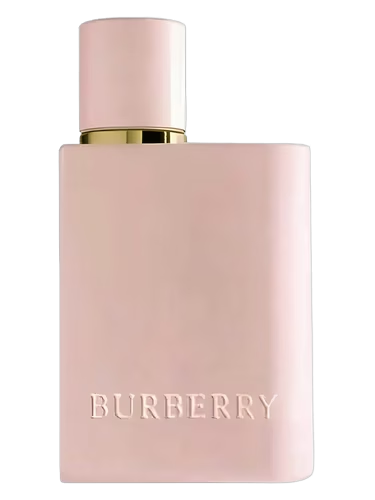
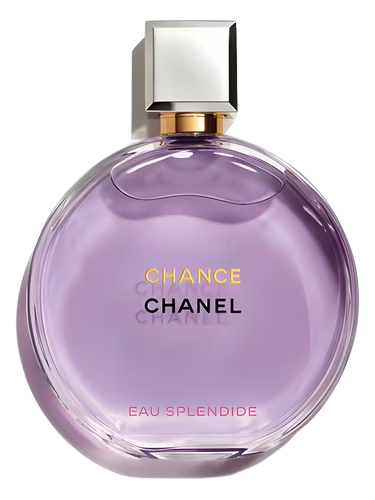
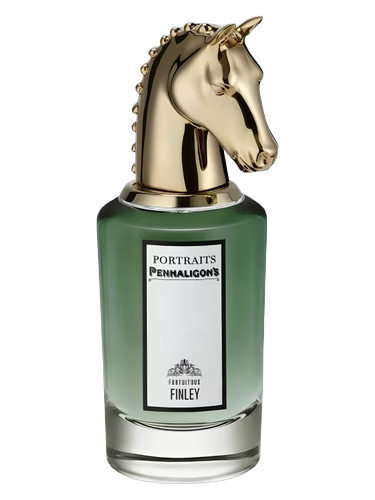
What is Snowberry?
Snowberry is a contemporary fragrance note derived from the Symphoricarpos genus, typically reconstructed as an accord to evoke a bright, wintry blend of red fruits and aromatic coniferous elements.What does Snowberry smell like?
It features a crisp and sophisticated profile with a sparkling top of citron and raspberry, a green heart of juniper berry and balsam, and a clean base of musk and winterberry.How is Snowberry essence extracted?
Because the berries do not yield significant oil through pressing, the scent is captured via solvent extraction, steam distillation, or advanced supercritical CO2 extraction, and often reconstructed using headspace technology.What are some top perfumes featuring Snowberry?
Notable fragrances include Gucci Guilty Eau Pour Homme, Bath & Body Works Starlit Night, and Jesus Del Pozo Noble Musk Nights.When is Snowberry in season?
While the plant blooms from late spring through summer, its signature waxy white berries reach their peak prominence and aesthetic interest during the winter months.