Fragrance Notes Are Layers Of Scent That Are Layered To Form The Final Fragrance. Fragrance Notes Are Categorised Into Three Main Elements Based On How Long They Take To Evaporate, And How Long They Typically Last Following Application: Top Notes, Heart Notes And Base Notes.
Santol
Santol is highly valued in perfumery for its potent, rich, and diffusive sandalwood character. It offers a warm, woody, and substantive note of superb quality, providing long-lasting sandalwood effects throughout the fragrance's top, middle, and base notes. It is often described as smooth and sophisticated.

Origin & Extraction Of Santol
Santol, derived from the Sandoricum koetjape fruit tree native to Southeast Asia, is highly unique in perfumery as it is not utilized for its fleshy fruit but for a synthetic aromatic compound that mimics high-quality sandalwood. Historically, sandalwood (Santalum album) has been a foundational ingredient, but due to issues of overharvesting and sustainability, perfumers sought alternatives that could replicate its warm, creamy, and substantive woody profile. Santol, as a specific captive molecule or accord, represents one of the modern solutions to this challenge.
Its relevance in perfumery is therefore contemporary, contrasting with historical notes like Bergamot or Lemon. The Santol note is used to provide long-lasting, diffusive, and sophisticated woody effects throughout a composition, particularly in modern fragrances that require a strong sandalwood presence without relying on the endangered natural oil. This integration allows the note to bridge the top, middle, and base of a scent, offering a smooth, persistent woodiness and adding complexity and longevity to modern oriental and woody compositions.
Extraction Methods of Santol
The extraction of santol essence and compounds is primarily achieved through thermal and chemical processes rather than mechanical expression. Historically, the fruit has been processed through traditional boiling and sugar-saturation methods to create preserves, marmalades, and syrups. In regions like the Philippines, the thick, astringent rind is often chemically peeled or blanched in boiling water for several minutes, then soaked in water or lye solutions (apog) to remove bitterness before being simmered in heavy sugar syrups to extract and preserve its sweet-tart flavor.
Modern and industrial extraction techniques have expanded to include the recovery of high-value compounds from santol waste. Recent studies utilize acid-extraction methods, such as using hydrochloric acid at high temperatures (80-90°C), to isolate pectin from the discarded rind. Furthermore, advanced processing now explores the fermentation and fractional distillation of santol peelings to produce bio-ethanol, as well as the use of ultrasound-assisted extraction (UAE) and microwave-assisted methods to improve the yield and antioxidant properties of the extracted extracts compared to conventional heating.
Santol, a contemporary aromatic molecule engineered to replicate the warm, creamy, and diffusive character of high-quality, sustainable sandalwood, is predominantly featured in modern and niche perfumery. Because it provides superb longevity and structure, it is a crucial component in woody and oriental fragrances aiming for a substantive base without reliance on endangered natural oils like Mysore sandalwood.
- The scent profile of Santol is central to **Zantol by Voyager**, where the note is utilized to evoke a vibrant and playful warmth, contributing to a complex, woody core.
- Another notable fragrance that relies on sophisticated sandalwood accords, often achieved through modern molecules like Santol, is **Santal du Pacifique** by Perris Monte Carlo, emphasizing a creamy, plush woodiness.
The rise of notes like Santol highlights a significant shift in the fragrance industry toward sustainability and advanced chemistry. It allows perfumers to integrate the coveted, smooth essence of sandalwood into complex compositions, ensuring the woody effect is not only rich and refined but also highly diffusive and long-lasting throughout the wear of the scent.
Modern perfumers appreciate Santol for its ability to bridge top, middle, and base notes, giving the fragrance a continuous, polished wood background. This makes it ideal for contemporary woody-oriental and sheer compositions, where a smooth, sophisticated foundation is essential for supporting brighter notes.
Sustainability Of Santol
Sustainability of Santol
- Enhancing on-farm biodiversity by up to 23% through the integration of santol trees into Southeast Asian agroforestry systems
- Promoting a circular economy by upcycling discarded fruit peelings into organic biofertilizers or sustainable ethanol fuel
- Improving soil health and climate resilience through natural carbon sequestration and leaf litter that enhances fertility and moisture retention
- Supporting rural livelihoods and socio-economic stability by providing farmers with high-value timber and fruit as a cost-effective alternative to monoculture
- Adopting water-efficient practices by utilizing the tree's natural drought-hardiness and implementing precision drip irrigation to minimize waste
- Developing eco-friendly industrial alternatives by using santol wood for wine barrels and investigating seed extracts for natural, non-chemical pest control
Trivia
The real Mysore sandalwood, Santalum album, is so rare and valuable that it is often referred to as liquid gold, and its essential oil has the unusual property of retaining its woody, spicy aroma for decades.
Most Popular Scents Using Santol
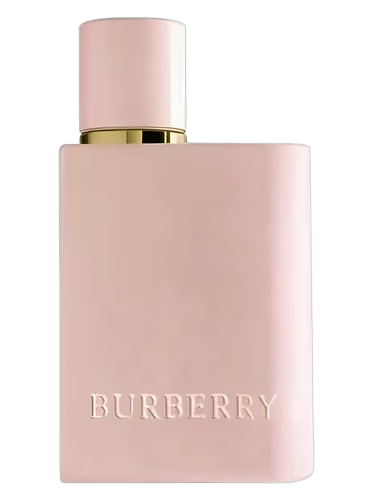
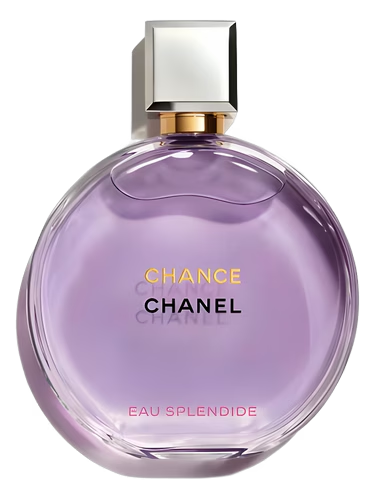
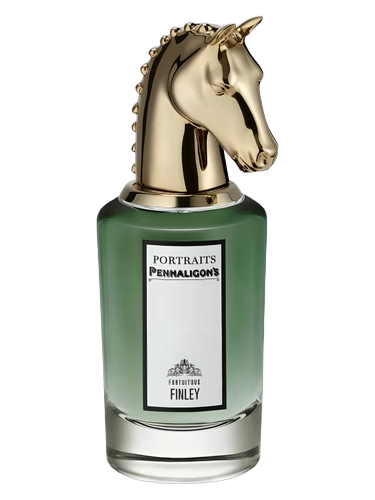
What is Santol?
Santol in modern perfumery refers to a synthetic aromatic molecule, such as Polysantol, engineered to replicate the rich, creamy, and diffusive character of high-quality sandalwood.What does Santol smell like?
It offers a potent, warm, and sophisticated woody scent with a smooth, milky, and substantive sandalwood profile that lasts throughout the fragrance's evolution.How is Santol different from natural sandalwood?
While natural Mysore sandalwood is endangered and rare, Santol provides a sustainable, laboratory-created alternative that offers superior diffusion and longevity without relying on natural oils.What are some top perfumes featuring Santol or Santol accords?
Notable fragrances include Voyager Zantol, SHL God of Fire, and Santal du Pacifique by Perris Monte Carlo.Why is Santol used as a base note?
Due to its high substantivity and exceptional longevity, it serves as a powerful anchor that provides a rich, velvety dry down and supports brighter top and middle notes.