Fragrance Notes Are Layers Of Scent That Are Layered To Form The Final Fragrance. Fragrance Notes Are Categorised Into Three Main Elements Based On How Long They Take To Evaporate, And How Long They Typically Last Following Application: Top Notes, Heart Notes And Base Notes.
Salak
Salak (Snake Fruit) offers a unique, complex aroma, blending the sweet, juicy fragrance of strawberry and pineapple with a subtle, exotic floral nuance. It features a complex, slightly tart or astringent undertone, providing a unique fruity-floral lift that is often described as uplifting and distinctive.

Origin & Extraction Of Salak
Salak, or Snake Fruit, is native to Indonesia and Malaysia and has a long history in Southeast Asian cuisine and traditional use. However, its history as a defined note in Western fine perfumery is very recent. As perfumers increasingly search for unique and exotic fruity notes to move beyond conventional citruses and berries, Salak's complex profile—blending facets of strawberry, pineapple, and subtle floral nuances—has attracted attention.
Its unique, slightly astringent character and exotic sweetness make it a specialized ingredient, often appearing in niche and contemporary fragrances that aim to evoke tropical locations or unconventional fruit accords. It serves as a modern fruity-floral lift, prized for its distinctiveness and ability to offer a unique textural element in the opening and heart of a composition.
Historically, the aromatic compounds and essential oils of salak, or snake fruit, have been isolated using traditional hydrodistillation and maceration techniques. Ancient methods involved simmering the fruit in water to capture volatile vapors or soaking the fruit flesh and leaves in solvents like methanol or ethanol for several days to release secondary metabolites and phenolic compounds. For aroma analysis, liquid-liquid extraction has also been a standard laboratory approach to isolate the fruit's complex fruity volatiles from aqueous homogenates.
Modern commercial and scientific extraction has evolved to utilize more efficient and precise technologies. Steam distillation remains a widely accepted process for large-scale production, where pressurized steam vaporizes the fruit's volatile compounds. However, recent advancements favor Supercritical Fluid Extraction (SFE) using carbon dioxide, which operates at lower temperatures to better preserve the delicate, thermally unstable aromatic profile of the fruit. Additionally, innovative techniques such as lyophilization (freeze-drying) followed by ultrasonic-assisted extraction and ultrahigh performance liquid chromatography (UHPLC) are now employed to quantify bioactive phytochemicals for use in high-end pharmaceutical and cosmetic applications.
Salak, or Snake Fruit, is a highly unconventional and exotic note, meaning it is not associated with the historical foundations of perfumery like traditional citrus or floral ingredients. Due to its recent introduction, compositions utilizing Salak often emerge from niche and artisanal houses seeking to explore photorealistic tropical fruit accords. These fragrances aim to capture the fruit's unique blend of sweet strawberry, juicy pineapple, and subtle astringent zest, providing an immediate, exotic lift in the top and heart notes.
- Salak's distinctive profile offers a modern alternative to traditional fruity notes, catering to contemporary trends that prioritize unique, high-impact freshness and a sense of tropical novelty.
While Salak is not widely featured in mass-market designer fragrances, it is a prized element in specialized collections designed to evoke specific geographic locations, particularly Southeast Asia. The perfumer's challenge when using Salak is to balance its intense sweetness and exotic floral nuances with its subtle, slightly metallic, or astringent undertone, ensuring the note remains vibrant and natural rather than cloying. Fragrances that successfully deploy Salak often use it as a striking contrast to marine, green, or deep amber bases.
- Although Salak does not have an iconic heritage fragrance, modern examples often appear in smaller collections, such as those from indie brands focusing on Indonesian themes, where the complexity of the Snake Fruit is celebrated alongside notes like coconut milk, rice steam, or tropical blossoms.
The use of Salak signifies a move toward more complex, textural fruit notes in the industry. It provides a contemporary, uplifting, and distinctive fruity-floral signature that is sophisticated yet playful. In terms of famous usage, while no single fragrance has made it a household name yet, any future fragrance that gains widespread acclaim and features this note prominently, such as a potential new exotic launch from a high-profile niche brand, would solidify Salak’s place in the modern fragrance wardrobe.
Sustainability Of Salak
Sustainability of Salak
- Utilizing traditional agroforestry systems that integrate salak with diverse crops like mango, banana, and medicinal plants to enhance biodiversity and sequester carbon
- Implementation of the subak water management system and rainwater collection to conserve water, reduce runoff, and increase groundwater filtration
- Adoption of zero-waste practices by utilizing every part of the salak palm to ensure resource efficiency and minimize environmental impact
- Transitioning toward organic farming through the use of manure, natural mulch, and mechanical pest protection to eliminate chemical dependency and protect soil health
- Preserving indigenous agricultural heritage through FAO-recognized Globally Important Agricultural Heritage Systems (GIAHS) that support smallholder livelihoods and cultural resilience
- Developing intercropping systems with nitrogen-fixing legumes to naturally enhance soil fertility and maintain agricultural productivity
Trivia
Salak is nicknamed "snake fruit" due to its reddish-brown scaly skin that perfectly mimics the texture of a cobra, yet its interior contains three white lobes that resemble large cloves of garlic.
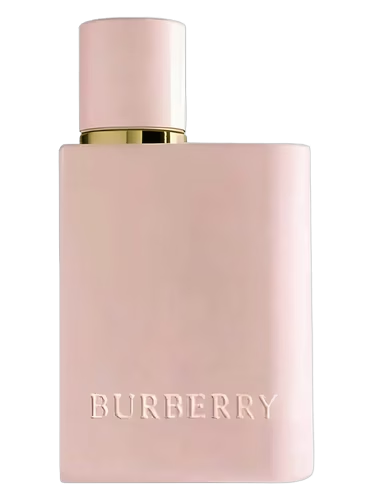
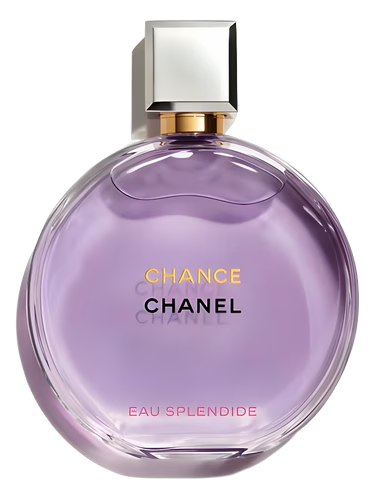
Most Popular Scents Using Salak

What is Salak (Snake Fruit)?
Salak is a fruit from a species of palm tree native to Indonesia, specifically Java and Sumatra, known for its reddish-brown scaly skin that resembles a snake.What does Salak smell like in perfumery?
It offers a complex and exotic aroma that blends the sweet, juicy notes of strawberry and pineapple with subtle floral nuances and a slightly tart or astringent undertone.How is Salak essence extracted?
The aromatic compounds are traditionally isolated through maceration or hydrodistillation, while modern methods utilize steam distillation and Supercritical Fluid Extraction (SFE) to preserve its delicate profile.What are some top perfumes featuring Salak?
The note is found in niche and contemporary fragrances such as Strangers Parfumerie Red Lime Soda and Zara Cocoa Sunset in Bali.When is Salak in season?
While the salak palm can fruit year-round in tropical climates, the primary harvest and peak production period typically occurs between May and December.