Fragrance Notes Are Layers Of Scent That Are Layered To Form The Final Fragrance. Fragrance Notes Are Categorised Into Three Main Elements Based On How Long They Take To Evaporate, And How Long They Typically Last Following Application: Top Notes, Heart Notes And Base Notes.
Rhubarb
Rhubarb offers a unique, vibrant, and tangy freshness, often likened to a blend of tart green apple and red berries. Typically synthetic, it provides a sophisticated, slightly acidic lift to compositions. It's used to inject an unforgettable, bright zest, pairing well with light florals and spicy notes like ginger, creating a modern, complex opening.

Origin & Extraction Of Rhubarb
Rhubarb's history extends back to ancient times, primarily in medicinal and culinary contexts. However, its use as a distinctive note in fine perfumery is a much more contemporary development. Unlike classical ingredients with centuries of use, rhubarb began to be incorporated into fragrances around the mid-20th century, following the trend of perfumers seeking unique, fresh, and slightly tangy elements that moved beyond traditional citrus structures.
In modern perfumery, the rhubarb note—which is often synthetic to achieve its characteristic vibrancy—is prized for its unique, slightly acidic lift. It serves to inject an unforgettable, bright zest into compositions, pairing sophisticatedly with light florals like rose and green notes, and also complementing spices such as ginger. This versatility has secured its place in contemporary fragrance design, offering a modern, complex opening, especially in green, fruity, and floral categories.
Extraction Methods of Rhubarb
Historically, rhubarb has been processed through traditional decoction and solar-based techniques. Ancient methods involved simmering the root (rhizome) in water to create medicinal teas or drying the plant in the sun. In Traditional Chinese Medicine, a specific historical process involves "steaming and sun-drying nine times" (SDR-9), a labor-intensive cycle designed to reduce toxicity while enhancing the potency of bioactive components like anthraquinones.
Modern extraction utilizes more precise scientific methods to isolate specific compounds for perfumery, medicine, and textiles. The latest techniques include reflux extraction using solvents like water or ethanol, where temperature and liquid-to-material ratios are optimized through response surface methodology. For high-purity extracts, advanced processes such as supercritical CO2 extraction, vacuum drying under reduced pressure, and even cellular extraction are employed to capture delicate aromatic molecules and water-soluble phyto-compounds without heat degradation. Additionally, real-time monitoring via chromatography and ion mobility spectrometry is now used to verify the purity and quality of the final essence.
The rhubarb note, prized for its unique, tangy, and sophisticated freshness, has been masterfully utilized in contemporary perfumery to create vibrant and unforgettable scents. Perhaps the most iconic modern expression is found in Frédéric Malle's **Bigarade Concentrée**, a fragrance that seeks to capture the entire bitter orange tree but is frequently associated with a bright, zesty rhubarb-like bitterness in its opening. A true celebration of the note, however, is Hermès' **Eau de Rhubarbe Écarlate**, which provides a powerful and enduring rhubarb signature that is simultaneously vegetal, tart, and uplifting.
- Rhubarb is often featured in compositions that aim for a sophisticated, fruity-floral profile without becoming overly sweet. Parfums de Marly’s acclaimed **Delina Eau de Parfum** uses the note prominently in its opening, where the sharp, tangy rhubarb cuts through the creamy sweetness of litchi and the richness of rose, providing a modern, effervescent, and luxurious lift that defines the fragrance’s signature complexity.
The versatility of the rhubarb note allows it to be interpreted across different fragrance families. In the gourmand category, the note appears in fragrances like Dolce&Gabbana's **Dolce Garden** where its tartness adds dimension to sweet, coconut, and floral accords. Furthermore, in niche and artisanal perfumery, such as with Prada’s **Infusion de Rhubarbe** and Floral Street's **Electric Rhubarb**, the note is often treated with a minimalist clarity, emphasizing its crisp, green, and slightly musky undertones to create airy, clean, and intriguing compositions.
Sustainability Of Rhubarb
Sustainability of Rhubarb
- Utilizing perennial cultivation practices that allow plants to remain productive for up to 15 years, reducing the need for frequent replanting and soil disturbance
- Implementing integrated pest management and biological controls, such as removing host weeds like curly dock, to manage pests like the rhubarb curculio without synthetic chemicals
- Adopting precision nutrient management by using rich compost and low-phosphorus fertilizers to prevent nutrient runoff and protect local water quality from algae blooms
- Supporting a circular economy through zero-waste culinary practices, including the composting of poisonous leaves and the use of surplus stalks in community food programs
- Advancing agricultural biodiversity by researching and genotyping diverse rhubarb cultivars to develop climate-resilient varieties suitable for local craft industries
- Promoting ethical sourcing and socio-economic resilience by partnering with organizations like the Sustainable Restaurant Association to embed globally recognized sustainability benchmarks
Trivia
While the rhubarb plant has been cultivated for thousands of years for medicinal and culinary uses, its scent is entirely synthetic in perfumery because the plant's natural essence is nearly impossible to extract.
Most Popular Scents Using Rhubarb
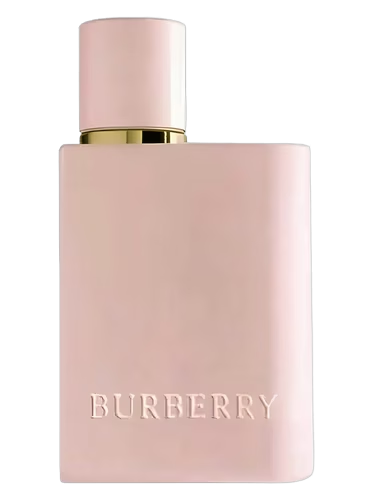
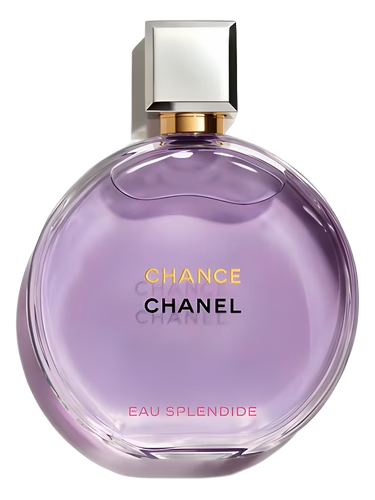
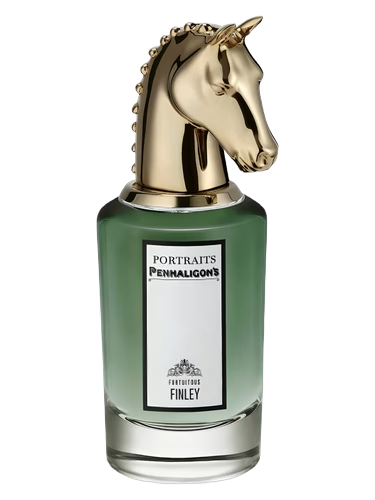
What is Rhubarb?
Rhubarb is a hardy perennial plant native to Asia, primarily used in modern perfumery for its unique, tart, and vegetal aromatic profile.What does Rhubarb smell like?
It offers a vibrant, tangy freshness often compared to a blend of sour green apple and red berries, providing a sophisticated, slightly acidic lift to fragrances.How is Rhubarb essence extracted for perfumes?
Because the natural essence is nearly impossible to extract from the plant, the rhubarb note in perfumery is almost entirely created using synthetic compounds to capture its characteristic zest.What are some top perfumes featuring Rhubarb?
Notable fragrances include Parfums de Marly Delina, Hermès Eau de Rhubarbe Écarlate, Dolce&Gabbana L'Imperatrice 3, and Prada Infusion de Rhubarbe.When is Rhubarb in season?
Rhubarb is a quintessential spring vegetable, with field-grown harvests typically occurring from late March through June in the Northern Hemisphere.