Fragrance Notes Are Layers Of Scent That Are Layered To Form The Final Fragrance. Fragrance Notes Are Categorised Into Three Main Elements Based On How Long They Take To Evaporate, And How Long They Typically Last Following Application: Top Notes, Heart Notes And Base Notes.
Potato
Potato, in perfumery, offers a complex, earthy, and vegetative profile. It features rich, savory notes—often described as musty, slightly sulfureous, and rooty—with underlying creamy, malty, and nutty nuances. It can also present green or slightly metallic undertones, providing depth and a unique, starchy texture to compositions.

Origin & Extraction Of Potato
The potato note has a very limited and modern history within traditional fine perfumery. Unlike notes derived from flowers, resins, or fruits, potato essence—primarily used to evoke an earthy, rooty, or starchy texture—is considered highly unconventional. Its application is not tied to any classical fragrance structures like Eau de Cologne, but rather to niche and avant-garde compositions aiming for photorealistic or abstract food and soil accords. Its complexity, often incorporating sulfureous, malty, and savory nuances, makes it challenging to incorporate, limiting its historical widespread use to experimental perfumery.
More recently, the concept of a potato-derived fragrance has surfaced, largely through marketing stunts or novelty products. A notable example is the "Frites by Idaho" perfume created by the Idaho Potato Commission. While this product aimed to capture the creamy, fried scent of French fries rather than the raw, earthy root, it highlights the ingredient's emerging, albeit often commercial, role in modern fragrance narrative. This usage demonstrates a contemporary trend towards utilizing familiar, savory notes to create unexpected and highly distinctive aromatic experiences.
Extraction Methods of Potato
The extraction of components from potatoes, primarily starch and juice, has evolved from simple manual techniques to sophisticated industrial processes. Historically, the most common method for isolating potato starch was the traditional precipitation or "wet grinding" method. This involves peeling and crushing the potatoes into a pulp, mixing them with water to create a homogenate, and then filtering the mixture through a muslin cloth to remove fibrous particles. The resulting filtrate is left to settle for 24 to 48 hours, allowing the starch granules to naturally precipitate at the bottom of a sedimentation tank. The supernatant is then decanted, and the remaining starch block is washed and dried, often by sunlight.
Modern industrial extraction has shifted toward more efficient mechanical and chemical systems. One of the primary contemporary methods is the hydrocyclone staged extraction, which uses centrifugal force to rapidly separate starch granules from proteins and cell fluids. This process typically involves up to 18 stages of concentration, recovery, and refining, significantly improving purity and yield while reducing labor costs. Additionally, the "dry method" has emerged for large-scale operations, utilizing mechanical peelers and rotary washing machines to minimize water consumption during the initial cleaning phase.
Latest advancements in potato extraction focus on "green" and high-precision techniques to isolate specific bio-compounds like proteins, lipids, and phenols. These include Ultrasonic-Assisted Extraction (UAE) and Microwave-Assisted Extraction (MAE), which use sound waves or radiation to disrupt cell walls and enhance mass transfer. Supercritical Fluid Extraction (SFE) using carbon dioxide is also employed as a non-toxic, highly selective alternative. For research and diagnostic purposes, advanced kits like the Wizard or DNeasy methods utilize silica-binding resin and vacuum manifolds to extract high-quality DNA from potato tubers and processed products.
The Potato note, due to its unconventional, earthy, and starchy profile, has a highly limited presence in mainstream fine perfumery, typically appearing only in niche or experimental fragrances seeking photorealistic or unusual savory depth. Because this note is challenging to integrate into classic structures, its use often defines avant-garde compositions rather than universally recognized bestsellers. When used successfully, it provides a unique texture, blending musty, rooty, or creamy nuances into abstract food or soil accords.
- One notable example, though often more of a marketing curiosity, is the highly publicized release of Frites by Idaho, created by the Idaho Potato Commission. While this perfume primarily aimed to capture the creamy, fried scent of French fries rather than the raw, earthy root, it highlights the ingredient's emerging role in modern fragrance narratives that embrace savory and unexpected notes.
Beyond novelty products, the earthy and vegetative character of the potato note can sometimes be suggested by clever blending of ingredients in sophisticated niche perfumes that aim to evoke the scent of wet soil, root vegetables, or a freshly dug garden. Although rarely listed explicitly as "Potato," the rooty, starchy texture is often achieved via molecules or accords that contribute similar underlying creamy, vegetative density to the base. This provides grounding and longevity to green and earthy fragrance families.
- Another subtle presence of this note can be found in fragrances that utilize a strong "dirty" patchouli or deep vetiver, which can carry the same musty, rooty, and slightly sulfureous characteristics found in the potato essence, such as in certain iterations of scents by artisanal brands known for capturing raw, natural smells.
The future relevance of the Potato note lies primarily in the hands of modern perfumers who are consistently pushing boundaries, often in the niche sector. As the demand for unique and photorealistic experiences grows, notes like Potato offer an opportunity to create unexpected textures and highly distinctive aromatic experiences that stand apart from traditional floral and citrus compositions. Its unconventional nature ensures that any fragrance featuring it, even subtly, achieves a strong, memorable, and often controversial signature.
Sustainability Of Potato
Sustainability of Potato
- Utilizing sustainable growing techniques such as crop rotation, cover crops, and the addition of compost to maintain soil health, reduce erosion, and naturally replenish nutrients
- Implementing precision irrigation technologies, soil probes, and high-tech central-pivot systems to optimize water usage and minimize loss through evaporation or runoff
- Adopting GPS and smart farming technology to precisely place inputs, optimize row spacing, and reduce equipment operation time, fuel use, and greenhouse gas emissions
- Promoting a circular economy by upcycling potato peels and scraps into nutritious snacks or composting them to create nutrient-rich soil for future harvests
- Advancing industry-wide social and economic sustainability through the Potato Sustainability Alliance, which focuses on benchmarking performance and supporting local farming communities
- Researching and adopting new, resilient potato varieties that require fewer pesticides and less water while providing higher yields and better storability
Trivia
The potato has inspired surprising niche fragrances, including Frites by Idaho, which was formulated to smell like freshly salted french fries, and BOHOBOCO's Polish Potatoes, which captures the earthy, "beastmode" scent of a 1980s vegetable market.
Most Popular Scents Using Potato
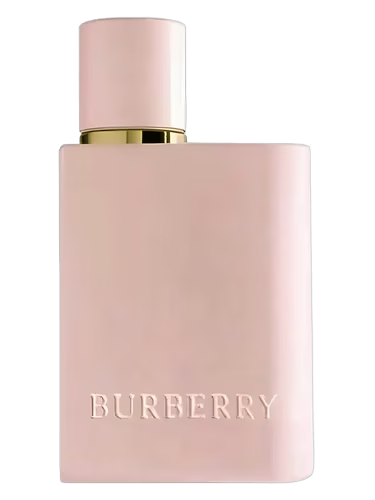
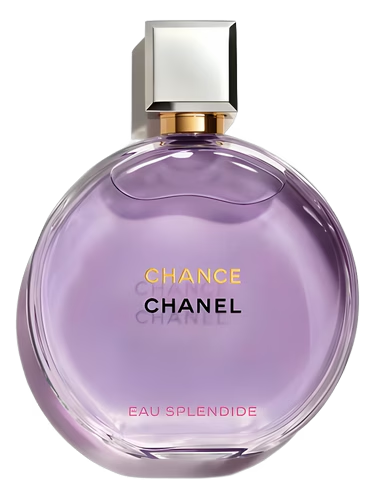
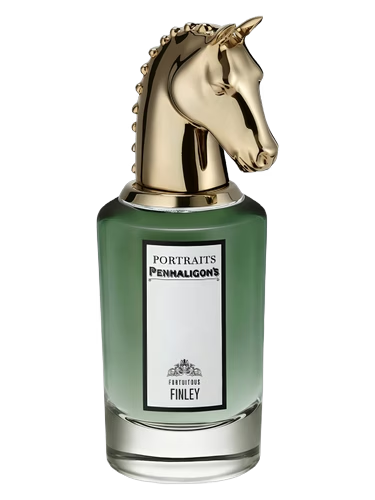
What is the Potato note in perfumery?
The Potato note is an unconventional fragrance element used primarily in niche and avant-garde perfumery to provide a complex, earthy, and starchy texture.What does Potato smell like?
It offers a savory and vegetative profile featuring musty, rooty, and slightly sulfureous notes with underlying creamy, malty, and nutty nuances.How is the Potato essence extracted?
In perfumery, components are typically tinctured or isolated using advanced methods like Supercritical Fluid Extraction (SFE) to capture specific starchy or earthy bio-compounds.What are some top perfumes featuring the Potato note?
Notable fragrances include Bohoboco Polish Potatoes, Ataraxia Perfumery Vestibule, Hilde Soliani Lets Party, and the novelty scent Frites by Idaho.When is the Potato in season?
Potatoes are a cool-season crop typically planted between March and May, with primary harvests occurring from early summer through late autumn.