Fragrance Notes Are Layers Of Scent That Are Layered To Form The Final Fragrance. Fragrance Notes Are Categorised Into Three Main Elements Based On How Long They Take To Evaporate, And How Long They Typically Last Following Application: Top Notes, Heart Notes And Base Notes.
Pear
The pear note offers a fresh, watery, and subtly sweet aroma, distinct from apple. It is often green and juicy, ranging from the crispness of a Conference pear to the soft, honeyed sweetness of a Bosc. It provides a luminous, uplifting, and slightly dewy top note, lending modern transparency and fruitiness.

Origin & Extraction Of Pear
The use of Pear in perfumery is a relatively modern phenomenon. While Pears themselves have been cultivated for thousands of years, the technology to successfully capture their fresh, dewy, and highly volatile aroma for fragrance use is contemporary, emerging prominently in the late 20th and early 21st centuries. Early fruit notes in perfumery often focused on heavier, less delicate scents. Pear notes—which can range from crisp green to soft, honeyed sweetness—are typically achieved using synthetic compounds to ensure stability and radiance, offering a luminous alternative to traditional floral or citrus top notes.
Today, the Pear note is highly valued in modern compositions, particularly in the creation of sheer, transparent, and uplifting fragrances, often bridging the gap between sparkling top notes and floral hearts. Its popularity surged as perfumers began to move toward more realistic and watery fruit scents, lending an air of contemporary sophistication and juicy vitality to perfumes, especially those aimed at a younger or more casual market.
Historically, the extraction of aromatic compounds and juices from pears involved simple mechanical and thermal treatments. Traditional methods included manual peeling, coring, and dicing, followed by pulping using basic grinders or stone presses. For preservation and flavor concentration, pear peels were often dried in the sun or open ovens, or simmered into syrups and preserves. In some regions, the "freezer and squeezer" method was a common domestic technique, where freezing the fruit helped break down cellular structures to facilitate easier juice extraction using manual hand-presses or lemon-style squeezers.
Modern commercial and laboratory extraction techniques have become significantly more sophisticated, focusing on maximizing the recovery of bioactive compounds like phenolics and fibers. Current standard methods include ultrasonic-assisted extraction (UAE) using methanol or ethanol solvents, which utilizes sound waves to rupture cell walls efficiently. Advanced industrial processes also employ tangential microfiltration, diafiltration, and supercritical CO2 extraction to capture delicate aromatic molecules and pure mucilage without the structural damage caused by high heat. For essential oils and essences, steam distillation and fractional distillation remain key, while the food industry utilizes centrifugal juicers to separate juice from pomace and seeds effectively.
The Pear note, prized for its fresh, watery, and subtly sweet aroma, has become a contemporary staple, often used to lend a modern, transparent, and juicy vitality to compositions. One of the most iconic fragrances to utilize this note is **Jo Malone London's English Pear & Freesia Cologne**. This scent showcases a luminous, crisp pear opening combined with the delicate softness of freesia, establishing a clean, elegant, and universally appealing freshness that became a global bestseller and a benchmark for the note's use in modern perfumery.
- **Jimmy Choo Eau de Parfum** features a juicy pear top note that adds brightness before transitioning into its rich, sweet heart of toffee and patchouli.
- **Givenchy's Irresistible Eau de Parfum** uses pear to provide a sparkling, uplifting counterpoint to its intense rose and blonde wood base.
In niche perfumery, the Pear note is often celebrated as the star ingredient, moving beyond a simple top note to form the core identity of the scent. For example, **Juliette Has a Gun Pear Inc.** focuses entirely on the essence of pear, creating a crisp, highly effervescent, and transparent aroma, often paired with musk and ambroxan to give the volatile fruit note lasting presence. This focus on purity highlights the note's ability to be sophisticated and minimalistic.
- **The 7 Virtues Lotus Pear** blends the juicy fruit with sweet florals and a hint of gourmand quality.
- **Clean Reserve Radiant Nectar Eau de Parfum** combines pear with ambrette seeds for a musky, warm, and highly luminous interpretation of the fruit.
Furthermore, Pear frequently bridges the gap between sparkling top notes and deeper, often gourmand or woody bases, providing a crucial element of youthful sweetness and uplift. It is favored in fragrances aimed at a modern, casual, or feminine audience, injecting vitality into otherwise heavy compositions. Fragrances like **Marc Jacobs Daisy Dream Eau de Parfum** utilize pear to add a light, airy, and fruity dimension to the floral and musky base, ensuring the opening is immediately captivating and cheerful.
Sustainability Of Pear
Sustainability of Pear
- Adopting Integrated Pest Management (IPM) strategies, such as using pheromones and scouting orchards, to significantly reduce the use of high-risk pesticides
- Implementing water-efficient practices, including the use of soil moisture sensors and automated irrigation systems, to optimize resource consumption
- Promoting biodiversity and climate resilience by cultivating fire-blight-resistant cultivars and utilizing hardy rootstocks
- Enhancing carbon sequestration through the maintenance of long-lived pear orchards that capture and store atmospheric carbon in the soil
- Advancing a circular economy by upcycling side-streams and focusing on responsible waste management to reduce the environmental impact of packaging and food waste
- Utilizing digital agriculture and satellite-driven monitoring tools to track environmental impacts and verify the effectiveness of sustainable farming practices
Trivia
Homer famously described the pear as a "gift from the Gods" in the Odyssey, and it was so highly regarded by the ancient Romans that they cultivated over 30 distinct varieties.
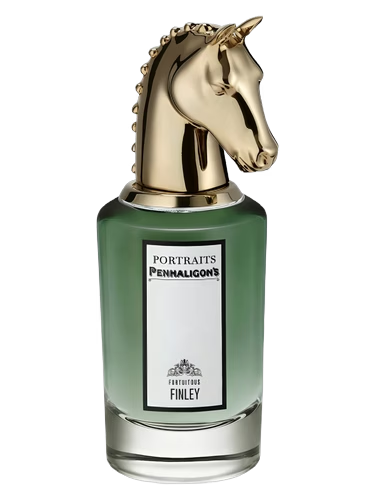
Most Popular Scents Using Pear


What is the Pear note in perfumery?
Pear is a modern, synthetic fragrance note prized for its fresh, watery, and subtly sweet aroma that provides a luminous and transparent quality to compositions.What does Pear smell like?
It offers a crisp, juicy, and cooling scent profile that ranges from green and crunchy to soft and honeyed, often described as less tart than apple and more translucent than peach.How is Pear essence extracted?
Natural pear extraction is not commercially viable because its aromatic compounds are too dilute and heat-sensitive, so perfumers use synthetic reconstructions like Pear Ester to recreate the scent.What are some top perfumes featuring Pear?
Iconic fragrances showcasing this note include Jo Malone London English Pear & Freesia, Juliette Has a Gun Pear Inc., and Guerlain Aqua Allegoria Pera Granita.What notes pair best with Pear?
Pear is highly versatile and blends naturally with white florals like freesia and jasmine, clean musks, and soft woody bases like cedarwood to create airy and sophisticated scents.