Fragrance Notes Are Layers Of Scent That Are Layered To Form The Final Fragrance. Fragrance Notes Are Categorised Into Three Main Elements Based On How Long They Take To Evaporate, And How Long They Typically Last Following Application: Top Notes, Heart Notes And Base Notes.
Passionfruit
Passionfruit offers an intensely exotic, juicy, and vibrant tropical aroma. It is tart, sweet, and slightly green, with complex nuances of citrus (grapefruit/lime) and a subtle, musky floral quality. It is used to lend a sparkling, mouth-watering, and luscious lift to fruity-floral and modern compositions.

Origin & Extraction Of Passionfruit
Passionfruit, native to South America, has a long history in its native regions, but its use as a distinct note in fine perfumery is a relatively modern development, capitalizing on the rise of fruity-floral and exotic gourmand categories starting in the late 20th century. Traditional perfumery historically focused on classic florals, resins, and citruses like Bergamot. Passionfruit's complex profile—which is intensely exotic, juicy, tart, and vibrant—required modern fragrance chemistry to capture effectively, as the natural oil is less stable and harder to extract for high-volume use than traditional botanical notes.
In contemporary perfumery, Passionfruit is prized for its ability to lend an immediate, mouth-watering, and luscious tropical lift to a composition. It moved away from simply being a generic "fruity" accord and became a recognizable signature note, particularly in fragrances aiming for a cheerful, vibrant, and vacation-like mood. Its inclusion provides a sparkling top note that often bridges into a sweet, subtly musky floral heart, making it popular in designer and niche fragrances seeking exotic vitality.
Extraction Methods of Passion Fruit
Historically, aromatic compounds from passion fruit were obtained through traditional steam distillation of the peels or simple mechanical pressing of the seeds. In many traditional practices, passion fruit peels were simmered in water to create fragrant infusions or spices, while the seeds, often considered industrial waste from juice production, were cold-pressed to extract their nutrient-rich oil. These methods focused on basic thermal or mechanical separation to capture the fruit's distinctive tropical aroma and bioactive components.
Modern commercial extraction has evolved to include more sophisticated and efficient techniques. Current methods utilize advanced steam distillation assisted by enzymatic hydrolysis and microwave-ultrasonic treatments to increase the yield of volatile oils from the pericarp. For the seeds, industry standards include solvent extraction—typically using hexane—or supercritical CO2 extraction, which preserves the integrity of delicate fatty acids and antioxidants. Recent innovations also explore surfactant-assisted aqueous extraction and ultrasound-assisted methods to provide more environmentally friendly and cost-effective alternatives for recovering high-value oils from processing by-products.
Passionfruit is a modern, sought-after note in contemporary perfumery, valued for its unique ability to inject a vibrant, exotic, and mouth-watering juiciness into compositions. This exotic profile is central to fragrances that aim for a festive or celebratory mood, distinguishing them from traditional citrus scents. A prominent example of this usage is found in Carolina Herrera's popular duo, where Passionfruit acts as a signature element. Specifically, in 212 VIP and 212 VIP Men, the note lends a sparkling, energetic opening, suggesting exclusivity and vitality, setting the stage for the party-ready nature of these scents.
- The note’s complex profile, often described as tart, sweet, and slightly green, allows it to blend seamlessly into different fragrance categories, from fruity-florals to deeper oriental and gourmand structures.
In the high-end niche market, Passionfruit is often used to add an unexpected tropical lift or to provide contrast to richer, heavier base notes. A notable and sophisticated execution of the note is Maison Crivelli's Oud Maracuja Extrait. In this luxury composition, the bright, tart, and vibrant character of Passionfruit (Maracuja) is masterfully paired against the deep, resonant, and woody facets of oud and leather. This contrast highlights the complexity of the fruit, using its freshness not just as a fleeting top note but as a sustained counterpoint that lifts and modernizes the classic oud profile.
- More recently, the note has been celebrated in compositions where tropical fruits are the centerpiece, focusing on a clean, uplifting, and direct interpretation of the fruit itself.
An example of a fragrance built around this singular note is Pacifica's Passion Fruit (2024). This perfume utilizes the passionfruit note prominently in its top notes, blending it with other bright fruits like pineapple and watermelon, supported by nuances of ginger and vanilla. This composition showcases the fruit's sweet, juicy, and uplifting characteristics, emphasizing a cheerful and clean tropical scent that is highly appealing in modern, light, and gender-neutral fragrances.
Sustainability Of Passionfruit
Sustainability of Passionfruit
- Promoting a circular bioeconomy by upcycling juice industry waste, such as seeds, into high-value bioactive oils and phenolic fractions for skincare and pharmaceuticals
- Developing disease-resistant and climate-resilient cultivars to ensure long-term crop viability and reduce the need for frequent replanting due to root and trunk rot
- Implementing renewable energy initiatives, such as solar-powered nurseries, to reduce greenhouse gas emissions and dependency on fossil-fuel-based electricity
- Adopting precision agriculture and integrated pest management (IPM) strategies to optimize water usage, improve soil health, and minimize chemical pesticide reliance
- Supporting smallholder farmer livelihoods through training in sustainable practices and establishing fair trade systems that ensure equitable income and market access
Trivia
The passionflower was named by 17th-century Spanish missionaries who saw the bloom as a symbol of the Passion of Christ, believing the ring of filaments around its heart represented the Crown of Thorns.
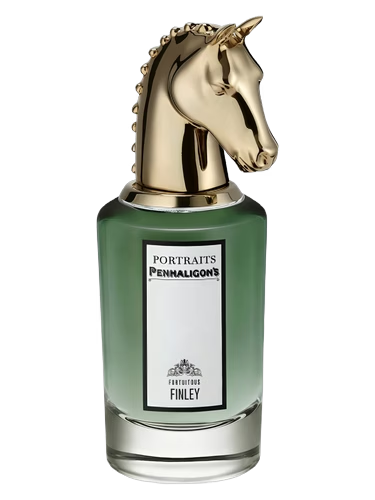
Most Popular Scents Using Passionfruit


What is Passionfruit?
Passionfruit is a tropical fruit native to South America, used in modern perfumery as a vibrant, exotic note to add a luscious, mouth-watering lift to fruity-floral and gourmand compositions.What does Passionfruit smell like?
It offers an intensely juicy and tart tropical aroma, blending sweet and slightly green nuances with citrus-like facets and a subtle, musky floral quality.How is Passionfruit essence extracted?
While traditionally obtained through steam distillation of peels or cold-pressing seeds, modern perfumery often uses advanced extraction techniques or synthetic accords to recreate its fresh, complex scent profile.What are some top perfumes featuring Passionfruit?
Popular fragrances featuring this note include Maison Crivelli Oud Maracuja, Tiziana Terenzi Cassiopea, Carolina Herrera 212 VIP, and Pacifica Passion Fruit.When is Passionfruit in season?
In tropical climates, it can be available year-round, but it typically peaks from mid-summer through late autumn in the Northern Hemisphere, with fruit reaching its sweetest flavor as the skin wrinkles.