Fragrance Notes Are Layers Of Scent That Are Layered To Form The Final Fragrance. Fragrance Notes Are Categorised Into Three Main Elements Based On How Long They Take To Evaporate, And How Long They Typically Last Following Application: Top Notes, Heart Notes And Base Notes.
Osmanthus
Osmanthus offers an exquisite, complex fruity-floral scent prized for its rich, unforgettable aroma. It features prominent honeyed apricot, peach, and dried fruit (raisin, plum) facets, underpinned by creamy, luscious nuances. It also carries subtle complexity from green, spicy, and delicate leather-like undertones, giving it exceptional depth and lasting elegance.

Origin & Extraction Of Osmanthus
Osmanthus, a flower native to Asia, particularly China and Japan, possesses a rich cultural history and has been revered for centuries, often known as the "tea flower" due to its traditional use in scenting tea. While its aromatic properties have been recognized for a long time, its foundational use in Western fine perfumery is a relatively modern development compared to classic European notes. Its complex, unforgettable scent, featuring honeyed apricot and subtle leather-like undertones, positioned it as a sophisticated, exotic ingredient.
The note gained serious momentum in fine perfumery during the late 20th and early 21st centuries as perfumers began exploring unique fruity-floral profiles beyond the traditional palette. Today, Osmanthus is highly prized for its versatility, bridging the gap between delicate floral essences and rich, fruity, or leathery bases, making it a staple in contemporary niche and designer compositions that seek exceptional depth and lasting elegance.
Extraction Methods of Osmanthus
The primary commercial method for obtaining osmanthus essence is a two-stage solvent extraction process. Historically, flowers were often preserved in a brine bath for weeks to prevent withering before being processed. The traditional method involves washing the fresh or salted blossoms with a non-polar solvent like hexane or petroleum ether to create a thick, waxy "concrete." This concrete then undergoes a second extraction with ethyl alcohol (ethanol) followed by filtration and evaporation to produce a highly concentrated "absolute," which is the prized material for luxury perfumery.
While steam distillation is a standard technique for many botanicals, it is less common for osmanthus due to low yields and a lighter, more fugitive aroma profile. Modern advancements have introduced highly efficient techniques such as supercritical CO2 extraction, which operates at lower temperatures to prevent the degradation of heat-sensitive aromatic molecules. Other recent innovations include ultrasonic-assisted flash extraction and the use of ionic liquids to significantly reduce processing time while improving the yield and purity of the volatile oils.
Osmanthus, prized for its complex apricot and leather facets, secured its reputation early with **Jean Patou 1000** (1972). This classic fragrance is noted as one of the first perfumes to utilize osmanthus and remains a benchmark, offering a sensual and intimate fruity-floral profile that paved the way for the note's recognition in fine perfumery.
In modern perfumery, Jean-Claude Ellena’s work at Hermès created one of the most celebrated interpretations: **Hermès Osmanthe Yunnan** (2005). This fragrance renders the note as translucent, shimmering tea, steeping osmanthus petals into a green-gold liquor. Similarly, The Different Company’s **Osmanthus** (2000), also by Ellena, is lauded for its clarity, presenting the flower as delicate petals floating over musks, emphasizing its luminous and airy qualities.
Contemporary designers often use osmanthus to add sophisticated depth to compositions. For instance, **Terre d'Hermès** utilizes the fruit-like facets of Blood Orange, while **Cartier La Panthère Parfum** (2020) incorporates osmanthus into a rich accord with gardenia and patchouli, using its apricot note to lend sensuality and its leathery accent to sharpen the composition's floral-chypre nature. Other notable modern uses include **Parfum d'Empire Osmanthus Interdite** and **Guerlain Pêche Mirage**.
Sustainability Of Osmanthus
Sustainability of Osmanthus
- Adopting sustainable farming practices in China and Japan to ensure delicate flowers are harvested without harming wild populations
- Implementing conservation efforts such as ancient tree protection, genetic diversity preservation, and the documentation of traditional knowledge
- Developing biotechnological innovations and Nature Print technology to replicate scent molecules, reducing the need for intensive natural harvesting
- Utilizing green technologies including CO2 extraction, microwave-assisted methods, and enzymatic processes to provide environmentally friendly alternatives to traditional solvent extraction
- Promoting a circular economy by offering refillable bottles and utilizing recyclable materials for secondary packaging
- Advancing research into sustainable delivery systems, such as the synthesis of silica nanocapsules for the durable release of fragrance
Trivia
In Chinese folklore, there is an unchoppable osmanthus tree on the moon whose blossoms can be ground into a tea that grants the drinker immortality.
Most Popular Scents Using Osmanthus
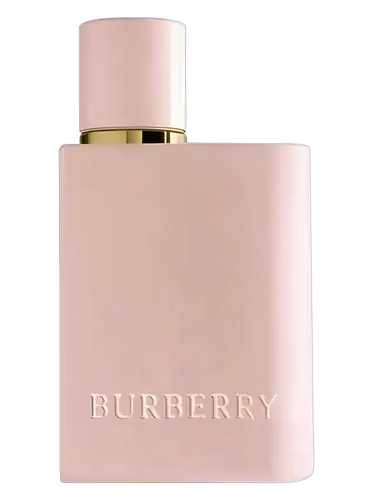
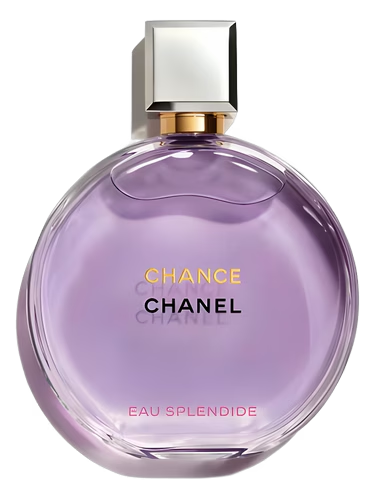
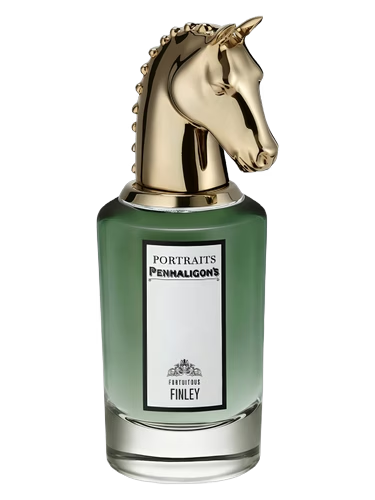
What is Osmanthus?
Osmanthus is a fragrant flower native to East Asia, particularly China and Japan, belonging to the Oleaceae family and prized in perfumery for its unique fruity-floral character.What does Osmanthus smell like?
It features a complex aroma dominated by honeyed apricot and peach notes, balanced by creamy floral nuances and sophisticated, leathery undertones.How is Osmanthus essence extracted?
The fragrance is primarily obtained through a two-stage solvent extraction process that produces a thick waxy concrete, which is then refined into a highly concentrated absolute.What are some top perfumes featuring Osmanthus?
Iconic fragrances highlighting this note include Jean Patou 1000, Hermès Osmanthe Yunnan, Narciso Rodriguez For Her, and Memo Paris Inlé.When is Osmanthus in season?
The plant typically blooms from late summer through autumn, with peak flowering occurring between September and November in most temperate regions.