Fragrance Notes Are Layers Of Scent That Are Layered To Form The Final Fragrance. Fragrance Notes Are Categorised Into Three Main Elements Based On How Long They Take To Evaporate, And How Long They Typically Last Following Application: Top Notes, Heart Notes And Base Notes.
Ornithogalum
Ornithogalum (Star-of-Bethlehem) presents a strong, sweet, and highly characteristic floral profile. Its rich aroma is often described as intensely honeyed and lush, with luminous, slightly narcotic white flower nuances. It adds powerful sweetness, depth, and a radiant floral core to compositions.

Origin & Extraction Of Ornithogalum
Ornithogalum, commonly known as Star-of-Bethlehem, is a white floral note that is considered a contemporary and specialized addition to the perfumer's palette. Unlike foundational florals with centuries of history in European perfumery, Ornithogalum’s use gained traction in modern fine fragrance, particularly within niche and artisanal houses. It is prized for its intense, sweet, and highly characteristic aroma, often described as honeyed and lush, which provides a radiant depth that sets it apart from more traditional white flowers.
Due to its strong, distinctive profile, Ornithogalum is often employed strategically in sophisticated compositions to enhance the floral core, lending a luminous, slightly narcotic quality without overpowering the blend. Its inclusion signifies a move toward exploring unique botanical aromas, offering perfumers a delicate yet potent ingredient to create complex floral bouquets or exclusive soliflores, appealing to modern trends seeking rare and natural-smelling sweetness.
Extraction Methods of Ornithogalum
Historically, compounds from Ornithogalum species were obtained through traditional maceration and percolation techniques, typically involving the soaking of dried bulbs or aerial parts in solvents like methanol for extended periods at room temperature. For specialized uses, such as capturing flower pigments or embryos, simple mortar-and-pestle homogenization followed by solvent extraction with acetone and petroleum ether was utilized. In botanical research, the standard CTAB (cetyltrimethylammonium bromide) protocol has long been the baseline for isolating genomic DNA, though it often struggled with the high levels of polysaccharides and secondary metabolites common in this genus.
Recent developments have focused on increasing efficiency and purity through combined technologies. Modern methods for extracting bioactive polysaccharides now utilize ultrasound-assisted extraction (UAE) or a combination of maceration and ultrasound, which significantly improves yields while reducing processing time. For molecular studies, optimized DNA isolation protocols have been developed that modify the standard CTAB method by adding polyphenol adsorbents like PVPP and activated charcoal, along with high concentrations of NaCl to eliminate interfering mucilage and proteins. Additionally, advanced cellular and membrane separation technologies, as well as high-performance liquid chromatography (HPLC), are now standard for the precise fractionation and analysis of its phenolic and antioxidant compounds.
Ornithogalum, or Star-of-Bethlehem, is a unique white floral note in modern perfumery, valued for its intense, honeyed sweetness and luminous quality. Due to its powerful and distinct profile, it is typically employed in niche and sophisticated floral compositions where a radiant, slightly narcotic white flower effect is desired. One notable composition that features this ingredient is Ornithogalum by an independent house, celebrating the flower as a soliflore, although it is often used as a delicate supporting note in grander bouquets.
- The characteristic honeyed sweetness of Ornithogalum allows it to seamlessly blend with other intense white florals like Tuberose and Gardenia, lending a radiant depth without overpowering the composition.
In mainstream perfumery, Ornithogalum’s subtle presence can be detected in complex floral-oriental scents. While not always listed explicitly, synthetic interpretations or accords mirroring its sweet, lush nuance contribute to the bright opening and heart of various designer fragrances. Its usage is strategic—designed to elevate the floral core and enhance longevity, adding a layer of sophisticated, natural-smelling sweetness to compositions such as White Flower Bouquet.
The note also finds a niche in high-end, exclusive collections where perfumers seek to evoke exotic garden imagery. Its inclusion suggests complexity and an attention to rare botanical details. For instance, a fragrance like Starry Night Bloom utilizes Ornithogalum to capture the ethereal, night-blooming aspect of white flowers, contrasting its lush sweetness with sharper green notes for a dramatic and memorable sillage.
Sustainability Of Ornithogalum
Sustainability of Ornithogalum
- Promoting low-maintenance landscaping by utilizing hardy, mountainous species that require minimal feeding and irrigation once established
- Reducing chemical dependency through the cultivation of varieties with high natural resistance to serious insect pests and diseases
- Supporting biodiversity by planting nectar-rich flowers that serve as an attractive food source for bees and other pollinators
- Implementing water-efficient gardening practices by leveraging the plant's natural drought tolerance and seasonal dormancy cycles
- Encouraging the use of long-lasting cut flowers in the floral industry to reduce waste and provide consumers with sustainable decorative options
Trivia
The name Ornithogalum translates from Greek as bird's milk, an ancient term used to describe something impossibly wonderful, while its flowers act as a natural weather forecaster by only opening when the sun shines and closing during cloudy weather.
Most Popular Scents Using Ornithogalum
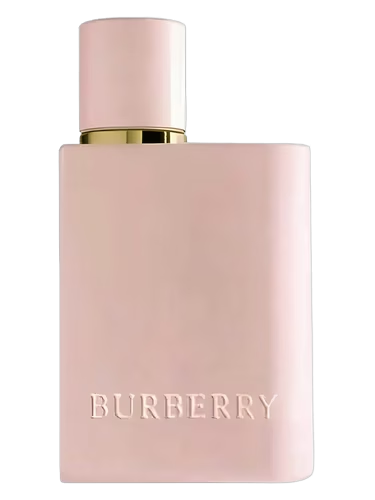
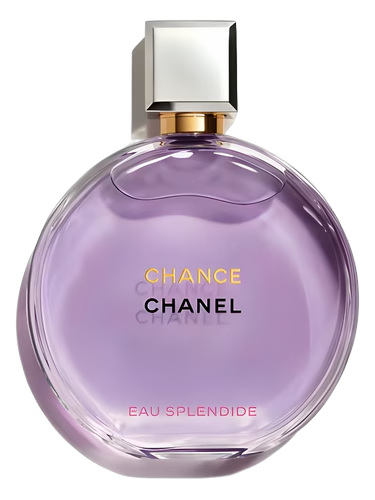
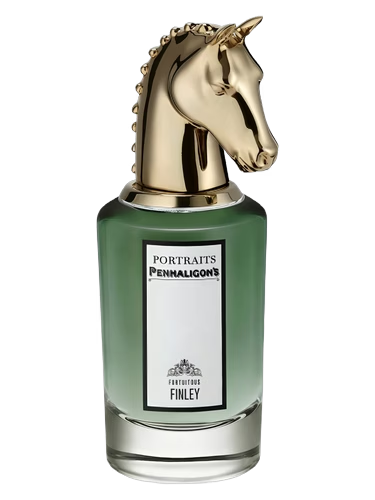
What is Ornithogalum?
Ornithogalum, commonly known as Star-of-Bethlehem, is a white floral note used in modern perfumery, native to Southern Europe, Northern Africa, and Western Asia.What does Ornithogalum smell like?
It features a strong, intensely honeyed, and lush aroma with luminous, slightly narcotic white flower nuances that add radiant depth and sweetness to compositions.How is Ornithogalum essence extracted?
The essence is traditionally obtained through maceration and percolation, while modern techniques often utilize ultrasound-assisted extraction to improve purity and yield.When is Ornithogalum in season?
These flowers typically bloom in late spring and early summer, specifically during May and June, and are known to open only when the sun is shining.What are some top perfumes featuring Ornithogalum?
A notable fragrance featuring this rare floral note is Gritti Seta, where it is used to provide a sophisticated and radiant floral core.