Fragrance Notes Are Layers Of Scent That Are Layered To Form The Final Fragrance. Fragrance Notes Are Categorised Into Three Main Elements Based On How Long They Take To Evaporate, And How Long They Typically Last Following Application: Top Notes, Heart Notes And Base Notes.
Orchid Cactus
Orchid Cactus offers a sophisticated, creamy white floral profile, often described as fluffy and angelic. It combines the intense, sweet fragrance of flowers (like jasmine/mogra) with delicate gourmand nuances of milk and sweet vanilla. It can also feature a mildly phenolic opening or subtle fruity/citrus undertones.

Origin & Extraction Of Orchid Cactus
The use of Orchid Cactus (often referring to the Queen of the Night cactus, *Epiphyllum oxypetalum*) as a specific note in perfumery is a relatively modern development, as perfumers increasingly seek unique and complex floral profiles beyond traditional ingredients. Since the flower blooms only at night and has a fleeting, intense, creamy, white-floral aroma, its scent profile is almost always created using headspace technology and synthetic reconstruction. This allows perfumers to capture its delicate, 'fluffy' scent, which blends white floral intensity (similar to jasmine or tuberose) with subtle gourmand or vanilla-like undertones, giving it a sophisticated, contemporary appeal.
While the note lacks the centuries of history associated with classic French perfume ingredients like rose or neroli, its synthetic interpretation has allowed it to find a place in diverse modern compositions. It is primarily used to add a unique luminous sweetness and creamy texture, bridging intense floral hearts with soft, gourmand bases. Its rise reflects a trend towards utilizing rare and complex floral scents, making it a distinctive element in contemporary designer and niche fragrances aiming for an elegant, enveloping sweetness.
Extraction Methods of Orchid Cactus
The primary method for extracting the aromatic essence of the orchid cactus (Epiphyllum oxypetalum), also known as Queen of the Night, is solvent extraction. Because the flowers are incredibly delicate and bloom only for a single night, traditional steam distillation is often avoided as the high heat can destroy the fragile volatile compounds. Solvent extraction involves saturating the petals in a hydrocarbon solvent like hexane to create a concrete, which is then refined with alcohol to produce a highly fragrant absolute that captures the flower's ethereal, spicy-sweet scent.
Historically, capturing the scent of such elusive and fragile blooms was achieved through enfleurage. This labor-intensive traditional method involved placing fresh flower petals onto layers of purified animal or vegetable fat. Over several days, the fat would absorb the plant's essential oils, and the depleted petals would be replaced with fresh ones until the fat reached the desired saturation, after which the fragrance was extracted using alcohol. In modern perfumery, latest methods include supercritical CO2 extraction and headspace technology. CO2 extraction uses pressurized carbon dioxide in a liquid state as a solvent at lower temperatures, preserving more of the plant's original chemical profile and resulting in a truer-to-nature scent. Headspace technology allows for the capture of the aromatic molecules directly from the living flower in the air, providing a precise chemical "fingerprint" of the scent without harvesting the rare bloom.
The Orchid Cactus note offers a unique, creamy white floral profile that is often deployed to add a sophisticated, almost 'angelic' sweetness to compositions. While many contemporary niche and designer fragrances are exploring this note, one of the earliest and most notable appearances is found in the classic men's scent, **The Dreamer** by Versace. Here, the floral creaminess contrasts against tobacco and amber notes, providing an unexpected soft, luminous counterpoint that defines the fragrance's enduring appeal.
- * * *
In modern perfumery, the Orchid Cactus note is valued for its ability to bridge intense floral sweetness with delicate gourmand nuances of vanilla and milk. This versatile character allows it to appear in diverse fragrance groups. For example, it is mentioned in connection with fragrances like Jean Paul Gaultier's **Scandal Pour Homme Absolu**, where it likely supports the sweet, oriental structure, lending a smooth, fluffy texture to the overall composition.
- * * *
Although it is primarily a rich floral ingredient, the sophisticated, slightly fruity/citrus undertones of Orchid Cactus make it suitable for bracing fresh compositions as well. Its inclusion is occasionally linked to fragrances like Creed’s **Green Irish Tweed**, where it functions as a subtle background element, enhancing the complexity of the fresh, green, and woody core by adding a trace of luminous, creamy floral depth without sacrificing the masculine structure.
Sustainability Of Orchid Cactus
Sustainability of Orchid Cactus
- Promoting eco-friendly cultivation by utilizing plastic-negative and sustainable packaging for plant delivery to minimize environmental impact
- Supporting carbon sequestration through the cultivation of cacti as land-based carbon sinks that efficiently remove CO2 from the atmosphere
- Adoption of water-efficient gardening practices, as these resilient epiphytes require significantly less water than traditional ornamental crops
- Advancing circular economy principles by upcycling plant cuttings for easy propagation, reducing the need for new nursery stock and resource consumption
- Implementation of organic care methods, including the use of natural fertilizers and well-draining peat-free soil mixes, to maintain soil health and biodiversity
Trivia
Despite their name and orchid-like appearance, orchid cacti produce edible fruit that closely resembles a small pitaya (dragon fruit).
Most Popular Scents Using Orchid Cactus


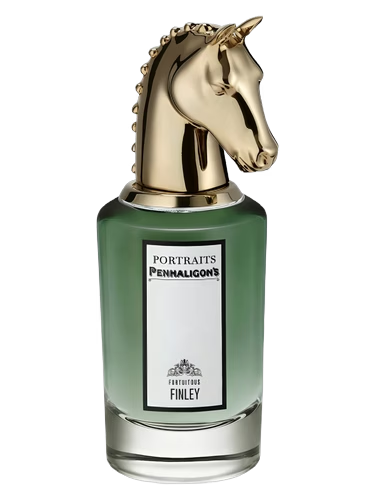
What is Orchid Cactus?
Orchid Cactus, primarily referring to the Queen of the Night (Epiphyllum oxypetalum), is a nocturnal-blooming plant known for its fleeting, intense, and creamy white floral aroma.What does Orchid Cactus smell like?
It offers a sophisticated, creamy white floral profile described as fluffy and angelic, blending jasmine-like intensity with delicate gourmand nuances of milk and sweet vanilla.How is Orchid Cactus essence extracted?
Because the blooms are delicate and short-lived, the scent is captured using solvent extraction to create an absolute, or via headspace technology and CO2 extraction to preserve its true chemical fingerprint.What are some top perfumes featuring Orchid Cactus?
Notable fragrances include Versace’s The Dreamer, Jean Paul Gaultier’s Scandal Pour Homme Absolu, and Mugler Alien Goddess Supra Florale.When is Orchid Cactus in season?
The plant typically blooms from late spring to early summer, often peaking between April and June, with individual flowers opening for only a single night.