Fragrance Notes Are Layers Of Scent That Are Layered To Form The Final Fragrance. Fragrance Notes Are Categorised Into Three Main Elements Based On How Long They Take To Evaporate, And How Long They Typically Last Following Application: Top Notes, Heart Notes And Base Notes.
Opium
A rich, Oriental Spicy profile: opulent and intoxicating. It features striking top notes of mandarin and bergamot, leading to a mystical heart of jasmine and myrrh. The scent is grounded by a sensual, deep base of resinous opopanax, warm amber, and earthy patchouli and vanilla.

Origin & Extraction Of Opium
The Opium note is inextricably linked to the legendary perfume Opium by Yves Saint Laurent (1977). This groundbreaking fragrance, which caused controversy upon its release, defined the heady, rich Oriental Spicy category. While the core "Opium" note is complex, incorporating elements of the scent profile itself—such as the prominent mandarin, myrrh, patchouli, and opopanax—it represented an intoxicating, powerful, and deeply sensual style that stood in stark contrast to the light fragrances of the era. The massive success of Opium solidified the dark, resinous, and narcotic profile as a classic pillar of perfumery.
The complex "Oriental Spicy" archetype that the Opium note represents can also be found in many other major historical releases, sharing a foundation of deep resins, amber, patchouli, and spices. Estée Lauder’s earlier, seminal Youth-Dew and Cinnabar echoed this bold, warm, and spicy profile, paving the way for the Opium generation. Even older fragrances like Guerlain’s monumental Shalimar and Habit Rouge share the core DNA of deep, warm, resinous notes that characterize this powerful, influential, and everlasting scent family, ensuring the legacy of this spicy-resin style continues in modern perfumery.
Extraction Methods of Opium
The primary method for extracting raw opium is the traditional process of incision and collection, which has remained largely unchanged since ancient times. Approximately three months after planting, once the poppy petals fall away, farmers use a special curved knife to make shallow vertical or horizontal slits (scoring) in the unripe seed capsules. This causes an opaque, milky sap or latex to exude, which thickens and darkens into a brownish-black gum as it air-dries on the pod overnight. This sticky residue is then manually scraped off and formed into bricks or cakes for transport.
In modern industrial and pharmaceutical production, the "poppy straw" method is often used to extract alkaloids like morphine directly from the dried plant material. Instead of scoring individual pods, the mature plant (pods and stems) is harvested and crushed. These dried heads are treated with aqueous or binary solvents, such as isobutanol mixed with water and alkali, to dissolve the alkaloids. Advanced techniques like solid-phase extraction, ultrasound-assisted extraction, and high-performance liquid chromatography (HPLC) are now employed in laboratory settings to refine, purify, and verify the concentration of specific opium alkaloids with high precision.
The Opium note is inextricably linked to the legendary perfume **Opium** by Yves Saint Laurent (1977). This groundbreaking fragrance, which caused controversy upon its release, defined the heady, rich Oriental Spicy category. While the core "Opium" note is complex, incorporating elements of the scent profile itself—such as the prominent mandarin, myrrh, patchouli, and opopanax—it represented an intoxicating, powerful, and deeply sensual style that stood in stark contrast to the light fragrances of the era. The massive success of **Opium** solidified the dark, resinous, and narcotic profile as a classic pillar of perfumery.
- **Opium** (YSL, 1977)
- **Cinnabar** (Estée Lauder, 1978)
- **Youth-Dew** (Estée Lauder, 1953)
While the original **Opium** is the most famous association, the complex "Oriental Spicy" archetype, which the note represents, can be found in many other major historical releases. These fragrances often share a similar foundation of deep resins, amber, patchouli, and spices. For example, **Cinnabar** by Estée Lauder, launched shortly after YSL’s masterpiece, echoed this bold, warm, and spicy profile. Similarly, Estée Lauder’s earlier, seminal **Youth-Dew** employed a dense, resinous, and opulent character that paved the way for the Opium generation, demonstrating the enduring appeal of this intoxicating scent family.
- **Shalimar** (Guerlain, 1925)
- **Habit Rouge** (Guerlain, 1965)
- **Coco Eau de Parfum** (Chanel, 1984)
Modern interpretations, although not always explicitly named "Opium," often refer to this spicy-resin style, ensuring its legacy continues. The Opium family paved the way for many other successful, intense Oriental fragrances, including classics like **Coco Eau de Parfum** by Chanel, which uses rich spices and resins for an opulent effect. Even older fragrances like Guerlain’s monumental **Shalimar** and **Habit Rouge** share the core DNA of deep, warm, resinous notes that characterize this powerful, influential, and everlasting perfume note.
Sustainability Of Opium
Sustainability of Opium
- Mitigating environmental degradation caused by illicit cultivation, including deforestation, soil erosion, biodiversity loss, and water depletion in ecologically fragile regions
- Reducing the carbon footprint of pharmaceutical production by optimizing final manufacturing stages and packaging, which account for the majority of CO2 emissions
- Promoting alternative development programs that support smallholder farmers in transitioning from poppy cultivation to sustainable high-value crops like coffee, saffron, and avocados
- Implementing community-based forest management and agroforestry initiatives to restore ecosystems and provide legitimate, stable livelihoods
- Advocating for environmentally just drug policies that replace forced eradication with sustainable agricultural transitions and resource conservation
Trivia
The 1977 launch of Opium was so successful that despite being priced higher than Chanel No. 5, every bottle sold out within hours, and the fragrance was even reportedly banned in several countries due to its controversial drug-related name.
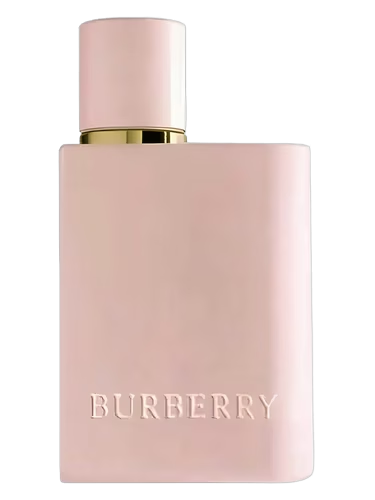
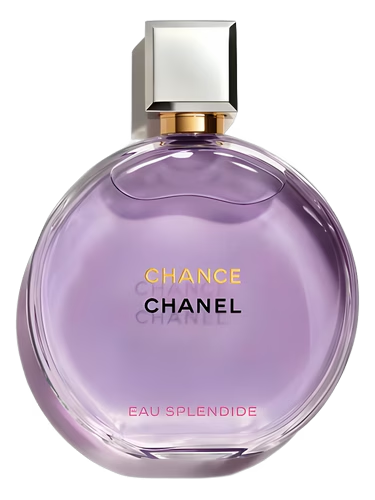
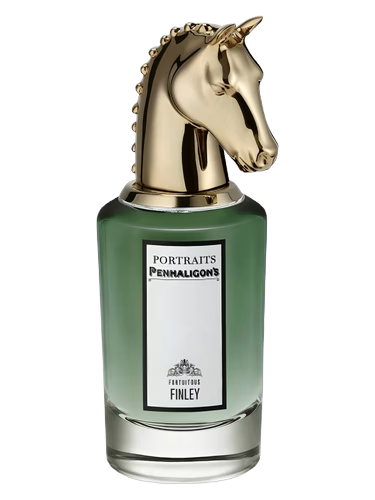
Most Popular Scents Using Opium
What is Opium?
In perfumery, Opium is a fantasy accord designed to evoke a dark, narcotic, and opulent atmosphere. It is not a direct botanical extract from the poppy plant, but rather a synthetic reconstruction of resins, spices, and florals.What does Opium smell like?
It offers a rich, Oriental Spicy profile that is deep and intoxicating. The scent features a balsamic warmth with notes of mandarin, myrrh, jasmine, and clove, grounded by a sensual base of amber, patchouli, and vanilla.How is the Opium accord created?
Since natural opium latex is a controlled substance not used in fragrance, perfumers build the accord using materials like labdanum, benzoin, eugenol, and jasmine absolute to mimic the cultural idea of a narcotic, resinous scent.What are some top perfumes featuring the Opium note?
The note is most famously represented by the Yves Saint Laurent Opium collection, including the original Opium, Black Opium, and Opium pour Homme. Other historical examples with similar spicy-resinous DNA include Estée Lauder’s Cinnabar and Youth-Dew.When is the best time to wear Opium fragrances?
Due to its heavy, warm, and spicy character, Opium is ideally suited for the fall and winter seasons. Its sophisticated and bold nature also makes it a popular choice for evening wear and special occasions.