Fragrance Notes Are Layers Of Scent That Are Layered To Form The Final Fragrance. Fragrance Notes Are Categorised Into Three Main Elements Based On How Long They Take To Evaporate, And How Long They Typically Last Following Application: Top Notes, Heart Notes And Base Notes.
Olive flower
Olive flower offers a delicate, green-floral, and slightly sweet aroma, often possessing ethereal, creamy, and subtly honeyed facets. It captures the gentle scent of Mediterranean spring, suggesting luminous white petals with soft, clean, and tender green undertones, used to add freshness and soft luminosity.

Origin & Extraction Of Olive flower
The use of Olive flower (Olea europaea) in historical perfumery is not as foundational as notes derived from classic Mediterranean plants, like citrus (Bergamot) or white florals (Jasmine). For centuries, the olive tree was primarily valued for its oil in culinary, medicinal, and religious applications, rather than the delicate, ephemeral scent of its tiny blossoms. As a specific, isolated note, Olive flower emerged much later in fine fragrance, coinciding with a modern trend that began in the late 20th and early 21st centuries. This shift saw perfumers seeking more nuanced, photorealistic, and regionally specific green-floral notes to evoke the sophisticated terroir of the Mediterranean landscape.
The Olive flower note gained notable prominence as a contemporary element used to bridge traditional white floral structures with green and aromatic facets. Its soft, slightly creamy, and subtle honeyed aroma makes it an elegant contrast or supporting heart note, particularly in fragrances aiming for a clean, luminous, and refined character. Its famous incorporation in major designer scents like Giorgio Armani's *Armani Code* in the early 2000s cemented its status as a sophisticated ingredient that adds depth and ethereal freshness beyond conventional floral components.
Extraction Methods of Olive Flower
Historically, the aromatic compounds of olive flowers have been captured through traditional hydro-distillation and maceration techniques. In hydro-distillation, the delicate flowers are submerged in water and heated, allowing the steam to carry the volatile oils to a condenser where they are collected as a hydrosol or a thin layer of essential oil. Maceration, another ancient method, involved soaking the blossoms in a carrier oil for several weeks to slowly infuse the oil with the flower's subtle, honey-like fragrance. Another traditional approach for delicate blossoms was enfleurage, where flowers were placed on layers of purified animal or vegetable fat to absorb their scent over several days.
In modern perfumery, while steam distillation remains a common practice for isolating essential oils from flowers and leaves, advanced methods like solvent extraction are more frequently used to produce olive flower absolutes. This process involves using a solvent such as hexane to dissolve the aromatic molecules, resulting in a highly concentrated "concrete" that is later refined with alcohol. Additionally, cutting-edge technologies like supercritical CO2 extraction have emerged as a superior method for capturing the flower's most volatile and heat-sensitive components. By using carbon dioxide in a pressurized, liquid-like state at low temperatures, producers can extract a pure, high-quality essence that more accurately reflects the natural scent of the living olive blossom without the risk of thermal degradation or solvent residue.
The Olive flower note, prized for its delicate, green-floral, and slightly sweet aroma, is notably utilized in contemporary perfumery to add a luminous, Mediterranean touch. One of the most famous fragrances to feature this note is Giorgio Armani's seminal masculine scent, Armani Code (2004). In Armani Code, the olive flower is instrumental in providing an unexpected, soft, and slightly creamy floral heart, offering a sophisticated contrast to the opening notes of lemon and bergamot and the deeper, warmer base of tonka bean and leather. This inclusion elevates the fragrance beyond a typical oriental blend, injecting a touch of ethereal freshness.
In niche perfumery, the Olive flower is often celebrated for its ability to convey the authentic scent of the Mediterranean spring. A prominent example is Fiore d'Ulivo by Xerjoff (2009). This fragrance focuses intensely on the olive flower, using it to create a radiant, sophisticated floral composition. The note's creamy and subtly honeyed facets are amplified here, blending seamlessly with lighter citruses and white florals to capture the scent of sun-drenched olive groves. The use of Olive flower in Fiore d'Ulivo showcases its elegance and tenderness as a central theme.
The versatility of the Olive flower note allows it to contribute unique complexity to a variety of fragrance styles. In Seville a l'Aube by L'Artisan Parfumeur (2012), the note is woven into a rich, narrative composition inspired by Seville's Holy Week. Here, the Olive flower's green-floral sweetness enhances the core accord of orange blossom, contributing to the scent's creamy, almost ethereal quality, which is then deepened by incense and beeswax. This example demonstrates how the Olive flower can serve as an elegant supporting element, bridging bright white florals with heavier, balsamic notes.
Sustainability Of Olive flower
Sustainability of Olive Flower
- Promoting climate change mitigation through carbon sequestration as olive trees act as stable carbon sinks for decades or even millennia
- Enhancing soil health and preventing erosion via extensive root systems that stabilize land and improve soil structure in arid regions
- Supporting biodiversity by creating micro-ecosystems that provide habitats for birds, insects, and pollinators like bees and butterflies
- Advancing a circular economy by repurposing olive by-products, such as pomace and leaves, into animal feed, organic fertilizers, and bioenergy
- Conserving water resources through the cultivation of drought-resistant trees and the implementation of precision irrigation and rainwater harvesting
- Fostering socio-economic resilience by supporting traditional low-impact farming techniques and establishing sustainability standards for growers
Trivia
The olive flower is a traditional symbol of peace and abundance, yet its delicate white blossoms are rarely distilled for essential oil; instead, perfumers often have to artistically recreate its unique scent—a subtle blend of licorice-like floral notes with creamy, powdery undertones—using synthetic accords.
Most Popular Scents Using Olive flower
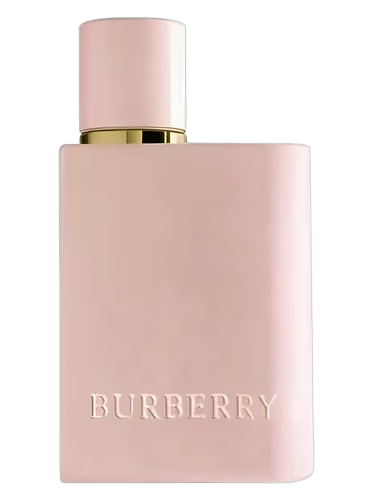
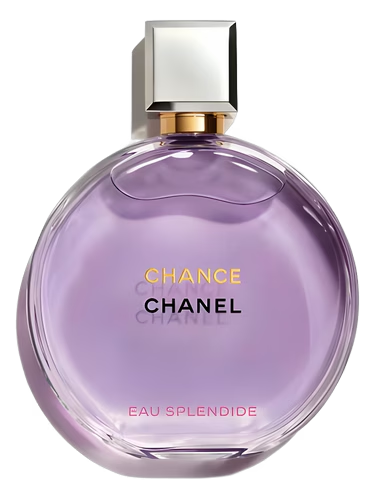
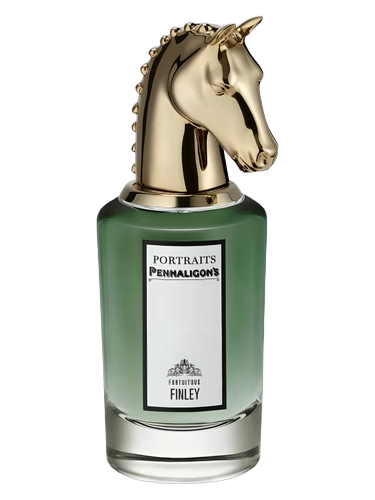
What is Olive Flower?
The olive flower is the small, delicate, cream-colored blossom of the Olea europaea tree, traditionally symbolizing peace and serving as the precursor to the olive fruit.What does Olive flower smell like?
It offers a soft, green-floral aroma with ethereal, creamy, and subtly honeyed facets, often described as having a faint jasmine-like sweetness or a waxy, Mediterranean freshness.How is Olive flower essence extracted?
While historically captured via hydro-distillation or maceration, modern perfumery primarily uses solvent extraction to create absolutes or supercritical CO2 extraction to preserve its most delicate, heat-sensitive compounds.What are some top perfumes featuring Olive flower?
Notable fragrances include Giorgio Armani Armani Code, Xerjoff Fiore d'Ulivo, L'Artisan Parfumeur Seville a l'Aube, and Demeter Olive Flower.When is Olive flower in season?
Olive trees typically bloom in the spring, with the primary flowering phase occurring from late April to early June, depending on the climate and cultivar.