Fragrance Notes Are Layers Of Scent That Are Layered To Form The Final Fragrance. Fragrance Notes Are Categorised Into Three Main Elements Based On How Long They Take To Evaporate, And How Long They Typically Last Following Application: Top Notes, Heart Notes And Base Notes.
Olive
Olive offers an oleaginous, slightly bitter note in perfumery, reminiscent of the Olea europaea tree and edible olives. It provides a unique, green, and subtly savory texture, often used to add depth and an unexpected Mediterranean freshness to compositions.

Origin & Extraction Of Olive
The olive tree (Olea europaea) has a deep historical and cultural resonance across the Mediterranean, utilized since ancient times for its oil in ceremonies, hygiene, and as a base for early perfumed unguents. However, the use of a distinct "Olive" note—capturing the specific oleaginous, green, and slightly bitter scent of the fruit or the wood—is relatively modern in fine perfumery. For centuries, perfumery focused on volatile florals, resins, and citruses; the subtle, savory scent of the olive required modern extraction techniques and a shift in aesthetic preference to be appreciated as a note.
The rise of the Olive note in contemporary fragrance compositions reflects a trend toward more abstract, naturalistic, and Mediterranean-inspired scents. Perfumers use it strategically to introduce an unexpected savory green texture, often blending it with fig leaf, woods, or aromatic herbs to evoke the feeling of the dry, sun-drenched landscape. It provides an unusual depth, moving beyond traditional sweet or sharp categories and serving primarily as a sophisticated heart or base note rather than a historical top note like traditional citrus.
The core process of extracting olive oil has remained largely unchanged for millennia: harvesting the fruit, crushing it into a paste, and separating the oil from the solids and water. Historically, this was achieved through stone grinding and hydraulic mat pressing. Olives were crushed by revolving millstones, and the resulting paste was spread onto woven mats. These mats were stacked and squeezed in a press, allowing the liquid to run off into basins where the oil was manually skimmed from the surface after settling.
In modern commercial production, the traditional batch-based pressing has been largely superseded by continuous centrifugation systems. After being cleaned and washed, olives are crushed using stainless steel hammer mills or rollers. The paste then undergoes malaxation—a critical step where it is slowly churned at controlled temperatures (ideally below 27-30°C for "cold extraction") to encourage oil droplets to coalesce. The oil is then separated from the pomace and vegetation water using high-speed industrial decanters and vertical centrifuges. Latest advancements include the use of nitrogen-controlled atmospheres during malaxation to prevent oxidation, and the integral method, which involves removing the pits before extraction to produce a less bitter, higher-quality oil.
The Olive note, characterized by its oleaginous, green, and subtly savory texture, is a sophisticated ingredient in modern perfumery, often used to evoke the sun-drenched, rustic landscape of the Mediterranean. Unlike volatile citrus notes, Olive provides a unique depth and unexpected freshness, functioning primarily as a heart or base note to stabilize and enrich a composition. Its application signals a movement toward abstract, naturalistic scents that move beyond traditional sweet or sharp fragrance categories.
- The note can be found in niche and artistic fragrances, such as A Grove by The Sea by Arquiste (2024), which likely uses the Olive note to enhance a sense of place and natural scenery.
- Similarly, 201 Ulivo by LabSolue suggests an Olive-centric focus, highlighting the pure essence of the olive tree (ulivo being Italian for olive tree) in a unisex composition.
- The inclusion of Olive in fragrances like Vivacite(s) de Bach and To Bring You My Love demonstrates its versatility, where it may be used to provide an earthy, green counterpoint to other notes.
While the Olive note is not a historical cornerstone like Bergamot or Rose, its contemporary prominence reflects perfumers' desire to create complex, naturalistic, and evocative textures. When combined with fig leaf, aromatic herbs, or woody bases, the olive creates a green, slightly bitter dimension, lending an air of refinement and unexpected savory interest to the final scent profile. This characteristic complexity is what makes it a prized element in high-end, modern compositions.
Sustainability Of Olive
Sustainability of Olive
- Implementing regenerative soil management practices such as cover cropping, mulching, and reduced tilling to prevent erosion and increase organic carbon sequestration
- Adopting precision irrigation technologies, including underground drip systems and soil moisture sensors, to reduce water consumption and minimize evaporation
- Promoting a circular economy by upcycling olive mill by-products into nutrient-rich compost, biofuels, and biodegradable packaging materials
- Integrating biological pest control and organic fertilization to reduce reliance on synthetic chemicals and protect local biodiversity
- Utilizing renewable energy sources, such as solar panels and biomass from pruning residues, to power irrigation and milling operations
Trivia
The olive tree is so hardy that it can live for over 1,000 years and has a robust root system capable of regenerating the entire tree even if its above-ground structure is completely destroyed.
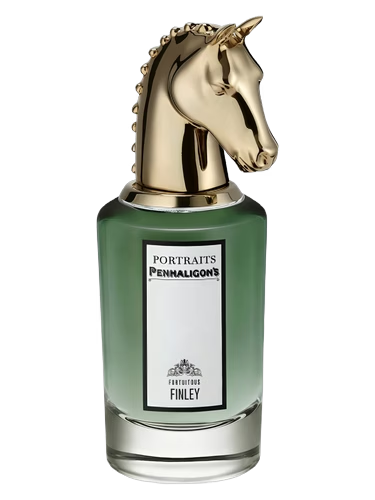
Most Popular Scents Using Olive


What is the Olive note?
The Olive note is a fragrance ingredient derived from the Olea europaea tree, capturing the oleaginous, green, and slightly bitter scent of its fruit and wood.What does Olive smell like in perfumes?
It offers a unique, green, and subtly savory profile with a distinct oily texture, providing a sophisticated Mediterranean freshness that is less sweet than traditional fruit notes.How is Olive essence extracted?
The oil is primarily obtained through cold expression (pressing) of the fruit, a process involving crushing the olives into a paste and separating the oil via centrifugation or traditional mat pressing.What are some top perfumes featuring the Olive note?
Notable fragrances include Tom Ford Cherry Smoke, Arquiste A Grove by The Sea, Xerjoff Fiore d’Ulivo, and LabSolue 201 Ulivo.When is the Olive harvest season?
The harvest typically occurs during autumn and winter, from October through February, with early harvests yielding sharper, peppery notes and late harvests producing milder, buttery aromas.