Fragrance Notes Are Layers Of Scent That Are Layered To Form The Final Fragrance. Fragrance Notes Are Categorised Into Three Main Elements Based On How Long They Take To Evaporate, And How Long They Typically Last Following Application: Top Notes, Heart Notes And Base Notes.
Narcissus
Narcissus offers a complex floral, green, and narcotic aroma. It features the scent of spring daffodils and green stems, deepened by notes of hay, honey, and a musky, animalic element that provides a lingering, floral musk quality, often used as a middle to base note in perfumery.

Origin & Extraction Of Narcissus
Narcissus has a rich and ancient history in perfumery, dating back millennia. Ancient civilizations, including the Arabs and Romans, prized the flower's essence, with the Romans creating a perfume known as *Narcissinum*. In India, the oil was used in ritual body applications, often alongside notes like jasmine and rose. The flower's name itself is rooted in the Greek word 'narke' ('to be numb'), alluding to its potent oil, and is famously linked to the Greek myth of the youth Narcissus, who was transformed into the flower after falling in love with his own reflection.
In Western perfumery, Narcissus is a cornerstone of classic compositions, notably appearing in the great white florals of the early 20th century, such as Caron's *Narcisse Noir* and Guerlain's *Vol de Nuit*. The essential oil, or absolute, is primarily extracted from species like the Poet's Narcissus (*N. poeticus*), *N. tazetta*, and *N. jonquil*, grown in regions like Grasse, France. Due to its labor-intensive, low-yield extraction, it remains a highly prized and expensive natural ingredient, valued for its complex and multifaceted aroma that expertly bridges floral, green, honeyed, and bold animalic/musky notes.
The primary method for extracting the essence of narcissus is solvent extraction, as the delicate aromatic compounds and heat-sensitive esters are often destroyed by traditional steam distillation. Historically, this process involved macerating fresh flowers in hydrocarbon solvents like hexane or petroleum ether to create a waxy concrete. This concrete is then washed with ethanol, chilled to precipitate plant waxes, and filtered to yield a highly concentrated and expensive absolute. Enfleurage, an ancient method where petals were layered on odorless fats to absorb their scent, was also once used for these delicate blooms but is now largely obsolete due to its labor-intensive nature.
In modern production, advanced technologies such as supercritical CO2 extraction have emerged as a cleaner, more efficient alternative. This process uses pressurized carbon dioxide as a "green" solvent to extract volatile fragrance compounds at low temperatures, avoiding thermal degradation and leaving no chemical residue. Additionally, recent developments in organic extraction (hexane-free) and the use of ultrasonic-assisted filtration have been implemented to enhance the purity and sustainability of the final absolute, which remains one of the most precious materials in fine perfumery.
Narcissus is a highly cherished, complex floral note in classical perfumery, adding a distinct green, honeyed, and subtly animalic depth. Its use often indicates a sophisticated, carefully crafted scent, distinguishing it from simpler floral compositions. One of the most iconic perfumes to feature this note prominently is Diorissimo, where its bright, green facets are beautifully juxtaposed with lily-of-the-valley, though some interpretations of the note often favor its more narcotic qualities.
- In the world of niche and artisanal perfumery, Narcissus is employed to evoke specific natural scenes, from spring meadows to humid gardens. The note lends a unique hay-like sweetness and an earthy quality that grounds a fragrance, giving it incredible longevity and a natural feel.
A more intense and celebrated representation of the Narcissus note can be found in Ostara by Penhaligon's, which captured the entire life cycle of the daffodil, from green stems to the floral heart. For those who appreciate the animalic, slightly challenging aspects of the flower, fragrances like Vol de Nuit by Guerlain use it as a foundational element, blending it seamlessly with oakmoss and other complex notes to create a classic chypre structure.
- More recently, contemporary designers have revisited Narcissus for its versatility. The note can be rendered sparkling and green, or deep and intoxicating. For example, J'adore Absolu, while focusing on a bouquet of other flowers, contains facets that echo the daffodil's rich depth, contributing to the overall opulent floralcy.
The duality of Narcissus—being both fiercely green and sweetly narcotic—allows it to transcend typical floral categories. Its rich essential oil is rare and costly, cementing its status in luxury perfumery. Whether providing a vibrant green burst in the top notes or settling into a musky, honeyed base, Narcissus ensures a memorable and enduring sillage in many classic and modern masterpieces, including the esteemed Grand Amour by Goutal, where it is presented in a magnificent, melancholic light.
Sustainability Of Narcissus
Sustainability of Narcissus
- Utilizing underground bulbs as natural storage organs that allow the plant to survive adverse seasons and reduce the need for year-round intensive care
- Promoting water conservation through the cultivation of drought-tolerant varieties that thrive with minimal irrigation once established
- Supporting local biodiversity by providing pollinator-friendly blooms that attract bees and other beneficial insects in early spring
- Improving soil health and preventing erosion via deep root systems that aerate the earth and increase water penetration
- Reducing carbon footprints by favoring local growers and adopting sustainable farming practices like cutting foliage to the ground to keep soil alive without rototilling
- Developing new cultivars with enhanced resistance to diseases and pests to minimize the reliance on chemical crop protection
Trivia
It takes a staggering 500 kilograms of fresh flowers to produce just 300 grams of narcissus absolute, a ratio so low and costly that it is often referred to as liquid gold in the perfume world.
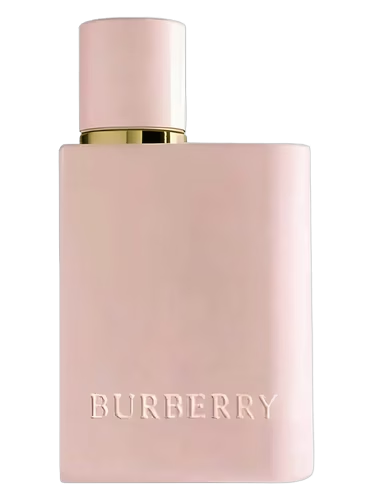
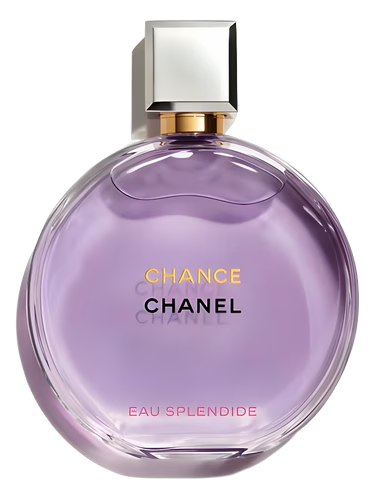
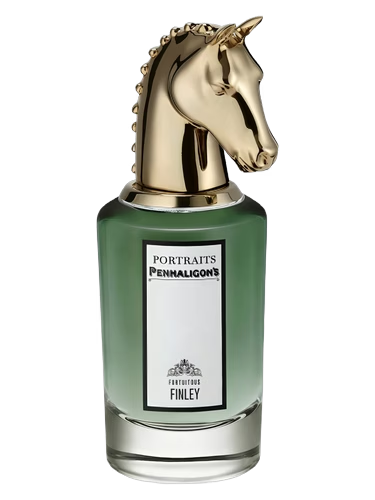
Most Popular Scents Using Narcissus
What is Narcissus?
Narcissus is a complex floral note derived from bulbous plants like the Poet's Narcissus and Jonquil, known for its multifaceted aroma that bridges green, honeyed, and musky facets.What does Narcissus smell like?
It offers a potent, narcotic scent featuring bright spring floral and green stem notes, deepened by undertones of hay, honey, and a distinct animalic, stable-like musk.How is Narcissus essence extracted?
The absolute is primarily obtained through solvent extraction of the fresh flowers to preserve delicate aromatic compounds that would be destroyed by heat.What are some top perfumes featuring Narcissus?
Notable fragrances include Penhaligon's Ostara, Caron Narcisse Noir, Diorissimo, Guerlain Vol de Nuit, and Givenchy L'Interdit Narcisse Blanc.When is Narcissus in season?
The flowers typically bloom in spring, with a peak display occurring between March and April, though some varieties may appear as early as December or as late as June.