Fragrance Notes Are Layers Of Scent That Are Layered To Form The Final Fragrance. Fragrance Notes Are Categorised Into Three Main Elements Based On How Long They Take To Evaporate, And How Long They Typically Last Following Application: Top Notes, Heart Notes And Base Notes.
Mushroom
Mushroom notes in perfumery are primarily earthy, fungal, and damp, evoking the rich aroma of a forest floor. They present complex nuances, ranging from fresh green and herbal to savory, metallic, and waxy. This unique profile adds a sophisticated, dark, and textural depth, blending well with woods and musty accords.

Origin & Extraction Of Mushroom
The use of true mushroom notes in perfumery is a modern and relatively rare phenomenon, often associated with niche and avant-garde fragrances. Historically, perfumery focused on volatile florals, resins, and musks. The earthy, damp, and sometimes savory aroma associated with fungi was not easily extracted or synthesized for use in classic compositions like Eaux de Cologne or traditional chypres. However, the conceptual use of earthy and damp accords—such as patchouli, vetiver, and oakmoss—has long provided the 'forest floor' foundation that contemporary mushroom notes seek to enhance or emulate.
Mushroom notes gained relevance in fine fragrance as perfumers began exploring darker, textural, and more realistic natural accords, particularly in the late 20th and early 21st centuries. These notes, which often involve complex synthesis to capture the scent of truffles or damp earth, provide sophistication and a unique sense of place. They are valued for their ability to bridge woody base notes with unusual gourmand or green elements, adding a sophisticated, almost metallic depth to compositions.
Extraction Methods of Mushroom
Historically, mushroom extraction has relied on hot water decoctions, a practice rooted in traditional medicine to break down the tough, indigestible chitinous cell walls and release water-soluble bioactive compounds like beta-glucans. This fundamental method, similar to brewing a potent tea or broth, involves simmering dried and ground mushroom fruiting bodies for extended periods to ensure the release of therapeutic constituents.
Modern commercial production typically utilizes a dual-extraction process to achieve a full-spectrum profile. This involves a primary hot water extraction followed by a secondary soak in a polar solvent, such as ethanol, to isolate water-insoluble compounds like triterpenoids and sterols. The resulting extracts are often concentrated through vacuum evaporation and then spray-dried or freeze-dried to create stable, highly potent powders.
The latest advancements in the field include ultrasonic-assisted extraction (UAE), which employs high-frequency sound waves to create acoustic cavitation. This process mechanically ruptures the fungal cell walls at lower temperatures, significantly increasing yield and reducing extraction time while preserving heat-sensitive molecules. Other sophisticated techniques, such as membrane separation and high-performance liquid chromatography (HPLC), are now standard for purifying and quantifying specific active markers to ensure consistency and pharmaceutical-grade quality.
Mushroom notes, prized for their earthy, damp, and fungal character, are typically reserved for highly complex and often niche compositions that aim to evoke the rich texture of a forest floor. One of the most famous examples featuring this evocative note is **Black Orchid** by Tom Ford. While not explicitly a mushroom-centric scent, the dense, earthy truffle accord within the composition often reads as a dark, slightly savory, and fungal mushroom note, contributing significantly to its opulent and mysterious character. This use demonstrates how the note adds a sophisticated, dark gourmand dimension.
In avant-garde perfumery, mushroom notes often appear in fragrances seeking a realistic, hyper-naturalistic damp earth accord. For instance, in certain releases by brands like Comme des Garçons or DS & Durga, the mushroom note enhances the realism of woody or mossy bases. The note is used to introduce a metallic or waxy fungal dimension, pulling the scent away from traditional floral structures and giving it a raw, textural depth. This approach positions the mushroom note as an essential bridge between rich wood notes and dark green or herbaceous elements.
Another area where the mushroom accord is utilized is in fragrances focused on the edible fungi, particularly truffle. While often listed simply as "truffle," the scent is intrinsically linked to the mushroom profile. A notable example is **Plein Soleil** by Yves Rocher, which utilizes an accord that evokes this dark, earthy, and sometimes savory mushroom quality to ground and enrich its floral and green aspects, offering a unique twist on a classic structure and adding sophisticated complexity to the opening or heart of the fragrance.
Sustainability Of Mushroom
Sustainability of Mushroom
- Utilizing advanced biotechnology to produce nature-identical fragrance molecules through microbial fermentation, reducing the need for resource-intensive harvesting
- Adopting mycelium-based materials as a plastic-free and fully biodegradable alternative to polystyrene and other polluting packaging plastics
- Promoting circular economy principles by upcycling agricultural waste, such as sawdust and coffee grounds, to grow fungi for packaging and fragrance extraction
- Reducing environmental footprints through energy-efficient growth methods that require minimal water, land, and light compared to traditional crops
- Leveraging lab-grown scent molecules to prevent the overharvesting of endangered plants and eliminate the need for animal-derived ingredients
- Implementing carbon sequestration strategies through symbiotic fungal relationships that help store carbon in the soil and reduce greenhouse gases
Trivia
While mushrooms are a staple in the fungal kingdom, they are uniquely distinguished in perfumery for the molecule 1-octen-3-ol, which provides a remarkably realistic "forest floor" aroma so potent that it is even found in the scent profile of certain aged wines like Burgundy and Barolo.
Most Popular Scents Using Mushroom
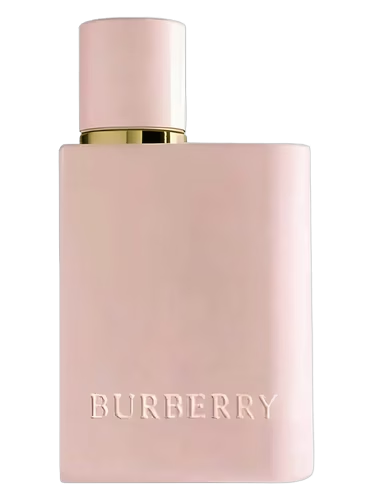
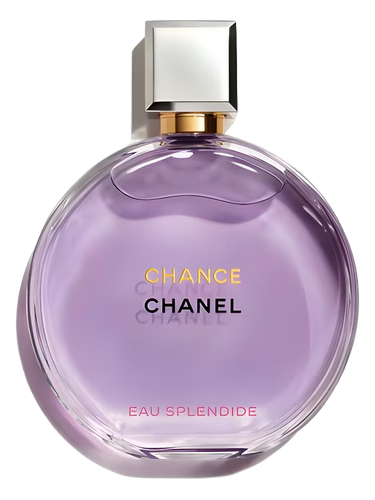
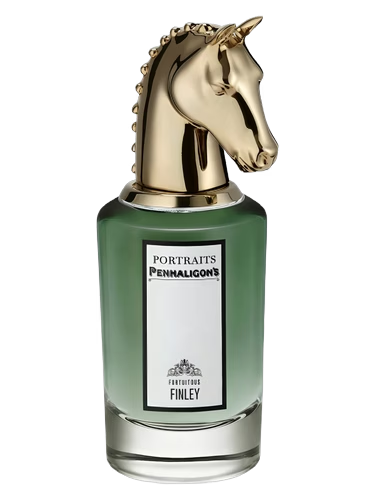
What is the Mushroom note in perfumery?
The mushroom note is a unique olfactory element used primarily in niche and avant-garde fragrances to evoke the earthy, damp, and fungal aroma of a forest floor.What does Mushroom smell like?
It possesses a complex profile that is primarily earthy and fungal, with nuances ranging from fresh green and herbal to savory, metallic, and waxy.How is the Mushroom essence extracted?
Modern production typically uses a dual-extraction process involving hot water decoction followed by a solvent soak, though advanced methods like ultrasonic-assisted extraction are increasingly used to preserve delicate molecules.What are some famous perfumes with a Mushroom note?
Notable fragrances include Tom Ford Black Orchid, which features a prominent truffle accord, Bohoboco Magic Mushrooms, and Clue Perfumery Morel Map.When are mushrooms in season?
While autumn is the peak season for many wild varieties like porcini and chanterelles, different species thrive year-round, from morels in spring to truffles in winter.