Fragrance Notes Are Layers Of Scent That Are Layered To Form The Final Fragrance. Fragrance Notes Are Categorised Into Three Main Elements Based On How Long They Take To Evaporate, And How Long They Typically Last Following Application: Top Notes, Heart Notes And Base Notes.
Morning Glory Flower
Morning Glory Flower offers a delicate, mildly sweet, and fresh floral aroma. It captures the essence of "morning air" with a crisp, green, and slightly aquatic transparency. The scent is often described as uplifting and luminous, sometimes featuring powdery nuances, lending a clean and ethereal freshness to compositions.

Origin & Extraction Of Morning Glory Flower
The Morning Glory flower (Ipomoea) note is a relatively modern and specialized addition to the perfumer's palette, lacking the centuries-old tradition associated with classic ingredients like Rose or Bergamot. Since the flower itself is nearly odorless or has an extremely subtle scent, its representation in perfumery relies heavily on headspace technology and synthetic reconstruction. This note gained relevance as perfumers, particularly in the late 20th and early 21st centuries, started seeking ethereal, transparent, and "atmospheric" accords to capture the feeling of natural elements like clean air and morning dew, moving beyond heavy, traditional florals.
Its primary historical relevance stems from its strategic use in aquatic, sheer, and "fresh floral" compositions. Perfumers utilize the Morning Glory note—characterized by its crisp, green, and mildly sweet transparency—to convey an uplifting and luminous top-note effect. It has been adopted by contemporary designer and niche houses to offer a sense of effortless cleanliness and dewy freshness, perfectly complementing modern trends that prioritize lightness and non-sweet floral profiles over the opulent bouquets of the past.
Extraction Methods of Morning Glory
Historically, the extraction of morning glory essence, particularly for traditional uses as natural dyes or for medicinal purposes, relied on simple maceration and solvent-based techniques. These processes typically involved soaking fresh or dried flowers and seeds in solvents like warm water or alcohol to release pigments and active compounds. For harvesting seeds, traditional methods involve manual collection from dried seed pods, which are then crushed or ground to access the internal compounds, as swallowing whole seeds results in minimal effect.
Modern extraction methods have become significantly more sophisticated, utilizing advanced technologies to enhance yield and purity. Current commercial and laboratory practices employ ultrasonic-assisted extraction (UAE) and microwave-assisted extraction (MAE) to efficiently capture delicate aromatic molecules and alkaloids. For pigment production, modern techniques involve crushing dried flowers into a fine powder followed by controlled heating, ultrasonic treatment, and centrifugal separation to remove impurities. Recent developments also include the use of supercritical CO2 extraction and advanced purification steps like column chromatography and ion-exchange resins to isolate specific high-purity compounds like galactomannan or ergot alkaloids for pharmaceutical and industrial applications.
The Morning Glory Flower note, with its delicate, airy, and slightly aquatic freshness, is often utilized by perfumers to capture the essence of a clean, dewy morning. While it is not as foundational as classic floral notes like rose or jasmine, it lends a unique, ethereal transparency to modern fragrances, particularly within the fresh floral and aquatic categories. It helps create a luminous, uplifting opening, providing a subtle green accent rather than a heavy sweetness.
- Morning Glory Flower is featured prominently in fragrances seeking a soft, nostalgic freshness. One notable example is **Gucci Bloom Acqua di Fiori**, which uses the note to accentuate a modern, green interpretation of the classic white floral bouquet.
- Another fragrance that often incorporates this note for its light, slightly powdery quality is **Jil Sander Sun Delight**, where it provides an airy contrast to the warmer, solar notes.
Its application is particularly effective in springtime or summer compositions where the goal is a scent that feels weightless and clean. The note's characteristic green and aquatic nuances allow it to blend seamlessly with white tea, cyclamen, and various musks, resulting in a scent profile that evokes freshly laundered linens or the first dew of the day, making it popular in both high-end designer scents and fresh body mists.
- In the world of niche perfumery, Morning Glory appears in sophisticated blends like **Jo Malone Bluebells**, where its delicate freshness supports the main green and sweet floral accord.
Ultimately, the inclusion of Morning Glory Flower signifies a focus on sophisticated simplicity and natural luminosity. Perfumers choose this note when they want to avoid heavy florals, instead opting for a sparkling, "just-out-of-the-shower" clean effect that remains effortlessly chic and refreshing throughout the wear time, solidifying its place as a key component in the contemporary quest for transparent freshness.
Sustainability Of Morning Glory Flower
Sustainability of Morning Glory
- Providing passive cooling for buildings by utilizing rapid-growing vines on trellises to create summer shade and reduce energy consumption for climate control
- Supporting urban biodiversity and local ecosystems by attracting and providing nectar for essential pollinators such as hummingbirds, bees, butterflies, and moths
- Enhancing soil stability on slopes through the use of native varieties like the California Morning Glory, which serves as an effective natural slope retainer
- Implementing responsible garden management by selecting non-invasive cultivars and deadheading spent flowers to prevent unwanted self-seeding and agricultural competition
- Promoting sustainable weed management by manually pulling young vines rather than relying on chemical herbicides to control growth
Trivia
More than 3,000 years before Charles Goodyear discovered vulcanization, ancient Mesoamericans used the sulfur-rich juice of the morning glory to turn raw latex into bouncy rubber balls.
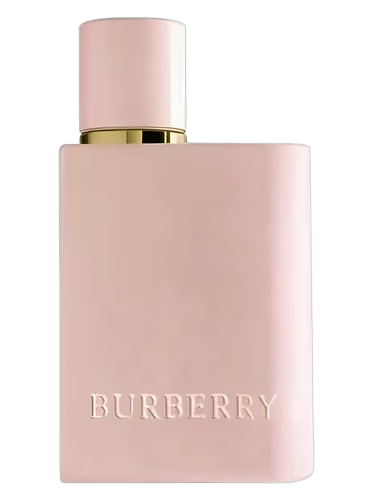
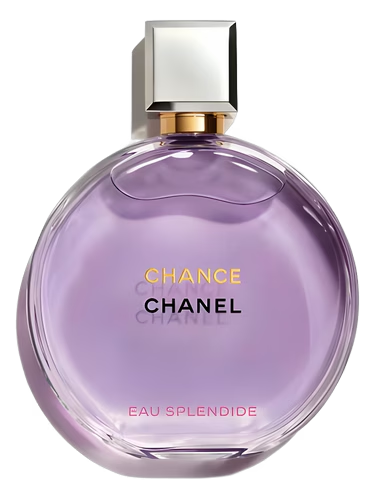
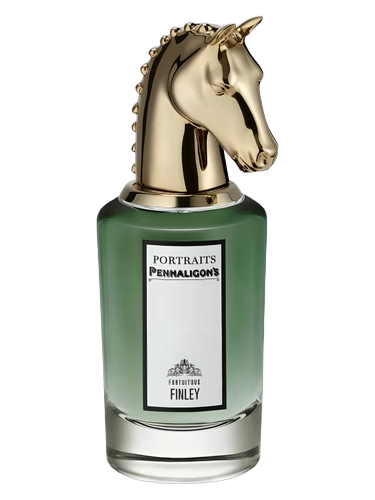
Most Popular Scents Using Morning Glory Flower
What is Morning Glory Flower?
Morning Glory (Ipomoea) is a climbing vine known for its trumpet-shaped blooms that typically open in the morning, and its scent is often represented in perfumery through synthetic reconstruction and headspace technology.What does Morning Glory Flower smell like?
It offers a delicate, mildly sweet, and fresh floral aroma characterized by crisp, green, and slightly aquatic nuances that evoke a clean, ethereal, and atmospheric quality.How is Morning Glory essence extracted?
Because the flowers have a very subtle natural scent, perfumers use headspace technology to capture its aromatic profile or rely on maceration and solvent-based techniques for industrial and traditional purposes.What are some top perfumes featuring Morning Glory Flower?
Notable fragrances include Gucci Bloom Acqua di Fiori, Jil Sander Sun Delight, Jo Malone Bluebells, and the Calgon Morning Glory collection.When is Morning Glory Flower in season?
Morning Glory typically flourishes from midsummer through early autumn, with a primary blooming window from June or July until the first hard frost of the season.