Fragrance Notes Are Layers Of Scent That Are Layered To Form The Final Fragrance. Fragrance Notes Are Categorised Into Three Main Elements Based On How Long They Take To Evaporate, And How Long They Typically Last Following Application: Top Notes, Heart Notes And Base Notes.
Monarda
Monarda (Wild Bergamot) oil offers a clean, fresh, sweet, and grassy aroma, often used for its uplifting, mildly herbaceous profile. It features bright nuances that are sometimes compared to subtle citrus or mint, providing a natural, lively opening to compositions.

Origin & Extraction Of Monarda
Monarda, often referred to as Wild Bergamot or Bee Balm, is not a traditional historical note foundational to classical perfumery like Bergamot or Lemon (which defined the 18th-century Eau de Cologne structure). Its use in Western fine fragrance is a relatively modern phenomenon. Historically, perfumery focused primarily on volatile zesty top notes and rich floral/resinous hearts. Monarda's unique profile—bridging citrus zest with a cool, herbaceous greenness—began gaining traction in contemporary and niche perfumery as houses sought natural, clean, and mildly spicy openings that evoked sun-drenched meadows or aromatic herb gardens.
The relevance of Monarda in perfumery today lies in its sophistication as a nuanced alternative to common fresh notes like Lemon Verbena or traditional Bergamot. It is valued for its ability to provide a natural, lively lift and enhance green and aquatic accords, lending clarity and preventing compositions from becoming overly sweet or heavy. While a single "famous" blockbuster fragrance centered purely on Monarda is rare, it is often utilized strategically by niche and artisanal brands to support other prominent notes like Lavender or Neroli, adding depth and complexity to modern aromatic and fresh compositions.
Extraction Methods of Monarda
Historically, monarda (also known as bee balm or wild bergamot) was processed through simple manual and water-based techniques. Native American tribes and early herbalists utilized hot water infusions (teas) and decoctions, or created poultices by boiling the leaves to capture its medicinal properties. Traditional "folk methods" for capturing its aromatic essence also involve long-term maceration, where fresh or dried aerial parts are steeped in solvents like alcohol to create tinctures, or in vinegar and honey to produce oxymels.
In modern perfumery and phytochemical research, the primary method for obtaining concentrated monarda essential oil is steam distillation or hydrodistillation, which isolates volatile compounds like thymol and carvacrol. However, recent advancements have introduced supercritical CO2 extraction as a superior alternative. This latest method operates at lower temperatures to prevent the thermal degradation of sensitive molecules like thymoquinone, resulting in a more potent and chemically accurate representation of the plant's natural aromatic profile compared to traditional distillation.
Monarda, often referred to as Wild Bergamot or Bee Balm, offers a unique, uplifting aromatic profile that bridges the fresh zest of citrus with a cool, herbaceous greenness. While it is not a traditional cornerstone of classical French perfumery like Rose or Jasmine, it is increasingly featured in contemporary and niche fragrances that aim for a natural, clean, and mildly spicy opening. Its usage is particularly valued for conveying the scent of sun-drenched meadows or aromatic herb gardens, providing a clean counterpoint to richer base notes. Its distinctive properties prevent a composition from becoming overly sweet or heavy, ensuring a lively lift.
- Monarda is a subtle but effective tool in crafting complex, naturalistic scents.
In modern high-end and artisanal perfumery, Monarda can be found lending its bright, almost minty-citrus freshness to compositions. For example, brands seeking photorealistic botanical freshness utilize it to enhance green accords or to give a novel twist to traditional Eau de Cologne structures. Its inclusion often signals a focus on purity and clarity, acting as a nuanced alternative to common notes like Lemon Verbena or Bergamot, even if its presence is frequently part of a broader, proprietary "herbaceous accord."
- Its clean, refreshing essence complements aquatic and green notes seamlessly.
Due to its relatively understated nature in commercial perfumery, Monarda is more often highlighted in niche houses. These fragrances often use the note to evoke specific natural settings or ingredients. A famous example that captures this clean, herbaceous spirit is often suggested to be found in specific interpretations of aromatic garden scents, although a single "famous" blockbuster fragrance centered purely on Monarda is rare. When it is used, it often supports a prominent note like Lavender or Neroli, adding depth to the opening of scents such as those in the L'Occitane or Jo Malone style, where natural herb notes are paramount, though specific, verified examples are often hidden within proprietary "green notes."
Sustainability Of Monarda
Sustainability of Monarda
- Promoting biodiversity by serving as a primary pollinator magnet that provides essential forage and habitat for bees, butterflies, and hummingbirds
- Supporting eco-friendly gardening as a hardy, deer and rabbit-resistant native species that requires fewer chemical interventions and pesticides
- Implementing sustainable cultivation practices such as regular clump division and pruning to naturally manage air circulation and prevent fungal diseases like powdery mildew
- Utilizing organic soil management by incorporating compost and natural organic matter to maintain plant health and soil fertility
- Contributing to water conservation in suitable climates by utilizing its natural resilience in moist meadows and floodplains, reducing the need for intensive irrigation once established
- Fostering a circular economy through seed saving and self-sowing capabilities, allowing for natural propagation and reducing the need for commercial nursery replacements
Trivia
Named after a 16th-century Spanish physician who never actually visited the Americas, Monarda is the natural source of thymol, a powerful antiseptic that remains a primary active ingredient in many modern commercial mouthwash formulas.
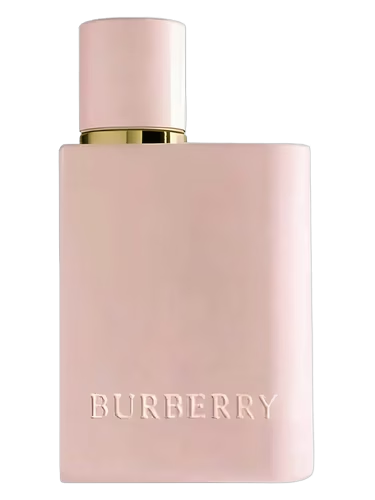
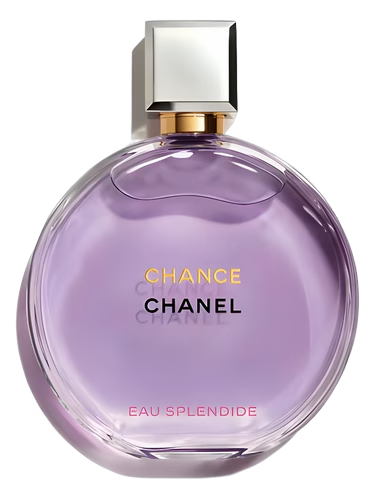
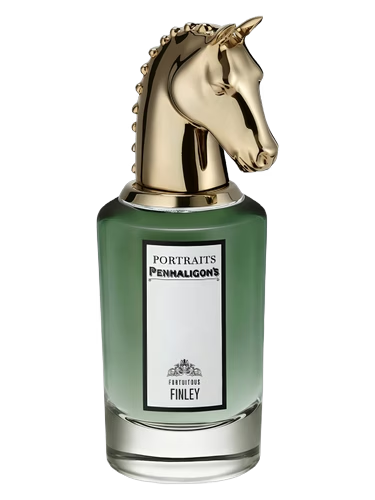
Most Popular Scents Using Monarda
What is Monarda in perfumery?
Monarda, also known as Wild Bergamot or Bee Balm, is a North American perennial herb used in modern and niche perfumery for its clean, uplifting, and mildly spicy aromatic profile.What does Monarda smell like?
It offers a fresh, sweet, and grassy aroma with bright nuances of citrus and mint, often compared to a blend of herbal greenness and cool zest.Is Monarda related to the Bergamot orange?
No, it is a member of the mint family (Lamiaceae); it earned the name Wild Bergamot because its fragrance and flavor are remarkably similar to the Italian bergamot orange used in Earl Grey tea.How is Monarda essence extracted?
In modern fragrance production, the essential oil is typically obtained through steam distillation or hydrodistillation of the plant's leaves and flowers.What are some top perfumes featuring Monarda?
Notable fragrances including this note are D:SOL MMXVI Isleta, Nose Perfumes Meadow Tea, Odoratika Aspasia, and DSH Perfumes Bee Balm.What are the benefits of Monarda in a fragrance composition?
It acts as a sophisticated alternative to traditional citrus, providing a natural, lively lift that enhances green and aquatic accords without making them overly sweet.