Fragrance Notes Are Layers Of Scent That Are Layered To Form The Final Fragrance. Fragrance Notes Are Categorised Into Three Main Elements Based On How Long They Take To Evaporate, And How Long They Typically Last Following Application: Top Notes, Heart Notes And Base Notes.
Mirabilis
Mirabilis presents as a complex, musky amber fragrance with sweet, earthy undertones, often incorporating a touch of incense. It is a warm, cocooning scent, frequently described with synthetic overtones. It blends fragrant sweetness with an inviting depth, making it ideal for sophisticated, rich compositions.

Origin & Extraction Of Mirabilis
The Mirabilis note, often associated with the four o'clock flower, lends a complex, musky amber profile with sweet and earthy undertones to modern fragrances. While not a classic component of historical perfumery, its synthetic interpretation—particularly the molecule used to capture its unique scent—has found a sophisticated home in contemporary niche and designer creations. This note is often utilized to add a warm, inviting depth and a touch of mysterious fragrance to compositions that lean towards amber and oriental categories, making the resulting scent both familiar and distinctly luxurious.
The usage of Mirabilis exemplifies a modern perfumery trend where unconventional or newly synthesized notes are employed to create unique textural effects. Because the natural extraction of the four o'clock flower is complex, the note often appears as a synthesized accord, allowing perfumers to precisely control its sweet, earthy, and sometimes incense-like qualities. This control ensures the note provides a long-lasting, inviting sweetness without becoming overly heavy or overtly gourmand, establishing it as a valuable asset for sophisticated, rich compositions.
Extraction Methods of Mirabilis
Historically, extraction methods for Mirabilis jalapa (Four O'Clock flower) have relied on traditional techniques such as maceration and infusion to capture its medicinal properties. Folklore practices, particularly in regions like Brazil and India, often involved cold maceration in water or simple decoctions of the leaves, roots, and flowers to treat inflammation, wounds, and abscesses. These traditional methods were valued for their simplicity in extracting water-soluble compounds like amino acids, carbohydrates, and phenols.
Modern extraction techniques have expanded to include successive solvent extraction using petroleum ether, benzene, chloroform, ethanol, and methanol to isolate specific bioactive groups such as alkaloids, flavonoids, steroids, and terpenoids. Recent advancements have introduced innovative approaches like green synthesis, which utilizes water and silver nitrate to create biogenic nanoparticles, and nanoformulations to enhance the solubility, stability, and therapeutic selectivity of the extracts. Additionally, advanced analytical methods such as gas chromatography-mass spectrometry (GC-MS) and liquid chromatography (LC-MS/MS) are now standard for identifying complex lipid and phenolic profiles, while supercritical CO2 extraction is explored to capture delicate aromatic molecules and highly pure fractions for pharmaceutical and cosmetic applications.
The Mirabilis note, often associated with the four o'clock flower, lends a complex, musky amber profile with sweet and earthy undertones to modern fragrances. While not a classic component of historical perfumery, its synthetic interpretation—particularly the molecule used to capture its unique scent—has found a sophisticated home in contemporary niche and designer creations. This note is often utilized to add a warm, inviting depth and a touch of mysterious fragrance to compositions that lean towards amber and oriental categories, making the resulting scent both familiar and distinctly luxurious.
- The Mirabilis note is notably featured in perfumes like Mirabilis 60 by L'Erbolario, where it is often paired with spices and resins to amplify its inherent warmth and sweetness.
- In more mainstream designer releases, an abstract Mirabilis facet can be implied in popular oriental-floral scents, although specific usage is often cloaked under broader "amber" or "exotic flower" descriptions.
- The depth and slightly synthetic overtones of Mirabilis allow it to bridge floral top notes and heavy amber bases, giving fragrances a sophisticated, cocooning quality.
The usage of Mirabilis exemplifies a modern perfumery trend where unconventional or newly synthesized notes are employed to create unique textural effects. Because the natural extraction of the four o'clock flower is complex, the note often appears as a synthesized accord, allowing perfumers to precisely control its sweet, earthy, and sometimes incense-like qualities. This control ensures the note provides a long-lasting, inviting sweetness without becoming overly heavy or overtly gourmand, establishing it as a valuable asset for sophisticated, rich compositions.
Ultimately, the Mirabilis note provides a compelling alternative to traditional heavy florals or resins, offering a sense of sweet, aromatic earthiness. Fragrances that highlight this component are often celebrated for their seamless blend of comfort and elegance. The Mirabilis accord helps create perfumes that feel warm, slightly powdery, and deeply enveloping, appealing to those who favor musky-amber scents with a unique, floral-gourmand twist.
Sustainability Of Mirabilis
Sustainability of Mirabilis
- Promoting water conservation through the cultivation of drought-tolerant species like Mirabilis multiflora, which require minimal irrigation once established
- Supporting local biodiversity by providing essential habitats and nectar sources for pollinators such as hummingbirds and butterflies
- Enhancing soil stability and health in arid and riparian ecosystems through deep, tuberous root systems that store water and nutrients
- Reducing the need for chemical interventions by utilizing naturally pest- and disease-resistant varieties that thrive in poor soil conditions
- Contributing to global plant conservation efforts through the protection and recovery of endangered species such as Mirabilis macfarlanei
Trivia
Mirabilis is also known as the Four O'Clock flower because its intensely sweet-smelling blossoms remain tightly curled all day and only burst into bloom in the late afternoon.
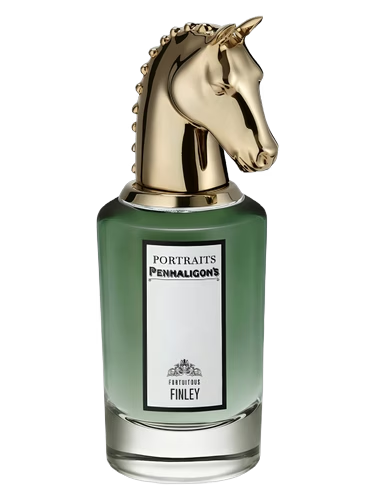
Most Popular Scents Using Mirabilis


What is Mirabilis?
Mirabilis, also known as the four o'clock flower, is a genus of plants native to the Americas prized in modern perfumery for its complex, musky amber profile with sweet and earthy undertones.What does Mirabilis smell like?
It offers a warm, cocooning scent that combines intensely sweet floral notes with musky, earthy facets and subtle hints of incense or synthetic overtones.How is Mirabilis essence extracted?
While historically extracted through maceration or infusion for medicinal use, the fragrance note in modern perfumery is typically created as a synthesized accord to precisely control its unique aromatic qualities.What are some top perfumes featuring Mirabilis?
Notable fragrances include L'Artisan Parfumeur 60 Mirabilis, Guerlain Florabloom Absolu, Miller Harris Hydra Figue, and L'Erbolario Bella di Notte.Why is it called the Four O'Clock flower?
The plant earned this name because its blossoms remain tightly curled throughout the day and only burst into bloom in the late afternoon or early evening.When is Mirabilis in season?
The plant typically follows a warm-weather cycle, blooming extensively from early summer through late autumn or until the first frost.