Fragrance Notes Are Layers Of Scent That Are Layered To Form The Final Fragrance. Fragrance Notes Are Categorised Into Three Main Elements Based On How Long They Take To Evaporate, And How Long They Typically Last Following Application: Top Notes, Heart Notes And Base Notes.
Mirabelle
Mirabelle offers a fantasy fruity note, reminiscent of sweet, fresh, and fleshy Mirabelle plum. It is luminous, juicy, and slightly tart, blending fruity sweetness with subtle floral and honeyed undertones. This profile adds vibrant, sun-kissed depth and refined elegance to fragrances.

Origin & Extraction Of Mirabelle
The Mirabelle plum, a small, sweet fruit primarily associated with the Lorraine region of France, is not a traditional historical note in perfumery like citrus or florals. The use of Mirabelle as a distinct fragrance element is relatively modern, emerging alongside the trend for realistic, juicy, and complex fruity notes in the late 20th and early 21st centuries. Unlike ancient ingredients that were extracted directly into essential oils, the Mirabelle note is often a 'fantasy' accord or a synthetic creation designed to capture the sweet, fleshy, and slightly tart essence of the sun-kissed fruit, blending fruity sweetness with subtle honeyed and floral undertones.
In contemporary perfumery, the Mirabelle note is valued for its ability to add a luminous, vibrant depth to compositions without the heaviness of richer, dried fruits. It acts as a sophisticated bridge between sparkling top notes and warmer, gourmand or woody bases. Its introduction reflects a move towards capturing specific, appealing fruit aromas, often appearing in niche and designer fragrances where it enhances freshness and vitality, evoking a sense of natural beauty and sun-ripened orchards.
Extraction Methods of Mirabelle Plum
Historically, the extraction of aromatic and bioactive compounds from Mirabelle plums involved traditional manual methods, such as crushing the fruit and stones followed by fermentation and steam distillation to produce spirits like Slivovitz. For oil extraction, pits were traditionally dried in sunlight and mechanical screw-pressed at low temperatures to preserve the oil's integrity. Traditional aqueous extraction through maceration and simple filtration was also common for creating food-grade extracts and syrups.
Modern commercial and industrial production has introduced more sophisticated techniques to enhance yield and purity. Current methods include ultrasound-assisted extraction (UAE) and microwave-assisted extraction (MAE), which utilize sound waves or electromagnetic radiation to rapidly isolate polyphenols and pigments while reducing solvent use. Advanced "white biotechnology" now employs patented enzymatic extraction, a zero-waste, solvent-free process that uses natural enzymes to release oils and active ingredients from seeds. Furthermore, high-purity oils are often refined using fractional distillation or solvent extraction with liquid hexane, while specialized formats like glycerolat extracts utilize steam distillation stabilized with vegetable glycerin for cosmetic applications.
The Mirabelle note, prized for its juicy, sweet, and slightly tart profile, has been notably showcased in designer collections looking to capture a modern, sun-kissed fruitiness. One of the most prominent uses is in the **Trésor Midnight Rose** line by Lancôme, where the plum's sweet depth complements rose and raspberry notes, giving the composition a romantic and vibrant lift.
While often utilized as a fantasy accord, Mirabelle lends itself beautifully to compositions seeking complexity beyond traditional single-note citruses or florals. It is featured in **Gucci Gorgeous Gardenia**, contributing to the rich, fruity opening alongside red berries and pear. In this context, the note acts as a bridge, adding fleshy sweetness that enhances the luminosity of the white floral heart.
In niche perfumery, the Mirabelle plum note is sometimes used to evoke gourmand facets or specific regional luxury. Although less common in purely classical scents, its modern appeal ensures its inclusion in contemporary releases that aim for a balance between sparkling freshness and warm, honeyed sweetness, often appearing in fragrances from houses like Jo Malone or certain limited-edition collections.
Sustainability Of Mirabelle
Sustainability of Mirabelle
- Promoting a circular economy by upcycling waste into high-value products, such as using kernels for cosmetic oils and skins for flavored syrups
- Adoption of sustainable and organic farming practices that improve soil fertility and prevent erosion compared to barren land
- Reducing environmental impact through the cultivation of long-lived trees that effectively sequester carbon from the atmosphere
- Utilizing zero-waste initiatives by repurposing plum pits for thermal products like dry hot water bottles or as nutrient-rich compost
- Supporting local agriculture and heritage growers who prioritize traditional, high-quality cultivation methods over industrial mass production
- Implementation of European traceability systems and quality standards, such as the Lorraine AOP, to ensure transparent and ethical sourcing
Trivia
While the mirabelle plum note is a staple in fine perfumery, it is almost impossible to extract a natural oil from the fruit itself; instead, perfumers must reconstruct its velvety, honeyed scent in a lab using the damascone molecule, the same chemical compound found in roses.
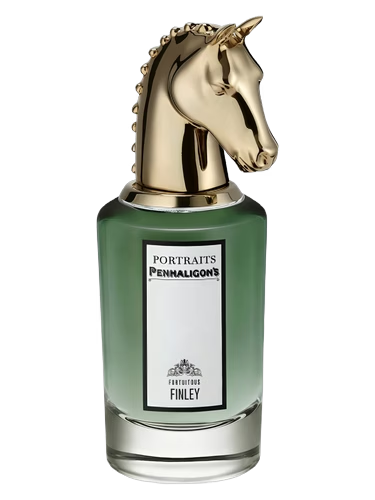
Most Popular Scents Using Mirabelle


What is Mirabelle?
Mirabelle is a small, sweet, golden-yellow plum primarily associated with the Lorraine region of France. In perfumery, it is used as a fantasy note to evoke a sun-kissed, juicy, and refined fruity character.What does Mirabelle smell like?
It offers a sweet, luminous, and slightly tart aroma with honeyed and floral undertones. Its scent is warmer and rounder than an apricot and more delicate than a traditional purple plum.How is the Mirabelle note extracted for perfumes?
Natural essential oil cannot be effectively extracted from the fruit's pulp. Instead, perfumers create a fantasy accord using synthetic molecules, such as damascone, to replicate its honeyed and velvety fragrance.What are some top perfumes featuring Mirabelle?
Notable fragrances include Chloé Nomade, Lancôme Trésor Midnight Rose, Gucci Gorgeous Gardenia, and Byredo De Los Santos.When is Mirabelle in season?
The fruit has a brief harvest window in the Northern Hemisphere, typically peaking between late July and mid-September, particularly in the Lorraine region.