Fragrance Notes Are Layers Of Scent That Are Layered To Form The Final Fragrance. Fragrance Notes Are Categorised Into Three Main Elements Based On How Long They Take To Evaporate, And How Long They Typically Last Following Application: Top Notes, Heart Notes And Base Notes.
Mimusops Elengi
Mimusops Elengi oil offers a delicate, sweet, and tenacious floral odor, often likened to orange flower and tuberose or stephanotis floribunda. It features a honeylike, heavy sweet backnote that is quite persistent.

Origin & Extraction Of Mimusops Elengi
Mimusops Elengi, commonly known as Bakul, has a history in scent deeply rooted in traditional South Asian perfumery, particularly in the form of attars and natural oils. The fragrant white blossoms, prized for their delicate, sweet, and tenacious aroma, have been used for centuries in cultural, religious, and medicinal practices across India and Southeast Asia. Its traditional significance meant that it was an early, natural source for persistent floral fragrance long before Western perfumery standardized extraction methods.
Its introduction to modern fine perfumery is more contemporary, as perfumers began seeking unique, long-lasting white floral notes that offered an alternative to jasmine or tuberose. Mimusops Elengi oil is valued for its persistence and its complex honeylike, sweet backnote, allowing it to anchor the heart of floral compositions. Today, it is primarily used in niche, artisanal, and Middle Eastern fragrances, where its distinct profile lends exotic depth and a tenacious, sophisticated warmth to high-end floral and oriental accords.
Extraction Methods of Mimusops Elengi
Historically, the aromatic and medicinal compounds of Mimusops elengi, commonly known as Bakul or Maulsiri, were obtained through traditional manual techniques such as simple water infusions, decoctions, and sun-drying. For floral fragrance, ancient methods often involved maceration in vegetable oils or water distillation to create scented waters and attars. In traditional medicine, the bark and seeds were typically pounded into pastes or boiled to create aqueous extracts for treating dental and gastrointestinal ailments.
Modern extraction utilizes a range of sophisticated chemical and mechanical processes to isolate specific bioactive compounds and volatile oils. Essential oils from the bark and flowers are primarily obtained through steam distillation or Soxhlet extraction using solvents like petroleum ether, chloroform, and methanol. Recent advancements have introduced liquid CO2 extraction for flowers, which is considered superior as it is solvent-free and preserves the delicate, creamy floral aroma better than conventional hexane extraction. For pharmaceutical and antioxidant research, partitioning techniques using ethyl acetate and n-butanol are frequently employed to concentrate phenolic and flavonoid fractions from the stem bark and seeds.
Mimusops Elengi, known as Bakul in India, offers a delicate, sweet, and tenacious floral note, often likened to orange flower or tuberose. While its use is deeply rooted in traditional attars and oils from South Asia, it has been embraced by modern houses seeking unique white floral signatures. One contemporary example where the Mimusops Elengi note is celebrated is in **Mystic Bakul by Norah Perfumes**, which distills the essence of the creamy white blossoms to capture its sacred and timeless beauty.
For large designer and niche houses, Mimusops Elengi often provides a subtle, exotic depth to complex floral bouquets. Although not always the star note in mainstream perfumery, its sweet, honeylike persistence makes it valuable for bolstering the heart of a composition. Houses like **Guerlain** and **Tom Ford**, known for their extensive exploration of floral ingredients, have incorporated this note or similar synthetic analogues to give their white floral fragrances a unique warmth and heavy sweetness.
The note also appears in fragrances from Middle Eastern perfumery, where rich, long-lasting floral and oriental accords are highly prized. Brands such as **Lattafa Perfumes** frequently feature deep, exotic floral oils, and Mimusops Elengi lends itself perfectly to these compositions, providing a persistent, honeylike sweet base that ensures the fragrance has significant tenacity and sillage.
Sustainability Of Mimusops Elengi
Sustainability of Mimusops elengi
- Promoting ecological resilience through the cultivation of drought-tolerant, termite-resistant, and cyclone-resistant trees that adapt to diverse ecosystems and coastal conditions
- Utilizing green synthesis methods to create zinc oxide and silver nanoparticles from leaf and flower extracts, offering eco-friendly and low-cost alternatives for biomedical and agricultural applications
- Supporting a circular economy by upcycling fruit waste into natural, non-toxic colorants and antimicrobial agents for sustainable textile dyeing and processing
- Enhancing biodiversity and urban forestry by planting multifunctional trees that provide dense shade, carbon sequestration, and a year-round food source for local wildlife
- Advancing sustainable healthcare through the integration of traditional Ayurvedic knowledge with contemporary pharmacological research to develop plant-based therapeutic solutions
Trivia
The flowers of Mimusops elengi, also known as the Spanish Cherry, are unique in that they open at twilight and release a powerful fragrance throughout the night, which they remarkably retain for several days even after being shed from the tree or sun-dried.
Most Popular Scents Using Mimusops Elengi
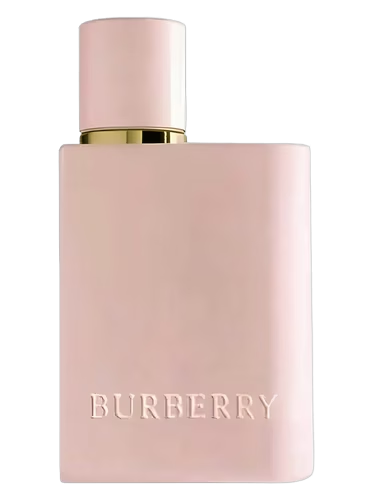
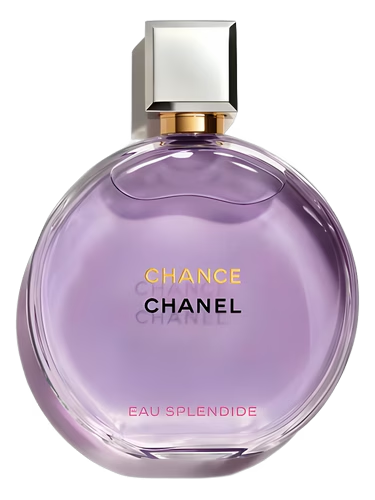
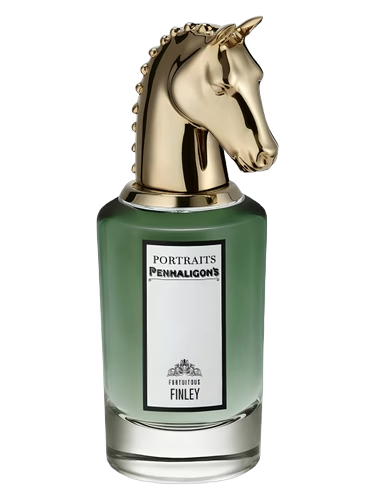
What is Mimusops Elengi?
Mimusops Elengi, also known as Bakul, is a tropical evergreen tree native to South Asia whose fragrant white blossoms are used to create traditional attars and essential oils for perfumery.What does Mimusops Elengi smell like?
It features a delicate, sweet, and tenacious floral aroma often compared to orange flower, tuberose, or gardenia, with a heavy, persistent honeylike backnote.How is Mimusops Elengi essence extracted?
The aromatic oil is primarily obtained through steam distillation or solvent extraction of the flowers, while modern techniques also utilize liquid CO2 extraction to better preserve its creamy floral profile.What are some top perfumes featuring Mimusops Elengi?
Notable fragrances include Norah Perfumes Mystic Bakul, Wild Veil Mahilampoo Soliflore, and Kannauj Attar Bakul Attar.When is Mimusops Elengi in season?
While the tree can flower year-round in tropical climates, peak blooming typically occurs during the dry season between March and June.