Fragrance Notes Are Layers Of Scent That Are Layered To Form The Final Fragrance. Fragrance Notes Are Categorised Into Three Main Elements Based On How Long They Take To Evaporate, And How Long They Typically Last Following Application: Top Notes, Heart Notes And Base Notes.
Michelia
Michelia offers a smooth, white floral fragrance with a gentle sweetness, reminiscent of magnolia. It features bright, fresh top notes (often citrus) followed by fruity nuances and a delicate, serene tea-like undertone, sometimes grounded by ambergris and sandalwood.

Origin & Extraction Of Michelia
Michelia, particularly the species Michelia champaca (Champaca) and Michelia × alba (White Champaca), has a long history of use in Asia, particularly India and China, dating back hundreds of years, primarily for traditional medicine and as a natural fragrance ingredient for hair and massage oils. The essential oil of its flowers, known for their powerful, sweet scent, has been highly valued in these regions for centuries. The genus Michelia itself was named after the famous Florentine botanist Pietro Antonio Micheli (1679–1737).
The incorporation of Michelia essential oil into fine Western perfumery follows this long Asian tradition, with notes like Champaca Absolute becoming highly sought after for their delicate, magnolia-like white floral aroma combined with fruity or tea-like nuances. While not a historical cornerstone like Rose or Neroli, its unique, luminous profile has secured its place in modern compositions, offering sophistication, especially in exotic, high-end, and niche fragrances. The use of Champaca essential oil is notably linked to historical fragrances such as Jean Patou's classic perfume, 'Joy.'
Extraction Methods of Michelia
Historically, the aromatic essence of Michelia flowers was captured through labor-intensive traditional methods such as cold and hot enfleurage, which used fats or oils to absorb the delicate floral scents, as well as simple water and steam distillation. In regions like Thailand and China, these traditional techniques were essential for preserving the volatile compounds of the highly sensitive blossoms, which begin to wilt and lose their fragrance shortly after being harvested.
Modern commercial production primarily utilizes steam distillation and solvent extraction to produce essential oils and concretes. Recent advancements have introduced highly efficient techniques such as supercritical CO2 extraction, which often uses ethanol as an entrainer to capture a broader range of aromatic molecules at lower temperatures, and subcritical solvent extraction. Additionally, innovative methods like cellular extraction and simultaneous distillation extraction (SDE) are being explored to maximize yield and preserve the complex, fruity-floral profile of the Michelia species.
Michelia, with its delicate, sweet, and magnolia-like white floral scent, has found a sophisticated niche in modern perfumery, offering a luminous, serene quality that elevates floral compositions. While not as common as notes like jasmine or rose, its unique fresh and tea-like nuances are prized for creating elegant and airy fragrances. One notable example showcasing the beauty of this flower is Magnolia Nobile by Acqua di Parma, which uses the floral character of magnolia (which is related to Michelia) to achieve a radiant, classic Italian scent profile.
- * * *
The note of Michelia, sometimes referred to as champaca, is essential in capturing exotic, uplifting fragrances that balance white florals with light fruity or citrus undertones. This versatility makes it perfect for scents aiming for a natural, almost dewy freshness. A famous fragrance that prominently features a related note, or the champaca variety, is Joyful by Escada, utilizing its bright, slightly apricot-tinged floralcy to create a cheerful and feminine aura.
- * * *
In high-end and niche perfumery, Michelia is often utilized to lend creamy texture and a subtle, almost green luminosity to a composition, frequently appearing alongside ambergris or sandalwood to give it depth and longevity. This note's serene quality makes it an excellent choice for luxury eaux de cologne or light, sophisticated skin scents. A complex and beautiful interpretation of the Chinese magnolia (Michelia alba) can be found in fragrances like Shanghai Lily by Tom Ford, where the flower note is draped in spices and woods for a rich, oriental effect.
Sustainability Of Michelia
Sustainability of Michelia
- Preserving genetic diversity through the selection of elite genotypes from wild populations to enhance local biodiversity and restore degraded habitats
- Implementing in situ and ex situ conservation efforts, including the establishment of ecological corridors, to address habitat fragmentation caused by climate change
- Adopting organic farming practices and integrated pest management to maintain soil health and prevent groundwater contamination
- Promoting a circular economy by upcycling side-streams from wood production into high-value essential oils for perfumery
- Utilizing trees as efficient carbon sinks and focusing on the cultivation of resilient species to mitigate the impacts of rising global temperatures
Trivia
In Hong Kong, the fragrant white flowers of the Michelia alba tree are so beloved that they are traditionally sold on street corners by vendors to be used as natural, wearable perfume or kept in small dishes to scent entire rooms.
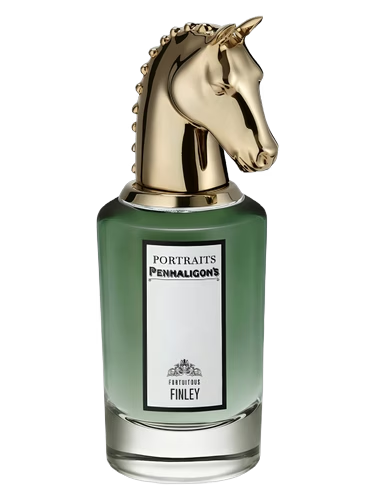
Most Popular Scents Using Michelia


What is Michelia?
Michelia is a genus of flowering plants in the magnolia family, native to South and Southeast Asia, highly valued for its fragrant blossoms used in traditional medicine and fine perfumery.What does Michelia smell like?
It offers a smooth, creamy white floral scent with gentle sweetness, featuring bright citrus top notes, fruity apricot-like nuances, and a serene, tea-like undertone.How is Michelia essence extracted?
The aromatic oil is primarily obtained through steam distillation or solvent extraction of the fresh flowers, though advanced methods like supercritical CO2 extraction are also used to preserve its delicate profile.What are some top perfumes featuring Michelia?
Notable fragrances include Jean Patou Joy, Tom Ford Shanghai Lily, Acqua di Parma Magnolia Nobile, and Escada Joyful.When is Michelia in season?
Michelia can bloom year-round in tropical climates, with the heaviest flowering typically occurring during the spring and summer months depending on the specific variety.