Fragrance Notes Are Layers Of Scent That Are Layered To Form The Final Fragrance. Fragrance Notes Are Categorised Into Three Main Elements Based On How Long They Take To Evaporate, And How Long They Typically Last Following Application: Top Notes, Heart Notes And Base Notes.
Methyl Pamplemousse
Methyl Pamplemousse is an impactful, vibrant aromatic chemical that captures the crisp, juicy, and slightly bitter essence of fresh grapefruit. It delivers a sparkling, bright, and intensely diffusive citrus top note with an excellent, modern transparency. Its clean, tart, and refreshing character is prized for adding lift and longevity to citrus and aquatic compositions.

Origin & Extraction Of Methyl Pamplemousse
Methyl Pamplemousse, being a synthetic aromatic chemical, does not possess the ancient history of natural citrus oils. Its relevance began in the modern era of perfumery, following the rise of synthetic materials in the 20th century. Its creation was driven by the need for stable, powerful, and long-lasting citrus notes, as natural grapefruit oil is highly volatile and quickly fades. The development of molecules like Methyl Pamplemousse (a trade name for different grapefruit-like materials, often referencing Pamplemousse—French for grapefruit) allowed perfumers to capture and sustain the vibrant, zesty, and slightly bitter essence of grapefruit peel in a way that natural materials could not.
The note has become indispensable in the modern fresh and aquatic fragrance categories, gaining significant traction in the late 20th and early 21st centuries. It is particularly valued in men’s perfumery and contemporary colognes for its clean transparency and intense diffusion, which contributes to the "invigorating" and "sporty" feel of many best-selling scents. By providing superior lift and longevity, Methyl Pamplemousse bridged the performance gap between volatile citrus top notes and longer-lasting base notes, cementing its role as a foundational material for high-definition, sustained freshness in sophisticated compositions.
Extraction Methods of Methyl Pamplemousse
Methyl Pamplemousse is a synthetic aroma chemical that is not found in nature; therefore, its "extraction" is a process of chemical synthesis rather than mechanical expression or distillation from botanical sources. Historically, since its discovery and commercialization by Givaudan in 1983, it has been produced through an acetalization reaction. This traditional synthetic route involves the reaction between 2,2,5-trimethyl-4-hexenal (which itself is derived from isobutyraldehyde and prenyl chloride) and methanol, typically in the presence of a catalyst such as calcium chloride.
In recent years, advancements in the production of this molecule and its analogues have focused on the "carbon/silicon switch" strategy. Researchers have developed methods to synthesize sila-methyl pamplemousse (a silicon-containing analogue) to study how silicon substitution affects olfactory properties. These modern synthetic techniques involve multi-step organometallic reactions, such as the treatment of (chloromethyl)trimethoxysilane with sodium methoxide followed by bromination and subsequent reactions with Grignard reagents like (3-methylbut-2-en-1-yl)magnesium chloride to yield the final scented compound.
Methyl Pamplemousse is a key synthetic ingredient known for creating hyper-realistic and lasting grapefruit notes, a quality essential in modern, high-performance fresh fragrances. Its clean, vibrant, and slightly bitter profile is often showcased in fragrances aiming for superior transparency and projection. It is a cornerstone in the architecture of many contemporary aquatic and citrus compositions, allowing the volatile top notes to linger significantly longer.
- One of the most celebrated uses of a powerful grapefruit synthetic like Methyl Pamplemousse is in the iconic fragrance, Terre d'Hermès. While the listed note may simply be "Grapefruit," the sheer persistence and vibrant, mineral freshness are often attributed to the skillful use of materials like Methyl Pamplemousse, which provides an intensely bright opening that complements the earthy vetiver and flint accords.
The chemical's ability to blend seamlessly with other aroma molecules while maintaining its distinctive, sparkling grapefruit character makes it indispensable for perfumers. Its crisp nature prevents citrus accords from becoming too sweet or photorealistic, instead lending a refined, energetic, and slightly metallic edge, crucial for masculine and unisex fragrances in the "fresh" category.
Sustainability Of Methyl Pamplemousse
Sustainability of Methyl Pamplemousse
- Utilizing synthetic alternatives to citrus essential oils to reduce the environmental pressure on natural crops and land resources
- Assessing renewable carbon content in line with ISO 16128 standards to prioritize ingredients derived from replenishable natural sources or biomass
- Evaluating biodegradability through OECD test guidelines to ensure the chemical breaks down effectively in the environment via microorganisms
- Monitoring manufacturing efficiency using Process Mass Intensity (PMI) to minimize waste generation during the production process
- Implementing strict ecotoxicity testing to classify and mitigate potential hazards to aquatic species and long-term environmental health
Trivia
Methyl Pamplemousse was developed as a synthetic alternative to natural grapefruit oil because it avoids phototoxicity and provides a stable, "bitter" rind scent that doesn't degrade or lose its punch like real citrus does in a bottle.
Most Popular Scents Using Methyl Pamplemousse
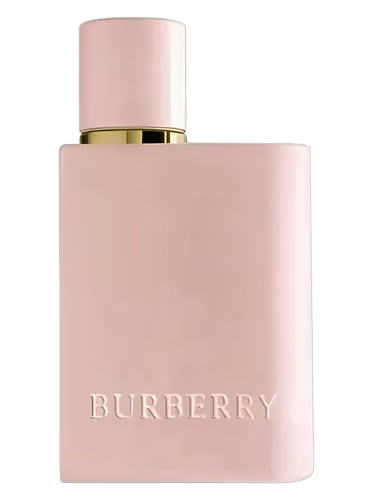
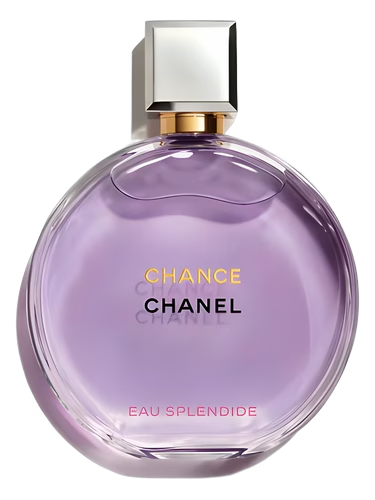
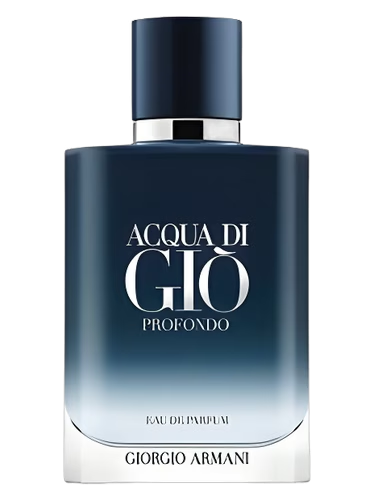
What is Methyl Pamplemousse?
Methyl Pamplemousse is a synthetic aroma chemical developed to replicate the crisp, zesty, and slightly bitter scent of fresh grapefruit peel.What does Methyl Pamplemousse smell like?
It features a vibrant and diffusive odor profile characterized by tart grapefruit, sulfurous nuances, and a clean, soapy-green undertone.How is Methyl Pamplemousse used in perfumery?
It is primarily used as a top note to add lift and longevity to citrus and aquatic compositions, and it often serves as a booster for vetiver accords.Is Methyl Pamplemousse a natural ingredient?
No, it is a synthetic molecule created through chemical synthesis to provide a stable alternative to highly volatile natural grapefruit oils.What are the benefits of using Methyl Pamplemousse over natural grapefruit oil?
It offers superior stability in alkaline bases like soaps, lacks the phototoxicity of natural citrus oils, and provides a consistent, long-lasting scent that does not oxidize easily.