Fragrance Notes Are Layers Of Scent That Are Layered To Form The Final Fragrance. Fragrance Notes Are Categorised Into Three Main Elements Based On How Long They Take To Evaporate, And How Long They Typically Last Following Application: Top Notes, Heart Notes And Base Notes.
Medlar
Medlar offers a nuanced fruity and slightly acidic aroma, often likened to baked apple or pear with hints of brown sugar and spice. It is sometimes blended with citrus (like bitter orange) and delicate floral notes (like peony) to create a warm, comforting, yet slightly tart profile that bridges fresh fruit with gourmand richness, suitable for a sophisticated heart note.

Origin & Extraction Of Medlar
The Medlar fruit (Mespilus germanica) has a long and interesting history, cultivated since Roman times, particularly valued across Europe for its unique, slightly fermented flavor after a process called 'bletting.' Traditionally, its use was primarily culinary and ornamental. Its application in perfumery is significantly more modern and niche. Unlike foundational citrus or floral ingredients, Medlar is not a traditional pillar of classic perfumery structures like Eau de Cologne. Its introduction reflects a contemporary trend toward evocative, complex, and sometimes gourmand fruit notes that are used to create sophisticated heart or base notes, rather than volatile top notes.
In contemporary perfumery, the Medlar note is prized for its ability to bridge fresh fruit accords with warmer, richer gourmand elements. It offers perfumers a nuanced profile likened to baked fruit, brown sugar, and spice, moving beyond simple sweetness to provide depth and comfort. Its relevance lies in its sophistication, as it is often synthesized or created as an accord to offer a slightly tart and acidic counterpoint to richer compositions, appealing to modern tastes for unique, naturalistic, and complex fruity warmth.
Extraction Methods of Medlar
Historically, the extraction of medlar (Mespilus germanica) has centered on traditional home-based maceration and infusion techniques. Because the fruit is high in tannins and requires a process called bletting to become edible, historical methods often involved steeping the softened fruit or its leaves in water or alcohol to capture its medicinal and aromatic properties. In some regions, like Saarland, Germany, the fruit was fermented and distilled to produce traditional schnapps, often refined with other botanical agents like hawthorn.
Modern extraction methods have become significantly more advanced, focusing on isolating specific bioactive compounds and high-quality oils from the seeds and pulp. The latest pharmaceutical and cosmetic standards utilize supercritical fluid extraction (SFE) with carbon dioxide, which allows for the recovery of essential fatty acids at low temperatures to prevent degradation. Other contemporary techniques include ultrasonic-assisted extraction for phenolic compounds, Soxhlet extraction using solvents like n-hexane for lipid profiling, and specialized cold-pressed methods for seed oil production.
The Medlar note, prized for its nuanced, slightly acidic, and gourmand profile (reminiscent of baked fruit and brown sugar), is generally featured in niche and modern perfumery rather than classical compositions. Its contemporary appeal is highlighted by recent releases such as Muschio 20 Nobile (Nobile 1942, 2024), where its comforting fruitiness likely balances a musky accord, and Ambrosia Aurea (Laura Biagiotti, 2024), where it contributes to a rich, complex warmth suitable for a sophisticated heart note.
- * * *
In the realm of artisanal and independent fragrance houses, Medlar is utilized to add unique depth and complexity. Examples include Khaos (Mythology Parfums, 2024) and Karuna (กรุณา) Prissana (2022). These compositions leverage Medlar’s subtle tartness and brown sugar nuances to bridge fresh openings with richer, longer-lasting base notes, moving beyond simple citrus or sharp fruit elements.
- * * *
Further demonstrating its versatility, the note appears in fragrances like Saint Lucia Cherry (Ailes des Anges, 2022) and 10 Bellezza (DiVina Terra, 2020), showing how Medlar can complement other fruity or floral themes. The inclusion of Medlar in products like 204 Nespolo (LabSolue) specifically emphasizes its distinctive nature, providing a sophisticated, evocative fruit accord that appeals to consumers seeking novel and naturalistic scents.
Sustainability Of Medlar
Sustainability of Medlar
- Utilizing hardy and climate-resilient trees that can withstand severe winters and late frosts, reducing the need for intensive agricultural interventions
- Promoting the cultivation of underutilized and forgotten heritage species to improve food security and agricultural biodiversity
- Implementing zero-waste practices by repurposing plant waste and fruit by-products for heavy metal extraction and environmental decontamination
- Encouraging circular economy principles through the use of infinitely refillable amber glass packaging and responsibly sourced, vegan formulations
- Supporting local biodiversity and sustainable land use by integrating low-maintenance, long-lived trees that thrive in diverse soil conditions with minimal chemical inputs
Trivia
The medlar tree is highly unusual because it blooms in the autumn when most other plants are entering winter dormancy, and its fruit is famously only edible after it has begun to decay through a process called bletting.
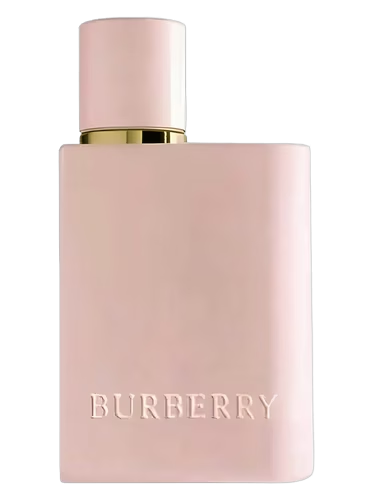
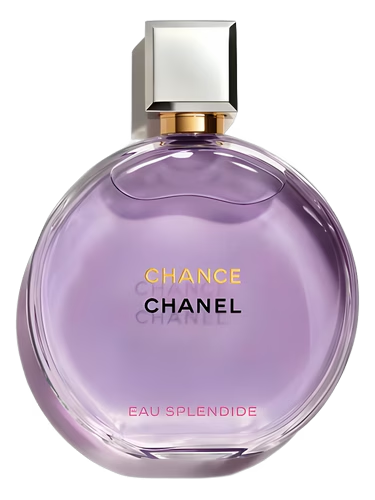
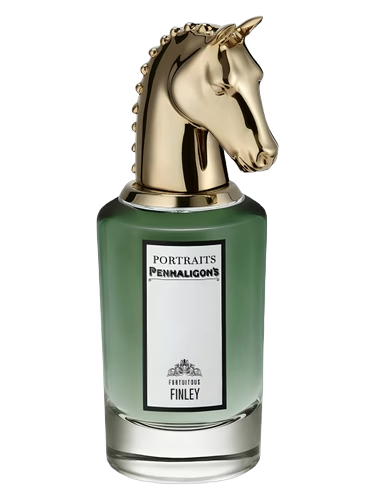
Most Popular Scents Using Medlar
What is Medlar?
Medlar is a fruit native to Southwestern Asia and Southeastern Europe, belonging to the rose family, and is known for its unique ripening process called bletting.What does Medlar smell like?
It offers a nuanced, fruity, and slightly acidic aroma reminiscent of baked apples or pears with warm hints of brown sugar and spice.How is Medlar essence extracted?
In modern perfumery, it is typically obtained through supercritical fluid extraction (SFE) with carbon dioxide or created as a synthetic accord.What are some top perfumes featuring Medlar?
Fragrances featuring this note include Nobile 1942 Muschio 20 Nobile, Laura Biagiotti Ambrosia Aurea, and LabSolue 204 Nespolo.When is Medlar in season?
The tree blooms in late spring, while the fruit is harvested in late autumn and undergoes bletting during the winter months to develop its sweet flavor.