Fragrance Notes Are Layers Of Scent That Are Layered To Form The Final Fragrance. Fragrance Notes Are Categorised Into Three Main Elements Based On How Long They Take To Evaporate, And How Long They Typically Last Following Application: Top Notes, Heart Notes And Base Notes.
Mahonia
Mahonia is a transparent, clean, and highly diffusive floral note, often used as a muguet base or Lyral replacement. It presents an ozonic, aldehydic freshness blended with green and slightly fruity nuances, delivering a sophisticated creamy white-flower bloom effect, anchored by a soft musky undertone, adding volume and lasting power.

Origin & Extraction Of Mahonia
The history of Mahonia in perfumery is primarily connected to the development of synthetic aroma compounds rather than traditional use. The Mahonia plant, native to America and Asia, is an evergreen shrub known for its prickly, holly-like leaves and yellow, winter-blooming flowers, but it is not traditionally distilled into essential oil for fragrance in the same way as classical ingredients. Its use is relatively recent, reflecting a shift toward complex, engineered notes that capture a specific floral effect—typically a sophisticated white-flower bloom.
In modern perfumery, "Mahonia" often refers to a fragrance base or chemical used to achieve a transparent, clean, and highly diffusive floral quality, frequently serving as a muguet base or a replacement for restricted materials like Lyral. This synthetic approach gives the note excellent volume and lasting power, imparting a creamy, ozonic, and subtly fruity freshness. It is valued by contemporary perfumers for its ability to add sophistication, complexity, and modern transparency to fresh and floral compositions, making it a key component in 21st-century fragrance design.
Extraction Methods of Mahonia
The primary method for extracting the essential oil from Mahonia species, such as Mahonia duclouxiana and Mahonia breviracema, is steam distillation or hydrodistillation of the leaves. In this process, plant material is either submerged in boiling water or exposed to pressurized steam to vaporize volatile compounds, which are then condensed back into a liquid form to separate the oil from the water.
Historically, Mahonia extracts were obtained through simpler maceration and infusion techniques, where dried bark, twigs, or leaves were soaked in solvents like water or alcohol to capture medicinal alkaloids such as berberine. Modern advanced methods now include supercritical CO2 extraction, which uses carbon dioxide under specific temperature and pressure to act as a solvent, and pressurized reactor vessels equipped with internal grinding mixers to achieve highly concentrated extracts for pharmaceutical and skincare applications.
Mahonia, valued in modern perfumery for its transparent, clean, and diffusive floral profile, often serves as a key note to impart a sophisticated, white-flower bloom effect with excellent lasting power. A prominent example showcasing this note is Valaya by Parfums de Marly (2023), which leverages Mahonia to deliver a contemporary and elegant freshness. Its role is often to add volume and a subtle, musky undertone, distinguishing these modern florals from traditional compositions.
- The note is also utilized in newer releases to achieve specific floral-fruity and clean-musk compositions, as seen in fragrances like Mystique Bouquet and Supremacy Tapis Rouge, both by Afnan (2024). These perfumes often pair Mahonia’s bright, aldehydic qualities with green or fruity nuances to create an uplifting and highly luminous opening that appeals to contemporary tastes.
Beyond niche and luxury releases, Mahonia is integrated into mainstream designer scents to provide an updated, crisp interpretation of floral freshness. For instance, Tommy Girl Now by Tommy Hilfiger (2018) features this note to anchor its youthful, clean, and energetic character. Its technical function as a high-performance floral base or Lyral replacement makes it invaluable for perfumers seeking sophisticated transparency and improved longevity in complex floral and fresh fragrance families.
Sustainability Of Mahonia
Sustainability of Mahonia
- Utilizing Mahonia as a sustainable alternative to overharvested botanical species due to its resilience and ability to thrive in diverse climates
- Promoting the use of synthetic recreations and "fantasy notes" to capture the aromatic profile of Mahonia without the environmental impact of large-scale extraction
- Supporting biodiversity by cultivating Oregon grape, which serves as a vital food source for local wildlife and pollinators
- Encouraging ethical sourcing and fair trade practices through partnerships with suppliers committed to preserving natural habitats in North America
- Adopting eco-friendly production methods, such as the solar method for floral essences, to minimize the carbon footprint of artisanal fragrance creation
Trivia
Mahonia is often called Oregon Grape due to its purple, waxy berries that resemble clusters of grapes, even though the plant is actually a member of the barberry family and completely unrelated to true grapes.
Most Popular Scents Using Mahonia


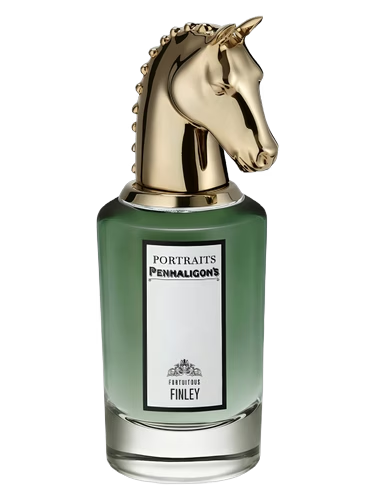
What is Mahonia?
Mahonia is a transparent and clean floral fragrance note, often used in modern perfumery as a synthetic base or molecule to replicate a sophisticated white-flower bloom effect.What does Mahonia smell like?
It offers a bright, diffusive aroma characterized by ozonic and aldehydic freshness, watery muguet (lily of the valley) qualities, and subtle green or fruity nuances.How is Mahonia essence produced?
While some botanical extracts can be obtained via steam distillation of leaves, the "Mahonia" note in fine fragrance is typically a synthetic recreation or a laboratory-produced molecule like Mahonial.What are some top perfumes featuring Mahonia?
Prominent fragrances include Parfums de Marly Valaya, Afnan Mystique Bouquet, Tommy Hilfiger Tommy Girl Now, and Prada L'Homme.Why is Mahonia used as a Lyral replacement?
It is valued for its technical performance and safety profile, providing a similar high-volume, diffusive muguet character to materials like Lyral that are now restricted in the industry.