Fragrance Notes Are Layers Of Scent That Are Layered To Form The Final Fragrance. Fragrance Notes Are Categorised Into Three Main Elements Based On How Long They Take To Evaporate, And How Long They Typically Last Following Application: Top Notes, Heart Notes And Base Notes.
Magnolia Leaf
Magnolia Leaf offers a crisp, intense green-floral profile with watery freshness. It presents a sharp, leafy-fruity opening that transitions to soft, elegant notes reminiscent of jasmine tea and freesia. This modern scent provides a sophisticated, bright, and slightly herbaceous character, ideal for transparent floral and white floral accords.

Origin & Extraction Of Magnolia Leaf
The use of Magnolia Leaf in fragrance is a more modern development in Western perfumery, following the historical dominance of the magnolia flower itself. Traditionally, the plant's aromatic qualities were celebrated in various cultures; for instance, the Malays historically utilized the leaves to perfume homes, baths, and clothing. The specific essential oil or essence used in the modern perfume industry, often sourced from Chinese provinces like Guanxi and Fujian, has only been consistently exported for global use since the 1990s.
This note emerged as perfumers sought a "greener," crisper profile, moving beyond the classic, heavy floral notes. Unlike the flower essence, the leaf offers a sharp, leafy-fruity, and herbaceous profile with watery freshness, making it ideal for contemporary, transparent floral, and aquatic compositions. Its modern relevance is tied to its ability to give fragrances a sophisticated, natural lift and a photorealistic depiction of the plant's vitality, complementing white florals without adding significant weight or sweetness.
Extraction Methods of Magnolia Leaf
The primary method for extracting essential oil from magnolia leaves is steam distillation. In this process, fresh or frozen leaves are placed in a distillation chamber where pressurized steam passes through the plant material, causing the volatile aromatic compounds to evaporate. These vapors then travel through a cooling system where they condense back into a liquid form, allowing the pure essential oil to be separated from the water (hydrosol).
Historically, magnolia leaf extracts were often obtained through simpler traditional methods such as maceration, where the leaves were crushed and soaked in base oils like almond oil or solvents like alcohol to capture their fragrance. Modern advancements have introduced more efficient and precise techniques, including microwave-assisted hydrodistillation and supercritical CO2 extraction. Specifically, salting-out solvent-free microwave rotary distillation (SOSFMRD) has been developed as an improved method to achieve even heating and rapid extraction, while supercritical carbon dioxide extraction is utilized to obtain high-quality volatile oils without the use of toxic solvents or high heat, preserving heat-sensitive aromatic components.
The Magnolia Leaf note, prized for its crisp, green, and watery freshness, is a key element in crafting modern, transparent floral compositions. It is often used to provide an energetic, sophisticated lift that complements traditional white florals without being overly heavy or sweet. A notable example of its use to create a bright, contemporary feeling is in **Gucci Bloom Acqua di Fiori**, where the leaf note supports the primary tuberose and jasmine, adding a dewy, green texture that emphasizes the 'Acqua' (water) concept of the flanker.
- **Jo Malone London Star Magnolia** utilizes the leaf note to enhance the ephemeral quality of the magnolia blossom itself, giving the scent a sharper, more realistic green opening that evokes the entire tree rather than just the flower.
- The note also appears in certain interpretations of fresh-fougeres, where its herbaceous, slightly metallic citrus undertone blends seamlessly with lavender and green elements to add complexity and longevity to the initial fresh burst.
Modern niche perfumery has embraced Magnolia Leaf for its photorealistic qualities, moving beyond the classic, powdery interpretation of the magnolia flower. This note allows perfumers to create a scent that is more about the freshness and vitality of the plant life. In scents like **Diptyque Olene**, while not solely focused on the leaf, similar green-aquatic textures are implied to maintain a feeling of lightness and natural dewiness, demonstrating how the leaf element contributes structure to hyper-natural floral bouquets.
Beyond providing freshness, Magnolia Leaf acts as an essential bridge note. Its subtle leafy-fruity opening makes it versatile, allowing it to transition smoothly from bright citrus top notes into the heart of a fragrance. This versatility is crucial in designs where a seamless flow is desired, such as lighter Eau de Colognes or fresh spring fragrances, ensuring that the scent remains invigorating and green for longer than conventional top notes, as seen in the green-floral profile of **Eau de Magnolia** by Frederic Malle, where the freshness is paramount.
Sustainability Of Magnolia Leaf
Sustainability of Magnolia Leaf
- Promoting biodiversity by providing critical food sources and nesting habitats for birds, squirrels, and beneficial insects
- Implementing circular economy practices by upcycling fallen leaves into nutrient-rich mulch and slow-release organic fertilizer to improve soil health
- Utilizing magnolias as sustainable replacements for invasive species to restore local ecosystems and prevent the spread of plant diseases
- Contributing to climate change mitigation through significant carbon sequestration and stormwater runoff interception
- Adopting water-efficient maintenance strategies, such as deep watering and root zone protection, to ensure long-term tree resilience
- Supporting conservation research and "stewardship" initiatives to protect endangered magnolia species from extinction and climate-related habitat loss
Trivia
The relationship between magnolia leaf oil and magnolia flower oil is so distinct that perfumers compare it to the relationship between petitgrain and neroli, as the leaves capture the fresh, crisp green aura of the entire living branch rather than just the sweet scent of the blossom.
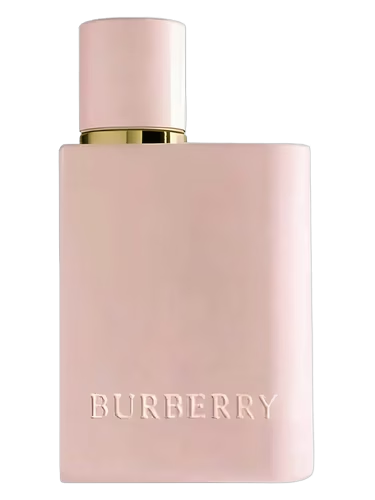
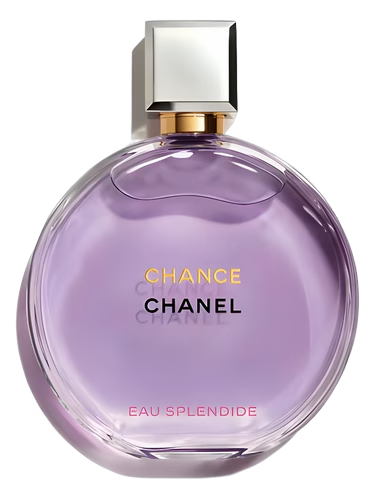
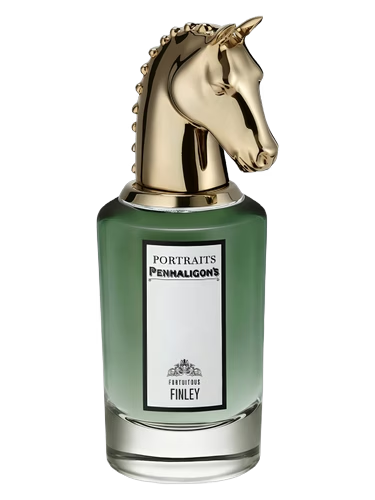
Most Popular Scents Using Magnolia Leaf
What is Magnolia Leaf?
Magnolia Leaf is a modern fragrance note derived from the broadleaf evergreen tree, valued in contemporary perfumery for providing a crisp, natural lift and a photorealistic green profile.What does Magnolia Leaf smell like?
It offers a crisp, intense green-floral aroma with watery freshness, featuring a sharp, leafy-fruity opening that transitions into soft notes reminiscent of jasmine tea and freesia.How is Magnolia Leaf essence extracted?
The essence is primarily extracted through steam distillation of fresh or frozen leaves, though advanced methods like supercritical CO2 extraction are also used to preserve heat-sensitive aromatic components.What are some top perfumes featuring Magnolia Leaf?
Popular fragrances include Gucci Bloom Acqua di Fiori, Frédéric Malle Eau de Magnolia, Jo Malone London Star Magnolia, and Estée Lauder Beautiful Magnolia.When is Magnolia Leaf in season?
Sourced from a broadleaf evergreen, the leaves are available year-round, though the tree undergoes a natural renewal cycle with peak leaf drop typically occurring between March and May.