Fragrance Notes Are Layers Of Scent That Are Layered To Form The Final Fragrance. Fragrance Notes Are Categorised Into Three Main Elements Based On How Long They Take To Evaporate, And How Long They Typically Last Following Application: Top Notes, Heart Notes And Base Notes.
Macadamia
Macadamia offers a rich, smooth, and creamy nutty aroma, often featuring warm, buttery, and slightly sweet gourmand facets. It provides an indulgent, velvety texture and deep comfort to fragrances, frequently used in base and heart notes to complement tropical, vanilla, or white floral accords, lending a sun-drenched, comforting warmth.

Origin & Extraction Of Macadamia
Macadamia nuts are native to Australia, where they were traditionally consumed by Indigenous Australians for thousands of years. They were introduced to other parts of the world, notably Hawaii, in the late 19th century. In perfumery, the use of Macadamia as a distinct, prominent note is relatively modern. It is not found in classical perfumery structures like Eau de Cologne, which relied on more traditional ingredients.
The Macadamia note gained relevance with the rise of the gourmand and dessert-inspired fragrance categories in the late 20th and early 21st centuries. Perfumers utilize the note, often as an accord, to evoke a creamy, warm, buttery, and slightly sweet aroma. It is frequently employed in contemporary compositions to add a luxurious, comforting texture, complementing notes like vanilla, coconut, and tropical florals, suggesting a sophisticated, edible warmth.
Extraction Methods of Macadamia
The primary method for extracting macadamia oil is cold expression (pressing), a mechanical process that involves crushing the dried kernels at low temperatures, typically below 49 degrees Celsius. Historically, macadamia oil was obtained through simple manual pressing or traditional expelling methods, though the industry was often constrained by the nut's extremely hard shell, which required specialized cracking machinery before extraction could occur. Unlike many vegetable oils that require pre-heating or "pre-cooking" to increase yield, macadamia oil is uniquely suited for cold pressing because its high fat content allows for the retention of its natural golden color and nutty aroma without the need for secondary refining.
Modern commercial production has advanced to utilize sophisticated hydraulic presses and fully automated screw-press systems (expellers) that optimize oil yield while maintaining strict temperature controls to preserve bioactive compounds like palmitoleic acid. Recent technological developments include subcritical extraction using organic solvents like butane or propane at low temperatures, and ultrasound-assisted hydrolase extraction, which enhances efficiency without the thermal degradation associated with traditional solvent methods. Additionally, molecular distillation is now employed to purify specific fatty acids, and freeze-dried microencapsulation techniques are being used to stabilize the oil for use in high-end pharmaceutical and cosmetic applications.
The Macadamia note is celebrated in modern perfumery for its rich, creamy, and gourmand texture, lending a luxurious, comforting warmth, particularly in the heart and base of a fragrance. This note is often showcased in compositions designed to evoke tropical or dessert-like indulgence. A key example highlighting this desirable warmth is Sol de Janeiro’s **Cheirosa '71** (2020), which uses the macadamia note to amplify its salted caramel and vanilla profile, establishing a highly popular, edible, and sun-drenched scent signature.
- * * *
In contemporary designer fragrance, Macadamia is utilized to add depth and a smooth, sweet complexity to traditionally lighter categories. Marc Jacobs’ **Daisy Wild** (2024), for instance, incorporates macadamia to provide a slightly buttery, velvety foundation, which supports and grounds the wild floral and banana flower notes, ensuring a sophisticated transition from the bright opening to the comforting drydown. This use demonstrates the note’s versatility in enhancing a composition’s structure while retaining a modern, uplifting quality.
- * * *
The note also finds a strong home in niche and high-concept fragrance lines, where its creamy facet is often paired with contrasting elements like white florals or unique milky accords. Commodity’s **Milk Orchid** (2025) is anticipated to feature macadamia prominently, combining its smooth, buttery sweetness with orchid and amber to create a scent that is both comforting and deeply sensual. This application leverages the macadamia’s ability to suggest an indulgent, sophisticated, and enduring sweetness in modern compositions.
Sustainability Of Macadamia
Sustainability of Macadamia
- Adopting a circular economy by reusing every part of the nut, including using shells for renewable energy or biochar and returning husks and branches to the soil as mulch
- Implementing biological pest control methods, such as utilizing Trichogramma wasps and nesting boxes for barn owls, to reduce the need for chemical pesticides
- Protecting biodiversity and natural pollinators by preserving wild native macadamia trees and utilizing native stingless bees for orchard pollination
- Promoting carbon sequestration through the cultivation of perennial macadamia trees, which remove significant amounts of CO2 from the atmosphere over their long lifespans
- Optimizing water usage through advanced irrigation scheduling and leveraging the tree's inherent ability to manage water efficiently during dry conditions
- Supporting socio-economic resilience by prioritizing local hiring and providing fair wages and benefits to workers within major growing regions
Trivia
Macadamia nuts possess the hardest shell of any commercially produced nut, requiring an incredible 300 pounds per square inch of pressure to crack open.
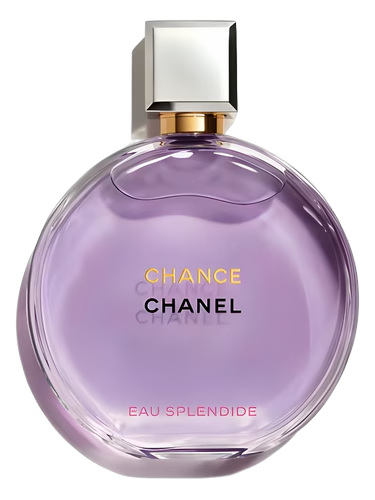
Most Popular Scents Using Macadamia


What is Macadamia?
Macadamia is a nut native to Australia that is used in modern perfumery to create a creamy, gourmand note, adding a luxurious and comforting texture to fragrances.What does Macadamia smell like?
It features a rich, smooth, and buttery nutty aroma with slightly sweet facets, often providing a velvety warmth similar to vanilla or coconut.How is Macadamia essence extracted?
The oil is primarily obtained through cold expression (pressing) of the dried kernels, a mechanical process that preserves its natural golden color and characteristic nutty scent.What are some top perfumes featuring Macadamia?
Notable fragrances include Sol de Janeiro Cheirosa '71, Marc Jacobs Daisy Wild, Phlur Matcha Milk, and Commodity Milk Orchid.When is Macadamia in season?
Harvesting occurs year-round depending on the hemisphere, typically from March to September in the Southern Hemisphere and August to February in the Northern Hemisphere.