Fragrance Notes Are Layers Of Scent That Are Layered To Form The Final Fragrance. Fragrance Notes Are Categorised Into Three Main Elements Based On How Long They Take To Evaporate, And How Long They Typically Last Following Application: Top Notes, Heart Notes And Base Notes.
Lydia Broom
Lydia Broom offers a complex, radiant, and slightly green floral profile. It is characterized by a honeyed sweetness reminiscent of Mimosa, a powdery warmth like Heliotrope, and a sharp, intoxicating intensity akin to Acacia blossom. This note provides a bright, sunny, and elegant Mediterranean freshness with a delicate, waxy texture.

Origin & Extraction Of Lydia Broom
Lydia Broom, derived from certain species of broom (Genista/Cytisus), has a history in perfumery that is more evocative and metaphorical than that of foundational florals like Rose or Jasmine. Historically, the use of broom in fragrance was often indirect, contributing to the "Foin Coupé" (cut hay) or yellow floral accords prized in 19th and early 20th-century compositions. Its intense, honeyed, yet slightly sharp aroma made it a valuable raw material for recreating the scent of sun-drenched Mediterranean landscapes and wild meadows, rather than being a standalone, celebrated note. However, its presence was vital in bridging the powdery sweetness of notes like Mimosa with greener, more herbaceous elements.
In modern and niche perfumery, Lydia Broom has gained recognition for its ability to lend sophisticated texture and lift, particularly in the realm of "soliflores" and abstract floral compositions. Perfumers today prize its complex profile, which includes facets of honey, hay, wax, and a slight bitterness reminiscent of green twigs, allowing it to provide greater longevity and complexity to top-heavy floral accords. Its contemporary use signals a movement towards showcasing unique, photorealistic botanical notes that capture specific environments, securing its place as a cherished, albeit specialized, note for nuanced fragrance development.
Extraction Methods of Lydia Broom
Historically, aromatic compounds from broom varieties like Lydia broom (Genista lydia) were obtained through simple extraction techniques such as infusion or long-duration steeping. Traditional methods involved boiling or simmering the plant material in water for periods ranging from fifteen minutes to an hour to extract pigments and volatile components, a process often used for artisanal dyeing and medicinal preparations.
In modern perfumery and botanical extraction, more advanced methods are utilized to capture the delicate floral and green notes of the plant. These include solvent extraction to create concretes and absolutes, as well as steam distillation for producing essential oils. Furthermore, propagation through semi-hardwood cuttings remains a standard practice for cultivating the plant to ensure a consistent supply of high-quality raw material for extraction purposes.
Lydia Broom, known for its complex, radiant, and slightly green floral profile with honeyed sweetness and powdery warmth, is a relatively uncommon yet highly prized note in niche perfumery, particularly for its ability to evoke the Mediterranean landscape. While not a staple of mass-market designer fragrances, it has been used by creators seeking a unique, sun-drenched floral intensity. One classic example where a prominent broom note—often related to the Lydia Broom profile—is utilized for its sunny, golden texture is **Broom** by a distinguished artisanal house, where it serves as the centerpiece of a bright, yet complex composition.
- The use of the broom note often signifies a focus on yellow florals, bridging the gap between mimosa's softness and acacia's sharper, more intoxicating zest.
The note truly shines in fragrances designed to capture specific natural scenes, moving beyond simple floral accords into olfactive storytelling. For instance, in **Mimosa & Cardamom** (while primarily centered on Mimosa, the supporting broom-like facets provide necessary lift and complexity), the bright, green nuances of Lydia Broom's profile complement the powdery floral heart, adding an elegant freshness. Furthermore, contemporary niche brands have experimented with it to give a unique edge to traditional soliflores, as seen in **Eau de Paca**, where the broom note lends a sophisticated, waxy texture and slight bitterness to an otherwise purely sweet bouquet.
- Perfumery often employs the broom note to impart a sense of "dry warmth," balancing wetter notes and extending the longevity of the top notes.
In summary, while Lydia Broom may lack the mainstream recognition of rose or jasmine, its complexity and photorealistic quality make it essential for capturing specific aromatic effects. Its presence, whether explicit or as a strong supporting facet, guarantees a fragrance with depth and character, moving from a bright, citrus-like opening to a warm, powdery dry-down. A great modern utilization of this note can be found in **Fiori d'Acacia**, where its radiant, slightly sharp intensity cuts through richer base notes, maintaining a luminous quality throughout the wear.
Sustainability Of Lydia Broom
Sustainability of Lydia Broom
- Promoting low-impact landscaping through exceptional drought and heat tolerance, significantly reducing the need for supplemental irrigation once established
- Enhancing soil fertility naturally as a nitrogen-fixing legume, which improves the nutrient profile of poor or marginal soils without the need for synthetic fertilizers
- Supporting local biodiversity by providing a rich nectar source for pollinators, including bees and butterflies, during its peak blooming season
- Reducing the carbon footprint of garden maintenance by serving as a resilient, low-maintenance groundcover that thrives in urban and windswept conditions
- Contributing to sustainable gardening practices by tolerating a wide range of soil pH and poor soil conditions, making it ideal for land restoration and xeriscaping
Trivia
Lydia Broom, also known as the "toothpick plant" in the Middle East, is a botanical contradiction whose vibrant golden flowers are as deliciously honey-scented as they are dangerously poisonous and hallucinogenic.
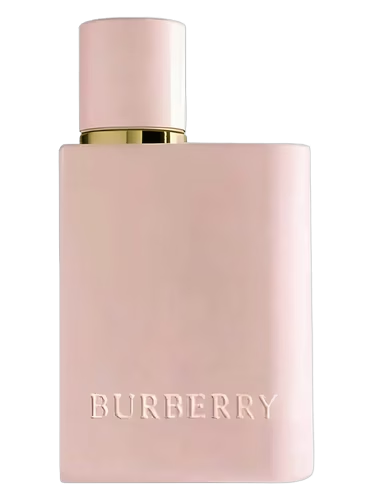
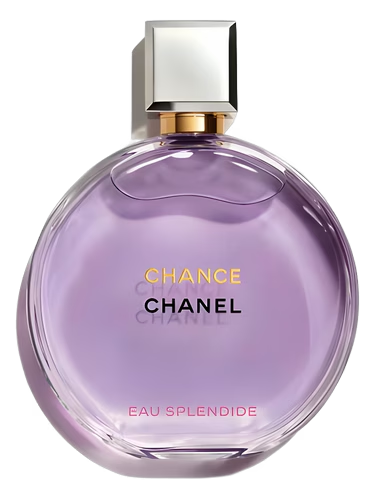
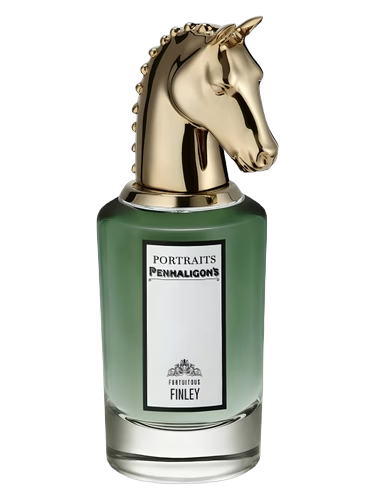
Most Popular Scents Using Lydia Broom
What is Lydia Broom?
Lydia Broom is a flowering shrub native to the Balkans, Turkey, and Syria, prized in perfumery for its radiant yellow blossoms that offer a complex, sun-drenched floral aroma.What does Lydia Broom smell like?
It features a honeyed sweetness reminiscent of mimosa, combined with powdery warmth like heliotrope and a sharp, green intensity similar to acacia blossom and hay.How is the Lydia Broom note used in perfumery?
In niche perfumery, it is used as a sophisticated heart note to provide texture, lift, and a photorealistic Mediterranean atmosphere to floral and green-floral compositions.Is there a natural essential oil for Lydia Broom?
While modern methods like solvent extraction and steam distillation can be used, Lydia Broom is often considered a fantasy note in perfumery, recreated by perfumers to capture its unique coconut-hay and honeyed profile.When does Lydia Broom bloom?
The plant follows a distinct seasonal cycle, typically producing a profusion of bright yellow flowers from mid-spring through early summer, specifically in May and June.What are some top perfumes featuring Lydia Broom?
Fragrances that highlight or utilize broom-like facets include Jorum Studio Gorseland, Mind Games As-suli's Diamond, Zoologist Bee, and Tom Ford Jasmin Rouge.