Fragrance Notes Are Layers Of Scent That Are Layered To Form The Final Fragrance. Fragrance Notes Are Categorised Into Three Main Elements Based On How Long They Take To Evaporate, And How Long They Typically Last Following Application: Top Notes, Heart Notes And Base Notes.
Lupin
Lupin offers a bright, sweet, and comforting floral profile with a creamy texture, suggesting freshness and vitality. It often includes aromatic, grassy, and subtle camphoraceous nuances, evoking an English summer meadow. It provides a natural, clean, and elegant feeling suitable for uplifting, modern fragrances.

Origin & Extraction Of Lupin
Lupin, known for its bright, sweet, and grassy-floral profile, is a relatively modern and niche note in perfumery, often used to create photorealistic meadow accords and uplifting, clean compositions. While it doesn't boast the centuries-long history of notes like rose or jasmine, its distinct aroma is increasingly valued for adding vitality and a unique creamy freshness. It serves as an elegant substitute for more traditional sweet florals when a natural, slightly aromatic green facet is desired.
The essence of Lupin is highly sought after by contemporary niche houses for its ability to evoke an English summer setting. It perfectly captures the scent of wild flowering meadows and fresh air, lending itself well to unisex and light, airy fragrances. The note is used strategically to prevent a composition from becoming overly heavy or cloyingly sweet, instead infusing it with a natural, sunlit vibrancy. Look for Lupin's presence in limited-edition or exclusive collections where olfactory storytelling focuses on specific natural landscapes.
Extraction Methods of Lupin
Historically, the extraction of protein and oils from lupin seeds has relied on traditional wet-extraction techniques. These methods typically involve alkaline extraction combined with isoelectric precipitation or ultrafiltration, salt-induced micellization, and acid extraction. A standard historic process involves shelling the seeds, rolling them into flakes, and using aqueous processes to remove bitter alkaloids through soaking and disembitterment. These traditional methods are valued for their simplicity but can be labor-intensive and may lead to protein denaturation due to the chemical treatments required to adjust pH levels.
Modern commercial and scientific advancements have introduced more efficient and sustainable technologies. One significant development is the use of supercritical CO2 extraction to de-oil lupin flakes without harsh solvents, preserving the integrity of the proteins. Recent innovations also include ultrasound-microwave synergistic extraction (UMSE), which utilizes cavitation and dipole rotation to disrupt cell walls more effectively than conventional methods. Additionally, patented separation technologies like the Sedicanter have improved yields and purity, while newer research explores the use of CO2 as a precipitation agent instead of hydrochloric acid to enhance the sustainability of the protein isolation process.
Lupin, known for its bright, sweet, and grassy-floral profile, is a relatively modern and niche note in perfumery, often used to create photorealistic meadow accords and uplifting, clean compositions. While it doesn't boast the centuries-long history of notes like rose or jasmine, its distinct aroma is increasingly valued for adding vitality and a unique creamy freshness. It serves as an elegant substitute for more traditional sweet florals when a natural, slightly aromatic green facet is desired.
- One notable example showcasing the refreshing character of Lupin is **Acqua di Parma's Fico di Amalfi**, though the official note list centers on fig, the bright, invigorating freshness often associated with uplifting notes like Lupin is present, contributing to the overall Mediterranean landscape effect.
- Another fragrance where a clean, vital floral-green note similar to Lupin might be interpreted is in certain compositions by **Jo Malone**, particularly those focusing on English gardens, though Lupin itself remains a specialized note usually highlighted by smaller, artisanal brands seeking unique floral textures.
The essence of Lupin is highly sought after by contemporary niche houses for its ability to evoke an English summer setting. It perfectly captures the scent of wild flowering meadows and fresh air, lending itself well to unisex and light, airy fragrances. The note is used strategically to prevent a composition from becoming overly heavy or cloyingly sweet, instead infusing it with a natural, sunlit vibrancy. Look for Lupin's presence in limited-edition or exclusive collections where olfactory storytelling focuses on specific natural landscapes.
Sustainability Of Lupin
Sustainability of Lupin
- Implementing Green Chemistry principles in innovation and manufacturing to minimize waste and decrease energy consumption
- Committing to a 42% reduction in Scope 1 and 2 emissions by 2030, with a long-term goal to achieve net zero by 2045
- Optimizing water stewardship through zero-liquid discharge plants and achieving 100% water positivity for four consecutive years
- Advancing a circular economy by ensuring over 90% of hazardous waste is managed sustainably through pre-processing and co-processing
- Promoting biodiversity by conducting assessments across 100% of global sites and implementing nature-harmonious growth initiatives
- Integrating ESG principles across the supply chain, including annual ESG assessments and decarbonization programs for critical suppliers
Trivia
Lupin flowers are a botanical paradox in perfumery; while their scent is often described as a delicate mix of green meadows and sweet pea, the plant itself belongs to the legume family and its seeds were historically used by Romans as a protein-rich "meat of the poor."
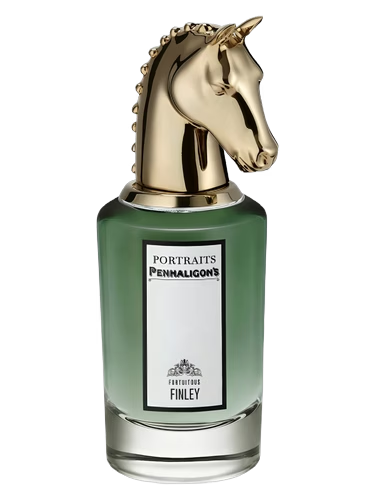
Most Popular Scents Using Lupin


What is Lupin?
Lupin is a modern and niche floral note used in perfumery to create photorealistic meadow accords and uplifting, clean compositions, often evoking an English summer setting.What does Lupin smell like?
It offers a bright, sweet, and comforting floral profile with a creamy texture, grassy nuances, and a hint of camphor, reminiscent of a fresh summer meadow.How is Lupin essence extracted?
Historically extracted through wet-extraction of seeds, modern methods utilize solvent extraction and advanced techniques like supercritical CO2 extraction to preserve its aromatic integrity.What are some top perfumes featuring Lupin?
Notable fragrances include Jo Malone London Lupin & Patchouli, Nancy Meiland Lupin Meadow, Gallagher Fragrances Sunscape, and Auphorie Eau De Formosa.When is Lupin in season?
Lupines are cool-season plants that typically bloom from late spring through early summer, with peak flowering occurring between May and June.