Fragrance Notes Are Layers Of Scent That Are Layered To Form The Final Fragrance. Fragrance Notes Are Categorised Into Three Main Elements Based On How Long They Take To Evaporate, And How Long They Typically Last Following Application: Top Notes, Heart Notes And Base Notes.
Longan Berries
Longan Berries offer a unique, translucent fruity note, reminiscent of a delicate, fresh lychee but with a slightly drier, muskier sweetness and a hint of white floral nuance. It provides a sheer, aqueous, and subtly honeyed texture, lending a soft, sophisticated, and uplifting tropical brightness often used in airy, modern compositions.

Origin & Extraction Of Longan Berries
Longan, or Dragon's Eye fruit, originates from Southeast Asia and China, where it has been cultivated for thousands of years for consumption and traditional medicine. Its history in perfumery is very recent compared to classic notes, as perfumers began seeking out unique, exotic, and transparent fruity accords to modernize compositions in the late 20th and early 21st centuries. The note is typically an abstract reconstruction or a high-tech extract, valued for its sheer, aqueous quality that avoids the heaviness of more traditional fruit essences.
The Longan Berries note is primarily utilized in contemporary niche and designer fragrances that aim for an airy, delicate, and sophisticated sweetness. It serves as a subtle tropical accent, often paired with aquatic notes, white musks, or delicate florals to enhance luminosity. Because it closely resembles lychee but with a drier, muskier undertone, it allows perfumers to introduce an exotic fruitiness while maintaining an elegant, non-gourmand lightness in modern compositions.
Extraction Methods of Longan Berries
The extraction of aromatic and bioactive compounds from longan berries (Dimocarpus longan) is primarily achieved through maceration, solvent extraction, and distillation. Historically, simple hot water extraction (HWE) and maceration were the standard methods, involving the simmering or soaking of the fruit pulp, seeds, or dried peels to capture their sweet, fruity essences and medicinal properties. These traditional techniques rely on the natural permeability of the plant material under heat or prolonged exposure to a liquid base.
Modern commercial and scientific practices have evolved to include more advanced and efficient technologies. Contemporary methods frequently utilize steam distillation or hydrodistillation with a Clevenger-type apparatus to isolate volatile compounds, often preceded by freezing or drying the material to disrupt cell walls. Furthermore, high-purity extracts are now produced using supercritical CO2 extraction, microwave-assisted extraction, and ultrasonic crushing, which allow for the precise collection of delicate aromatic molecules without the thermal degradation associated with traditional boiling.
The Longan Berries note, known for its sheer, aqueous, and subtly honeyed tropical sweetness, is a relatively modern addition to the perfumer's palette, often appearing in contemporary compositions aiming for sophisticated lightness. A notable example is **Daisy Dream Daze** by Marc Jacobs. This fragrance utilizes the longan note to provide a luminous, uplifting start, blending its delicate fruitiness with sweet florals to maintain the airy, youthful signature of the Daisy line while introducing an exotic, non-heavy freshness.
- * * *
In niche perfumery, Longan Berries are valued for their complex profile, which avoids the heaviness of more traditional fruit essences. In **Rain Tea** by Chasing Scents, the note is expertly employed to evoke a translucent, comforting sweetness, mirroring the fruit's association with delicate Asian beverages. Here, the longan note serves to enhance the composition's overall tea and aquatic theme, adding a subtle, muskier depth that prevents the fragrance from becoming overtly tart or sugary, maintaining an elegant balance.
- * * *
Other modern interpretations demonstrate the versatility of the Longan Berries accord. **Coïncidence** by Scène Fragrance and **Longan & Red Dates 桂圆红枣** by Project Element 元素项目 0000 showcase the note's adaptability. While the former likely uses it for a subtle, exotic brightness in a broader composition, the latter focuses on its cultural roots, pairing it with red dates to create a specific, warm, gourmand-tropical scent profile, illustrating how longan can function both as a delicate supporting accent and a central theme in modern fragrance creation.
Sustainability Of Longan Berries
Sustainability of Longan Berries
- Promoting a circular economy by valorizing agricultural waste, such as repurposing longan seeds into natural coagulant aids for eco-friendly water treatment
- Implementing integrated pest management (IPM) and biological remedies to reduce reliance on synthetic agrochemicals and meet stringent food safety standards
- Adoption of smart irrigation techniques and precision water management to improve efficiency and maintain soil moisture in tropical and subtropical regions
- Enhancing biodiversity through agroforestry and intercropping practices that support healthy soil microbiomes and provide habitats for pollinators
- Supporting socio-economic resilience for smallholder farmers by integrating apiculture, which can increase fruit yields by 20% and provide secondary honey income
- Developing innovative post-harvest cold treatment processes to eliminate pests without the use of irradiation or harmful chemicals, ensuring safe global exports
- Focusing on food loss reduction initiatives throughout the supply chain to improve food security and minimize environmental impact in line with global sustainability goals
Trivia
The longan is known as the dragon's eye because its translucent white flesh and dark, pupil-like seed create the uncanny appearance of a realistic eyeball when the shell is removed.
Most Popular Scents Using Longan Berries
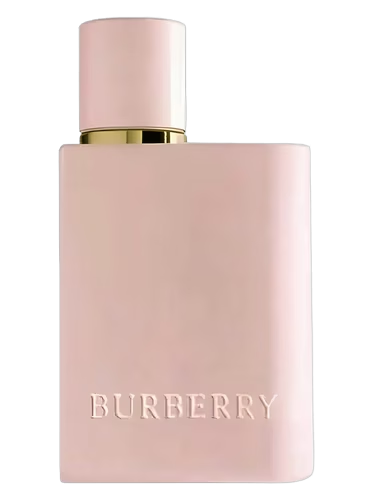
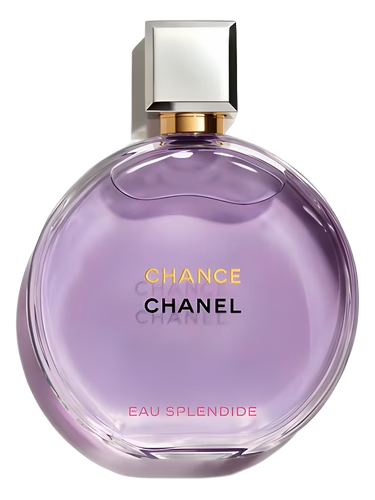
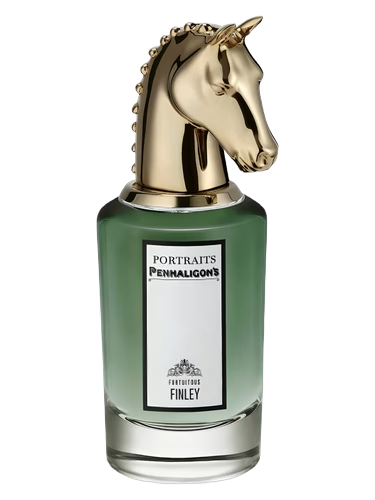
What are Longan Berries?
Longan Berries, also known as Dragon's Eye, are tropical fruits native to Southeast Asia and China, used in modern perfumery for their sheer, aqueous, and subtly honeyed fruity profile.What does the Longan Berries note smell like?
It offers a unique, translucent sweetness similar to lychee but with a drier, muskier undertone and soft white floral nuances, providing an airy and sophisticated tropical brightness.How is the essence of Longan Berries extracted?
The aromatic compounds are typically captured through distillation, maceration, or solvent extraction, with modern high-tech methods like supercritical CO2 extraction used to preserve delicate molecules.What are some top perfumes featuring Longan Berries?
Notable fragrances include Marc Jacobs Daisy Dream Daze, Chasing Scents Rain Tea, Scène Fragrance Coïncidence, and Project Element Longan & Red Dates.When are Longan Berries in season?
The fruit typically ripens and is harvested during the summer months, with the peak season generally spanning from late July to September in the Northern Hemisphere.