Fragrance Notes Are Layers Of Scent That Are Layered To Form The Final Fragrance. Fragrance Notes Are Categorised Into Three Main Elements Based On How Long They Take To Evaporate, And How Long They Typically Last Following Application: Top Notes, Heart Notes And Base Notes.
Loganberry
Loganberry offers a complex, juicy red fruit profile, blending the sweet, slightly tart facets of raspberry and blackberry. It is characterized by a fresh, vibrant fruitiness with nuanced undertones of sweet apricot and tropical pineapple. This multifaceted berry note is used to provide a lush, sparkling, and slightly jammy opening.

Origin & Extraction Of Loganberry
The Loganberry is a hybrid fruit, first accidentally created in 1881 by James Harvey Logan in Santa Cruz, California, by crossing a raspberry and a blackberry. Unlike many older fruit notes, Loganberry is not a historically foundational element in perfumery. Its use largely emerged with the rise of modern fragrance chemistry in the late 20th and early 21st centuries, where perfumers sought increasingly specific and complex berry and red fruit accords to add lushness and a slight jammy sweetness.
Because the natural essential oil of berries is often difficult or unstable to extract and utilize in fragrance, the Loganberry note is typically created as a synthetic accord, capitalizing on its unique profile that balances the tartness of blackberry with the sweetness of raspberry, often incorporating nuances of apricot or pineapple as suggested by its odor profile. It is favored in contemporary compositions, particularly fruity-florals and gourmand scents, to provide a vibrant, complex, and sparkling opening note.
Historically, the extraction of loganberry essence and juice was a manual, labor-intensive process centered on hand-picking the fruit at peak ripeness and using mechanical pressing. Because loganberries do not pull free from the core like raspberries, they were traditionally harvested with the receptacle intact and crushed to release their tart, deep-red juice for use in artisanal jams, syrups, and country wines.
Modern commercial extraction utilizes advanced technologies to preserve the fruit's complex aromatic profile and bioactive compounds. Current methods include aseptic pureeing, where the fruit is processed into a shelf-stable concentrate without refrigeration, and innovative green extraction techniques like Cold Plasma-Assisted Enzyme Method (CPEM) and Supercritical Fluid Extraction (SFE). These latest methods, often optimized by artificial neural networks, allow for the selective isolation of anthocyanins and polyphenols while significantly reducing solvent use and processing time.
The Loganberry note provides a unique blend of tartness and sweetness, often described as a hybrid of blackberry and raspberry. This complex profile makes it a popular choice for modern fragrances looking for an unconventional fruity opening. Notable examples of its use include Purple Accento and Purple Accento Crystal Edition from Xerjoff, which feature the note to add a sophisticated, deep berry sweetness to their compositions.
- Healing Berry by Jorum Studio
- #flowerpower (2023) by Ramon Monegal
Loganberry is also celebrated in the world of independent and artisanal perfumery, where its rich, slightly earthy fruitiness can be fully showcased. Healing Berry by Jorum Studio is a prime example, centering the note in a complex composition that explores its natural, almost jammy facets. The note's use is geared towards creating layered, photorealistic berry experiences rather than simple, bright top notes.
- The note is featured in other modern, unique compositions such as Eau d'Aspiration by Gravel and Sunshine Vibe by Maracujá Brasil.
The Loganberry note is typically used to bridge sparkling, fresh openings with warmer, more substantial heart and base notes, adding longevity to a fruity accord. Its tart, juicy character and subtle resinous qualities make it versatile across various fragrance families, from uplifting fruity-florals to deep gourmand or woody oriental structures.
Sustainability Of Loganberry
Sustainability of Loganberry
- Promoting organic and natural farming practices such as composting, crop rotation, and the elimination of synthetic pesticides to build soil health and biodiversity
- Adopting water-efficient resource management, including water recycling systems and drip irrigation, to reduce overall consumption
- Implementing renewable energy solutions like solar power to decrease the carbon footprint of production and processing facilities
- Utilizing circular economy principles by transforming production waste into organic soil amendments and using recycled or lightweight packaging materials
- Supporting heritage preservation and seed-saving initiatives to maintain genetic diversity and long-term crop resilience
- Establishing sustainable land stewardship through intensive rotational grazing of heritage livestock and promoting the growth of native-aligned hybrids
Trivia
The loganberry is a serendipitous hybrid created by accident in 1881 when judge James Harvey Logan attempted to cross two varieties of blackberries and unintentionally produced a cross between a blackberry and a red raspberry.
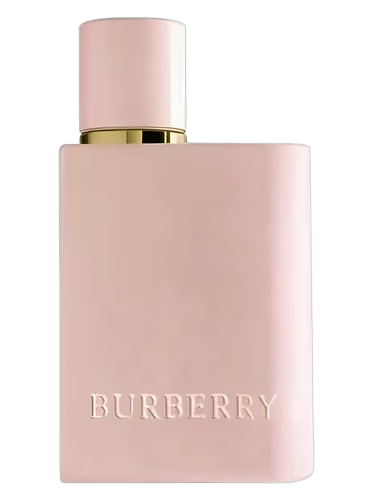
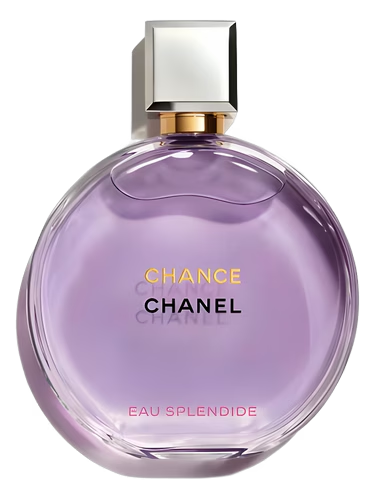
Most Popular Scents Using Loganberry

What is Loganberry?
Loganberry is a hybrid fruit created in 1881 by crossing a North American blackberry and a European red raspberry, now used in modern perfumery for its complex red fruit profile.What does Loganberry smell like?
It offers a juicy, multifaceted aroma that blends the tartness of blackberry with the sweetness of raspberry, often featuring nuances of apricot and tropical pineapple.How is Loganberry essence extracted for perfume?
Because natural extraction is difficult, the note is typically created as a synthetic accord; however, modern techniques like Cold Plasma-Assisted Enzyme Method are used for fruit processing.What are some top perfumes featuring Loganberry?
Notable fragrances include Jorum Studio Healing Berry, Xerjoff Purple Accento, and Ramon Monegal #flowerpower.When is Loganberry in season?
The fruit typically blooms in spring and is harvested during its peak window from late June through July, bridging the gap between strawberry and autumn berry seasons.