Fragrance Notes Are Layers Of Scent That Are Layered To Form The Final Fragrance. Fragrance Notes Are Categorised Into Three Main Elements Based On How Long They Take To Evaporate, And How Long They Typically Last Following Application: Top Notes, Heart Notes And Base Notes.
Litsea Cubeba
Litsea Cubeba, often called May Chang, offers an intense, bright, and invigorating lemon scent that is sharper and cleaner than traditional lemon, with a subtle floral and slightly green-herbaceous undertone. It is intensely fresh and often described as being reminiscent of lemongrass and verbena, providing a sparkling citrus uplift in perfumery compositions.

Origin & Extraction Of Litsea Cubeba
Litsea Cubeba, often referred to by its common name May Chang, originates from the essential oil extracted from the fruit of the evergreen tree native to East Asia. While the plant has a long history in traditional medicine and aromatherapy, its widespread use in fine perfumery is a relatively modern development. Unlike the historically essential citrus notes like Bergamot or Lemon, Litsea Cubeba gained prominence in the late 20th and early 21st centuries. Perfumers discovered its intense, bright, and clean lemon scent offered a superior, less volatile alternative to traditional lemon oils, along with a distinct herbaceous and floral complexity reminiscent of lemon verbena and lemongrass.
Today, Litsea Cubeba is highly valued in contemporary perfumery, particularly within niche and natural fragrance lines, for its ability to provide a clean, invigorating, and high-fidelity citrus opening. It is frequently employed in fresh, aquatic, and light Eau de Cologne compositions where a sparkling, uplifting effect is desired. The note's subtle complexity allows it to bridge the volatile top notes with the middle and base, giving the initial citrus burst a longer-lasting, more refined presence. Its inclusion often signifies a modern approach to freshness, appealing to consumers who seek transparent and natural-smelling compositions.
Extraction Methods of Litsea Cubeba
Litsea cubeba essential oil is primarily extracted through steam distillation or hydrodistillation of the plant's fresh fruits, though it can also be obtained from the flowers, leaves, bark, and roots. Historically, traditional distillation methods involved the use of simple steaming kiers, boilers, and condensers to capture the volatile oils, a process that remains the standard for commercial production in China and Southeast Asia. To further refine the oil and enrich its bioactive components like citral, advanced techniques such as vacuum fractional distillation and molecular distillation are frequently employed to separate thermally unstable compounds and improve purity.
Recent developments focus on enhancing yield and sustainability through green extraction technologies. Solvent-free microwave extraction (SFME) has emerged as a significant advancement, utilizing in situ water within plant cells to release oils more efficiently than traditional hydrodistillation while reducing energy consumption. Additionally, innovative methods such as ultrasonic-assisted extraction, supercritical carbon dioxide (scCO2) extraction, and the use of deep eutectic solvents are being utilized to capture delicate aromatic molecules and maximize the valorization of by-products like the fruit kernels.
The Litsea Cubeba note, often referred to as May Chang, provides an intense, clean, and invigorating lemon scent that has been embraced by modern perfumery for its lasting freshness and unique character, differentiating it from traditional citrus oils. While traditionally used in aromatherapy, its bright, sparkling profile makes it a key component in refreshing and uplifting fragrances.
- A notable use is in L'Occitane Verbena Eau de Toilette, where Litsea Cubeba reinforces the lemon verbena accord, boosting its clean, green, and vibrant qualities.
- Another example is Acqua di Parma Fico di Amalfi, where it contributes to the sparkling, zesty opening, supporting the dominant grapefruit and bergamot notes to create a bright, Mediterranean-inspired energy.
- In niche perfumery, Atelier Cologne Pomélo Paradis uses the ingredient to enhance the overall citrus vibrancy, giving the scent its intensely fresh, zesty, and effervescent top-note burst.
Litsea Cubeba is frequently employed to extend the longevity of citrus compositions, as its molecular structure is often more persistent than volatile citrus fruit oils like lemon or lime. This characteristic makes it valuable in Eaux de Cologne and fresh, summery compositions, ensuring the initial burst of zest and brightness endures well into the heart phase of the fragrance.
Sustainability Of Litsea Cubeba
Sustainability of Litsea Cubeba
- Advancing toward a zero-waste biorefinery by repurposing large amounts of residue and biowastes from essential oil processing into value-added products like animal feed and lauric oil
- Implementing eco-friendly extraction technologies, such as steam distillation and ultrasound-assisted extraction, to reduce energy consumption and eliminate the use of harmful chemical solvents
- Increasing supply chain transparency and ethical sourcing by partnering directly with local seed collectors and establishing distillation plants within growing regions
- Supporting the socio-economic well-being of indigenous communities through traditional knowledge documentation programs and fair trade principles that provide stable incomes and capacity building
- Promoting biodiversity and environmental protection by re-using dried oil residues as fuel for distillation and encouraging natural cultivation practices that reduce the impact on local ecosystems
Trivia
Also known as May Chang, Litsea cubeba is primarily used in industrial chemistry as a renewable chemical factory to synthesize Vitamins A, E, and K, rather than for fine fragrance.
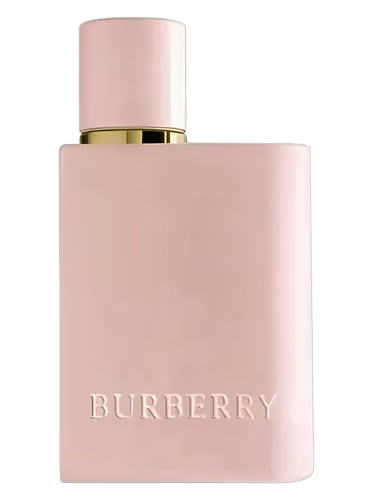
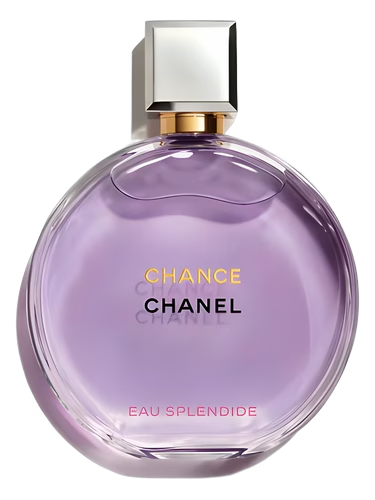
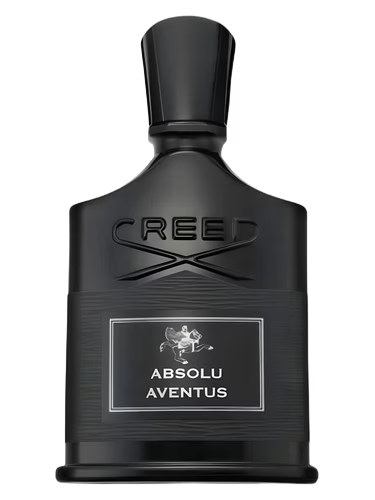
Most Popular Scents Using Litsea Cubeba
What is Litsea Cubeba?
It is an essential oil extracted from the fruit of an evergreen tree native to East Asia, also known as May Chang, prized for its intense and clean lemon-like scent.What does Litsea Cubeba smell like?
It offers a sharp, sparkling lemon aroma with subtle floral and green-herbaceous undertones, often compared to a more refined and sweeter version of lemongrass.How is Litsea Cubeba oil extracted?
The oil is primarily obtained through steam distillation or hydrodistillation of the plant's fresh, pepper-like fruits.What are the benefits of Litsea Cubeba in perfumery?
It serves as a high-impact top note that provides a long-lasting citrus uplift and helps bridge volatile top notes with a fragrance's heart.What are some famous perfumes featuring Litsea Cubeba?
Notable fragrances include L'Occitane Verbena, Acqua di Parma Fico di Amalfi, Atelier Cologne Pomélo Paradis, and Nishane Wulóng Chá.