Fragrance Notes Are Layers Of Scent That Are Layered To Form The Final Fragrance. Fragrance Notes Are Categorised Into Three Main Elements Based On How Long They Take To Evaporate, And How Long They Typically Last Following Application: Top Notes, Heart Notes And Base Notes.
Litchi
Litchi offers a vibrant, aqueous, and tropical fruity profile, often described as a blend of juicy grape, sweet pear, and tart berries. It has a distinctive delicate, sweet rose undertone, with nuances of peach and apricot. It lends a sparkling, uplifting, and subtly floral freshness, commonly used in modern fruity-floral compositions.

Origin & Extraction Of Litchi
Litchi (lychee) is a tropical fruit native to China, where its cultivation dates back thousands of years. While the fruit itself has a rich ancient history, its distinct scent profile—a blend of sweet, aqueous fruitiness with a delicate, subtly floral rose nuance—only became prominent in Western perfumery with the rise of modern fragrance chemistry and the Fruity-Floral category in the late 20th century. Before this, perfumers generally relied on traditional fruit notes or constructed basic fruit accords.
In contemporary perfumery, Litchi is often created synthetically, using molecules that capture its vibrant, aqueous, and sweet aroma, making it less volatile and more stable than natural fruit extracts. It is highly valued for its ability to add a sparkling, exotic, and contemporary uplift to compositions, moving beyond traditional citrus notes. Litchi's sweet, rosy undertone makes it a frequent and popular pairing with light florals, helping to define the modern, cheerful aesthetic of many designer and niche fragrances.
Historically, litchi aromatic compounds and oils were obtained through traditional manual and simple mechanical processes. For centuries, extraction from litchi seeds involved drying and crushing the raw material, followed by maceration in water or spirits to capture its essence. In some traditional practices, hydrodistillation using a Clevenger-type apparatus was employed to isolate essential oils from the leaves, peels, and seeds, a method that remains a foundational technique in botanical studies today.
Modern commercial extraction has evolved to include more precise and efficient methods. Cold pressing (mechanical expression) is the preferred method for producing high-quality litchi seed oil, utilizing low-temperature controlled conditions (typically 80-90°F) to preserve delicate phytonutrients and aromatic integrity without chemical solvents. For perfumery and flavor analysis, advanced techniques such as Solvent Assisted Flavor Evaporation (SAFE) and supercritical carbon dioxide (CO2) extraction are utilized to isolate specific volatile compounds. Furthermore, industrial processes now explore pressurized fluid extraction and ultrasound-assisted extraction to optimize the yield of bioactive phenolic compounds from litchi side-streams like peels and seeds.
Litchi has emerged as a star note in the contemporary fruity-floral category, celebrated for its unique profile that balances aqueous sweetness with a delicate rose nuance. This sweet, tropical fruitiness provides an immediate sense of vibrancy and modern femininity, making it a highly desirable opening note for fragrances designed to be cheerful and uplifting. The note is essential in current releases that seek to offer an exotic twist on traditional fruit accords.
- A prominent modern example is Kayali’s Eden Sparkling Lychee | 39 Eau de Parfum, which centers the Litchi note to provide a juicy, effervescent, and bright top layer.
- The note also plays a critical supporting role in fragrances like Mugler’s Angel Nova Eau de Toilette, where its fruity character enhances the composition’s dynamic, bold, and energetic opening before transitioning to the rose heart.
- In Hermès’ Tutti Twilly d'Hermès, Litchi is utilized to offer a cheerful, sparkling contrast to the main ginger and tuberose notes.
The subtle, rosy undertone of Litchi makes it a perfect companion for floral notes, helping to create seamless transitions between the fruit top notes and the flower heart. This effect is masterfully demonstrated in high-end fragrances like Maison Francis Kurkdjian’s L'eau À la Rose, where the aqueous Litchi brightens and sweetens the dominant rose accord without adding weight, resulting in a fresh, delicate, and enduring elegance.
Furthermore, Litchi's sophistication is often showcased in niche perfumery to give complex, long-lasting structures an immediate, dazzling lift. For instance, in Ex Nihilo’s Fleur Narcotique Extrait de Parfum, Litchi’s luminous, juicy quality contributes to the perfume's overall intoxicating and slightly addictive floral character, proving that the note can anchor complex luxury compositions as effectively as it brightens simpler ones.
Sustainability Of Litchi
Sustainability of Litchi
- Promoting organic farming practices by utilizing farmyard manure, vermicompost, and biogas slurry to sequester soil carbon and improve water-holding capacity
- Supporting smallholder economic resilience by providing high-value crops that can significantly increase the income of families with small landholdings
- Implementation of integrated pest management and bio-enhancers to reduce reliance on synthetic agrochemicals and protect local ecosystems
- Developing eco-friendly post-harvest technologies, such as sulfur-free processing, to extend shelf life naturally and meet global safety standards
- Enhancing biodiversity and resource conservation through intercropping with leguminous plants and using organic mulches to prevent soil erosion
- Adoption of water-efficient irrigation systems, such as drip irrigation, to minimize moisture stress and optimize resource usage in water-sensitive regions
Trivia
Litchi is often called the king of fruits in China and possesses a chemical profile so similar to roses that it contains high concentrations of rose oxide, the same volatile compound that gives roses their distinctive scent.
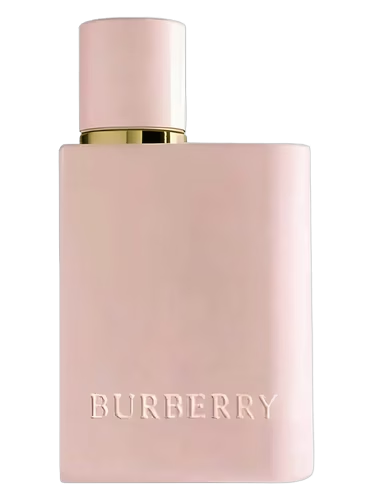
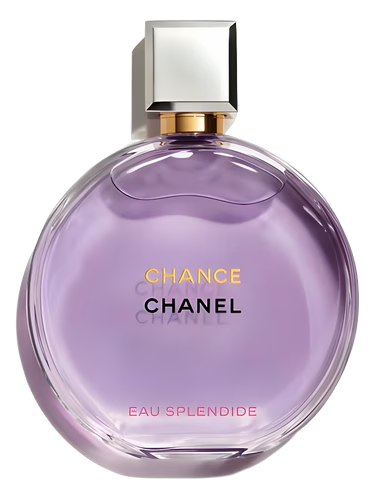
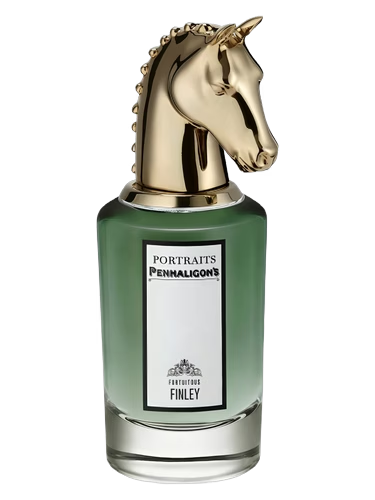
Most Popular Scents Using Litchi
What is Litchi?
Litchi is a tropical fruit native to Southern China and Northern Vietnam that became a staple in Western perfumery with the rise of modern fruity-floral fragrances in the late 20th century.What does Litchi smell like?
It offers a vibrant, aqueous, and tropical fruity profile similar to a blend of juicy grape and sweet pear, characterized by a distinctive and delicate rose-like undertone.How is Litchi essence extracted?
In modern perfumery, litchi notes are often created synthetically or obtained through advanced methods like CO2 extraction and molecular distillation to capture its fresh, sparkling aroma.What are some top perfumes featuring Litchi?
Popular fragrances featuring this note include Parfums de Marly Delina, Chloe Eau de Parfum, Mugler Angel Nova, and Kayali Eden Sparkling Lychee | 39.When is Litchi in season?
The fruit has a short harvest window primarily during the late spring and summer months, typically reaching peak abundance between May and August.