Fragrance Notes Are Layers Of Scent That Are Layered To Form The Final Fragrance. Fragrance Notes Are Categorised Into Three Main Elements Based On How Long They Take To Evaporate, And How Long They Typically Last Following Application: Top Notes, Heart Notes And Base Notes.
Lime (Linden) Blossom
Lime (Linden) Blossom is a bright, uplifting yellow floral note, possessing a luminous, sweet character reminiscent of warm honey and pollen. It features delicate green nuances and a hint of fresh, slightly tropical zestiness. The profile is elegant, airy, and evocative of early summer, often used to create a cheerful and tender opening.

Origin & Extraction Of Lime (Linden) Blossom
Linden, or Lime Blossom ( Tilia species), has a long history of appreciation across Europe, dating back to ancient times where the tree was a symbol of love and longevity. Its use in historical fragrant preparations was widespread, though often for medicinal or ceremonial purposes. The characteristic sweet, honeyed aroma of the flowers—which bloom intensely during early summer—made them a cherished ingredient in traditional European herbalism and simple scented waters.
In fine perfumery, Linden Blossom emerged as a distinct and valued note, particularly as perfumers sought to capture naturalistic, fleeting floral scents. Unlike the heavy florals popular in the 19th century, linden provided a bright, airy, and luminous quality. It is often employed in modern and niche compositions to evoke nostalgia, summery freshness, and natural elegance, acting as a bridge between green notes and soft, pollen-like sweetness. It is recognized for its unique ability to be both comforting and subtly invigorating.
Extraction Methods of Lime (Linden) Blossom
Historically, the aromatic and medicinal properties of linden blossoms were captured through simple traditional techniques such as infusions, decoctions, and macerations. In European folk medicine, blossoms and their attached bracts were steeped in hot water to create "tilleul" tea or boiled to produce deep red decoctions used for therapeutic baths. Ancient methods also involved infusing the fresh flowers into honey or alcohol to create tinctures, sometimes adding glycerin to stabilize the solution. For perfumery, the delicate scent was traditionally obtained by macerating dried flowers in solvents or fats.
In modern production, linden blossom extract is primarily obtained through conventional liquid-solid extraction using solvents like ethanol and water, often involving precise temperature controls between 60°C and 75°C to optimize the yield of bioactive flavonoids and phenolics. For skincare applications, common industrial processes involve macerating the flowers in a mixture of deionized water and glycerin, followed by heating to 100°C, cooling, and fine filtration to produce a stable aqueous concentrate. While high-quality absolutes can be produced via solvent extraction, the scent is frequently recreated synthetically in modern perfumery to capture the volatile honey-like aroma of farnesol that is difficult to preserve through heat-intensive distillation.
Linden Blossom, or Lime Blossom, is a cherished floral note in perfumery, valued for its bright, honeyed, and slightly green scent profile, which beautifully captures the essence of summer. It is often employed to create fragrances that feel simultaneously comforting and uplifting. One house that masterfully features this note is L'Artisan Parfumeur. They used it prominently in their iconic creation, La Chasse aux Papillons Extreme, where the linden acts as the central, luminous floral note, evoking a sun-drenched garden and pairing perfectly with tuberose and jasmine.
- * * *
The gentle, airy quality of Lime Blossom lends itself perfectly to softer, more ethereal compositions. A further exploration by L'Artisan Parfumeur resulted in L'Ete en Douce, where the linden note contributes a sweet, clean, and tender opening. This fragrance is an excellent example of how the note can be used to create a sophisticated, quiet freshness that is less zesty than citrus fruit and more focused on the delicate, honeyed floralcy of the flower itself, making it ideal for warm weather or subtle skin scents.
- * * *
In contemporary and niche perfumery, Lime Blossom continues to be utilized to add unique luminosity and complexity, often bridging traditional floral structures with modern simplicity. For example, Sol Salgado Extrait de Parfum by Thomas de Monaco showcases the note’s unique capacity to blend a slightly tropical zest with a warm, pollen-like sweetness. The note’s inherent complexity—combining elements of honey, green leaves, and delicate lemon—ensures that fragrances featuring it possess an elegant, multi-faceted radiance.
Sustainability Of Lime (Linden) Blossom
Sustainability of Lime (Linden) Blossom
- Classified as Green/Least Concern on the IUCN Red List of endangered species, indicating a stable sustainability status in the wild
- Promoting the adoption of sustainable and regenerative farming methods, including the elimination of GMO seeds and synthetic chemicals, to protect soil health and biodiversity
- Developing managed production models for forest villagers to replace heavy wild pruning with technical pruning equipment, ensuring the long-term health of natural linden forests
- Establishing legal frameworks and certification standards, such as FairWild, to regulate harvesting practices and prevent over-exploitation of medicinal plant populations
- Utilizing linden trees as urban environmental superstars that improve air quality by sequestering carbon and providing critical habitats and food sources for diverse pollinators
Trivia
Despite its common name, the lime linden tree is not related to the citrus lime; it belongs to the marshmallow family and was traditionally used by Germanic tribes to construct shields due to its soft, lightweight wood.
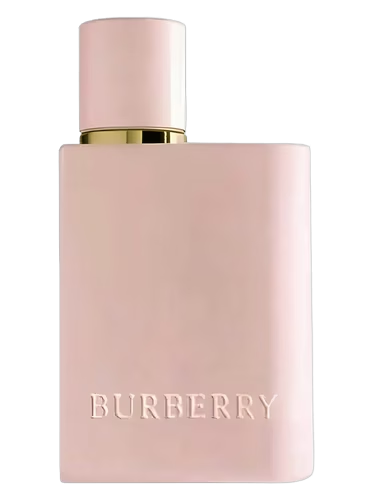
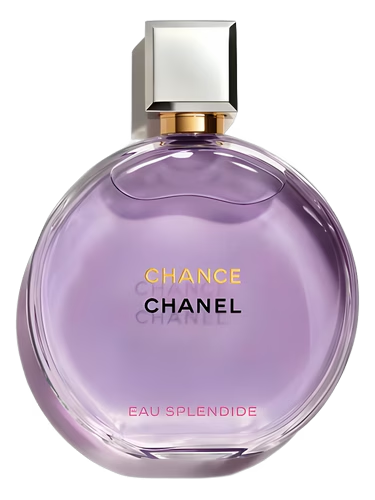
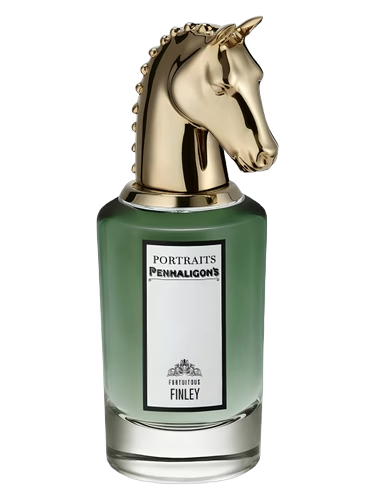
Most Popular Scents Using Lime (Linden) Blossom
What is Lime (Linden) Blossom?
Lime (Linden) Blossom is a fragrance note derived from the flowers of the Tilia tree, prized for its bright, honeyed yellow floral profile and its historical association with love and longevity.What does Lime (Linden) Blossom smell like?
It features a luminous, sweet aroma reminiscent of warm honey and pollen, balanced by delicate green nuances and a hint of fresh, slightly tropical zestiness.Is Lime (Linden) Blossom related to citrus lime?
No, despite its common name, the linden tree belongs to the Malvaceae (marshmallow) family and is entirely unrelated to the citrus fruit.How is Lime (Linden) Blossom essence extracted?
In modern perfumery, high-quality extracts are primarily obtained through CO2 extraction or solvent extraction, though the scent is also frequently recreated synthetically to capture its delicate, volatile facets.What are some top perfumes featuring Lime (Linden) Blossom?
Notable fragrances include L'Artisan Parfumeur La Chasse aux Papillons, Marc-Antoine Barrois Tilia, Elizabeth Arden 5th Avenue, and Jo Malone London French Lime Blossom.When is Lime (Linden) Blossom in season?
The trees typically bloom during a short and intense period in early to mid-summer, generally spanning from late June through July.