Fragrance Notes Are Layers Of Scent That Are Layered To Form The Final Fragrance. Fragrance Notes Are Categorised Into Three Main Elements Based On How Long They Take To Evaporate, And How Long They Typically Last Following Application: Top Notes, Heart Notes And Base Notes.
Lily-of-the-Valley
A delicate, radiant floral note (Muguet), often synthetically reconstructed due to extraction difficulty. It is fresh, green, dewy, and airy, with subtle soapy nuances. It serves as an elegant heart note, lending clarity, brightness, and soft femininity to compositions, blending seamlessly with other florals, green notes, and musks.

Origin & Extraction Of Lily-of-the-Valley
Lily-of-the-Valley, or Muguet, is highly prized in perfumery for its delicate, radiant, and fresh aroma. However, due to the difficulty of extracting a usable natural essence, it is almost always synthetically reconstructed. The note embodies spring, purity, and feminine elegance, and its use is a cornerstone of classic compositions. The difficulty of extraction meant that chemists had to successfully synthesize the aroma to secure its place in fine fragrance.
The note truly gained iconic status in 1956 with the launch of Diorissimo by Christian Dior. Perfumer Edmond Roudnitska revolutionized the use of Muguet by creating a radiant floral soliflore, capturing the singular scent of the flower and expressing a sense of happiness and optimism. This fragrance set the benchmark for Lily-of-the-Valley scents and cemented its legacy as an essential component for creating sheer, clean, and bright floralcy in both classic Eaux de Cologne and modern compositions.
Extraction Methods of Lily of the Valley
Historically, lily of the valley was considered a mute flower because its delicate scent could not be captured through traditional steam distillation, which destroys its volatile compounds. To overcome this, early perfumers utilized the labor-intensive method of enfleurage, which involved layering fresh blossoms on sheets of animal fat to absorb their fragrance. Despite these efforts, the yield was often too small for commercial viability, leading most perfumers to create lily of the valley accords from scratch using other natural and synthetic ingredients.
In modern perfumery, the fragrance is almost exclusively recreated through synthetic reconstruction and headspace technology (Nature Print), which analyzes and reproduces the molecules released by the living flower. While molecules like hydroxycitronellal, Lilial, and Lyral have traditionally been used to mimic its profile, recent advancements include the development of biotech-derived molecules like BioMuguet. In 2021, a breakthrough in sustainable extraction was achieved with the launch of Muguet Firgood, the first true natural lily of the valley extract obtained through a proprietary solvent-free process using flowers grown via vertical farming.
Lily-of-the-Valley, or Muguet, is a cornerstone of classic and feminine perfumery, embodying freshness, spring, and delicate elegance. Its synthetic reconstruction (due to the difficulty of natural extraction) is one of the most successful achievements in perfumery chemistry, allowing its radiant, green, and dewy character to shine. This note is perhaps most famously immortalized in **Diorissimo** by Christian Dior, created in 1956. Perfumer Edmond Roudnitska sought to capture the true, singular scent of Muguet, using it as the dominant theme to express a sense of happiness and optimism, making it a revolutionary floral soliflore at the time.
- **Diorissimo** (Dior) is considered the benchmark for Muguet fragrances.
- **Anaïs Anaïs** (Cacharel) uses Lily-of-the-Valley to enhance its youthful, green floral bouquet.
- **Pleasures** (Estée Lauder) utilizes the note to create its signature sheer, airy, and bright floralcy.
Beyond the soliflores, Lily-of-the-Valley plays a crucial supporting role in many iconic floral compositions, providing a luminous, clean lift that prevents richer notes from becoming too heavy. A notable modern example is **Gucci Envy**, where Muguet contributes to a sharp, green, and bright opening that contrasts with the heavier wood and musk base. It is essential in creating a sense of 'dewiness' and clarity, ensuring that a fragrance feels sparkling and effortlessly elegant rather than dense.
- **Muguet du Bonheur** (Caron) is another classic dedication to the note.
- **White Linen** (Estée Lauder) uses Muguet to achieve its iconic crisp, clean, and soapy texture.
- **Aqua Universalis** (Maison Francis Kurkdjian) features Muguet for its sheer, clean, and airy freshness alongside citrus notes.
In contemporary perfumery, Muguet continues to be utilized for its association with freshness and purity, even finding its way into more complex, niche structures. The challenge for modern perfumers is often to present the classic note in a new light—perhaps by pairing it with metallic or ozonic accords, as seen in some avant-garde compositions, or by deepening its green undertones. However, the note's most enduring legacy remains its role in defining the structure of the "clean floral," providing the unmistakable scent of spring encapsulated in a bottle, an effect often highlighted in fragrances like **Miu Miu Eau de Parfum**.
Sustainability Of Lily-of-the-Valley
Sustainability of Lily of the Valley
- Developing the world's first sustainably sourced natural extract using advanced vertical farming technology to reduce land and water usage
- Prioritizing clean fragrance standards by creating 100% natural extracts as alternatives to traditional synthetic chemicals like Lilial and Lyral
- Implementing unique extraction processes that capture the flower's authentic scent while ensuring a reproducible and safe supply for the cosmetics industry
- Promoting biodiversity and soil health through organic gardening practices, including the use of humus-rich soil and natural compost
- Supporting eco-friendly production models that focus on small-scale, per-need manufacturing to minimize waste and environmental impact
Trivia
Despite its status as a cornerstone of floral perfumery, lily of the valley is a silent flower that yields no essential oil through traditional extraction; its iconic scent must be painstakingly recreated in the lab using synthetic molecules.
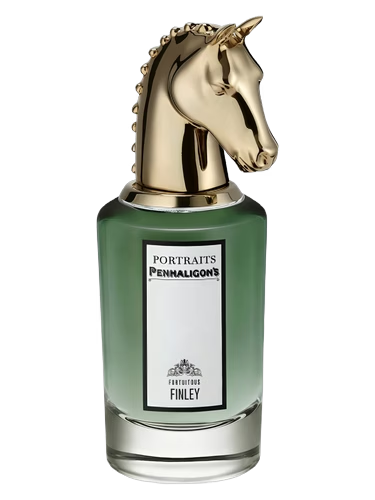
Most Popular Scents Using Lily-of-the-Valley


What is Lily-of-the-Valley?
Lily-of-the-Valley, also known as Muguet, is a delicate woodland flower native to Europe and Asia, prized in perfumery for its fresh, green, and radiant floral aroma.What does Lily-of-the-Valley smell like?
It possesses a sheer, dewy, and airy scent profile characterized by a clean floral sweetness, subtle soapy nuances, and a crisp green clarity reminiscent of spring.How is Lily-of-the-Valley essence extracted?
Because the flower is "mute" and does not yield essential oil through traditional distillation, its scent is almost exclusively recreated using synthetic reconstruction and headspace technology.What are some top perfumes featuring Lily-of-the-Valley?
Iconic fragrances include Dior Diorissimo, Guerlain Muguet, Estée Lauder Pleasures, Cacharel Anaïs Anaïs, and Maison Francis Kurkdjian Aqua Universalis.When is Lily-of-the-Valley in season?
The plant is a spring perennial that typically blooms for a short but intense period of two to four weeks between April and June.