Fragrance Notes Are Layers Of Scent That Are Layered To Form The Final Fragrance. Fragrance Notes Are Categorised Into Three Main Elements Based On How Long They Take To Evaporate, And How Long They Typically Last Following Application: Top Notes, Heart Notes And Base Notes.
Lemon
The lemon note in perfumery is bright, zesty, and intensely refreshing, evoking the scent of freshly squeezed fruit and rind. It is sharp, acidic, and uplifting, serving as a classic top note for providing an immediate, sparkling lift to a fragrance. It is often utilized in Eaux de Cologne and summer scents for its clean, effervescent, and cheerful character.

Origin & Extraction Of Lemon
Lemon is a cornerstone in the world of classic perfumery, most notably as a crucial component of the traditional Eau de Cologne structure. Its use dates back centuries, providing the foundation for the "fresh" category of fragrances. Colognes like 4711 Original Eau de Cologne, first launched in 1792, rely heavily on a brilliant blast of lemon and other citruses to deliver their invigorating, clean, and ephemeral scent experience, establishing lemon as the benchmark for cleanliness and vivacity in fragrance.
In modern perfumery, the versatility of the lemon note allows it to transcend traditional categories. While still essential for providing an immediate, sparkling lift in top notes, high-quality natural lemon essence is now prized for its complex facets—ranging from green and bitter to slightly sweet. This complexity allows lemon to be used strategically to add sharpness and brilliance to modern compositions, ensuring a luminous opening while preventing heavier base notes from becoming too dense too quickly.
Extraction Methods of Lemon
The primary method for extracting lemon essential oil is cold expression (pressing) of the fruit's peel, a mechanical process that ruptures the oil sacs located in the flavedo to release the essence. Historically, this was achieved through labor-intensive manual techniques such as the sponge method, which involved cutting the fruit in half, removing the pulp with a sharp-edged spoon (cavatura), and pressing the rinds against a sponge to collect the fluids. Another traditional method, the "ecuelle a piquer," utilized a bowl lined with needles to prick the fruit's skin. In the 18th century, the first technical descriptions of Sicilian lemon oil production emerged, eventually leading to the development of mechanical devices like the sfumatrice and the "calabrese machine" to automate the pressing process.
Modern commercial production has evolved to use high-speed mechanical peelers (pelatrice) and specialized in-line extractors that can process juice and oil simultaneously. These systems utilize stainless-steel drums and water sprays to create an oil-in-water emulsion, which is then refined through centrifugation to isolate the pure essential oil. Recent advancements include the integration of pectic enzymes during cold extraction to break down pectin and improve yields, as well as the use of microwave-assisted extraction and supercritical CO2 extraction to capture more delicate aromatic profiles while minimizing thermal degradation. While distillation (hydrodistillation or steam distillation) is also used—particularly for producing oils for food flavoring or phototoxic-safe applications—cold expression remains the gold standard for high-quality perfumery.
Lemon is a fundamental note in the history of perfumery, most famously defining the original structure of Eau de Cologne. Its sparkling, sharp, and intensely refreshing profile made it the cornerstone for compositions like **4711 Original Eau de Cologne** and Guerlain's **Eau de Guerlain**. These classic fragrances rely on lemon to provide an immediate, invigorating lift and a clean, effervescent opening that remains a benchmark for the Fresh fragrance family even today.
In modern perfumery, lemon often provides necessary brightness and contrast to richer, more complex compositions. For instance, in Dolce & Gabbana’s iconic **Light Blue**, lemon delivers a vivid, zesty Mediterranean freshness that cuts through the cedar and musk base, ensuring the fragrance remains airy and suitable for warm weather. Similarly, in Acqua di Parma's **Fico di Amalfi**, the lemon note contributes to the overall sunny, radiant impression, blending seamlessly with grapefruit and fig nectar.
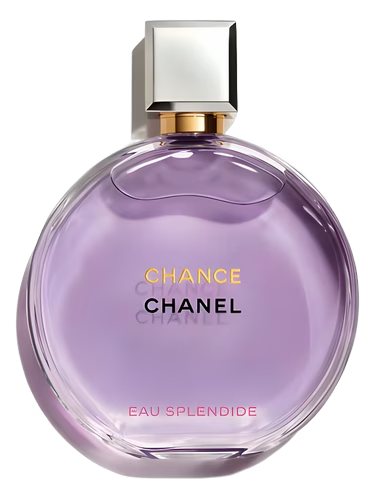
Lemon also plays a crucial role in balancing gourmand and oriental scents, preventing them from becoming too heavy or cloying. In luxury and niche perfumery, houses often use high-quality lemon essential oil to enhance sophisticated freshness, as seen in Creed’s **Viking**, where the note adds a bracing, masculine zest to the spicy, woody core. Furthermore, in the realm of feminine florals, a bright lemon opening, like that found in Chanel’s **Chance Eau Fraîche**, provides a luminous introduction to the jasmine and vetiver heart, highlighting the fragrance’s vibrant character.
Sustainability Of Lemon
Sustainability of Lemon
- Utilizing trees as efficient carbon sinks that sequester atmospheric carbon into the ground more effectively than other citrus varieties
- Adopting precision irrigation and drip systems to manage high water requirements and prevent over-salination of groundwater
- Promoting circular economy practices by repurposing lemon waste, peels, and rinds for essential oils, animal feed, cosmetics, and energy production
- Implementing Integrated Pest Management (IPM) and organic farming to reduce the environmental impact of pesticides and synthetic fertilizers
- Supporting social and economic sustainability through producer cooperatives that ensure fair trade, gender equality, and stable incomes for farming communities
- Developing innovative cultivation techniques, such as growing lemons on trellises, to maximize resources and land stewardship
Trivia
The word lemon is derived from the Arabic word laymun, and the fruit was originally introduced to Europe during the Middle Ages.
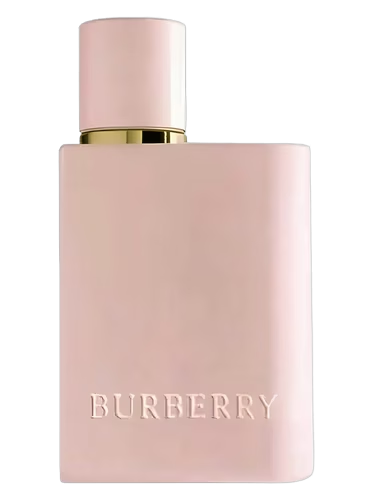
Most Popular Scents Using Lemon

What does lemon smell like in perfume?
The lemon note is bright, zesty, and intensely refreshing, characterized by a sharp, acidic, and uplifting aroma that evokes freshly squeezed fruit and rind.How is lemon essential oil typically extracted?
The primary method is cold expression (pressing) of the fruit's peel, which ruptures oil sacs in the flavedo to release the essence while preserving its delicate aromatic compounds.What is the role of lemon in fragrance compositions?
Lemon is a classic top note that provides an immediate, sparkling lift; it is a cornerstone of Eaux de Cologne and helps balance heavier base notes or gourmand scents.When is the peak season for lemon production?
While lemon trees can produce fruit year-round, peak harvest typically occurs during the winter and early spring months, with the primary blooming period beginning in late winter.What are some iconic perfumes that feature a prominent lemon note?
Notable fragrances include Maison Margiela Replica Under the Lemon Trees, Dolce & Gabbana Light Blue, Chanel Allure Homme Edition Blanche, and 4711 Original Eau de Cologne.