Fragrance Notes Are Layers Of Scent That Are Layered To Form The Final Fragrance. Fragrance Notes Are Categorised Into Three Main Elements Based On How Long They Take To Evaporate, And How Long They Typically Last Following Application: Top Notes, Heart Notes And Base Notes.
Lavender
Lavender offers a classic, aromatic-floral scent that is simultaneously fresh, herbaceous, and clean. It features camphoraceous and slightly spicy facets, often described as a soft, sweet blend of floral powder, fresh hay, and subtle mint. It imparts a calming, sophisticated fougère lift, essential in colognes and men's fragrances.

Origin & Extraction Of Lavender
Lavender is one of the most historically significant notes in perfumery, acting as the backbone of the fougère fragrance family, which translates to "fern-like." This aromatic-herbal note provides a sophisticated, clean, and herbaceous freshness. A quintessential example of Lavender's foundational role is in classic creations like Pour Un Homme de Caron, launched in 1934. This iconic scent is a masterpiece built around a striking Lavender top note blended with vanilla, showcasing how the note can be both refreshing and comforting.
Beyond the fougère genre, Lavender has found renewed popularity in modern luxury and niche perfumery, where it is often treated with greater complexity and intensity. A major turning point came with releases that pushed Lavender into new territory, such as Jicky by Guerlain, which pioneered the pairing of Lavender with vanilla, and more recently, scents like Tuxedo by Yves Saint Laurent, which uses a clean, bright Lavender alongside patchouli and spices for a formal, contemporary feel. These fragrances demonstrate Lavender's versatility, proving it can be a central note in rich, elegant, and long-lasting compositions.
Extraction Methods of Lavender
The primary method for extracting lavender essential oil is steam distillation, a process where pressurized steam passes through freshly harvested lavender buds and flowers to release aromatic compounds. Historically, this method has been the classical standard for centuries, often utilizing traditional copper stills—sometimes modified from whiskey production—to capture the volatile oils. Ancient techniques also included simple hydrodistillation, where plant material was boiled directly in water, and enfleurage, where flower petals were placed on layers of fat to absorb their fragrance over several days before being extracted with alcohol.
Modern commercial production has refined these traditional processes by implementing advanced industrial systems where harvest carts connect directly to steam generation units to begin distillation minutes after cutting, preserving the highest concentration of volatile compounds. Recent developments have introduced innovative techniques such as cellulase-assisted hydrodistillation, which uses enzymes to break down plant cell walls for better oil quality and shorter extraction times. Additionally, supercritical CO2 extraction is now employed to capture a broader spectrum of aromatic molecules at lower temperatures than steam, resulting in an essence that more closely mimics the scent of the living plant.
Lavender is one of the most historically significant notes in perfumery, acting as the backbone of the fougère fragrance family, which translates to "fern-like." This aromatic-herbal note provides a sophisticated, clean, and herbaceous freshness. A quintessential example of Lavender's foundational role is in classic creations like **Pour Un Homme de Caron**, launched in 1934. This iconic scent is a masterpiece built around a striking Lavender top note blended with vanilla, showcasing how the note can be both refreshing and comforting.
- The use of Lavender in fragrances is often associated with cleanliness and masculinity, due to its ubiquity in traditional barbershop scents and aftershaves.
- Modern perfumery frequently pairs Lavender with contrasting elements, such as amber, woods, or gourmand notes, to give it contemporary depth.
Beyond the fougère genre, Lavender has found renewed popularity in modern luxury and niche perfumery, where it is often treated with greater complexity and intensity. A major turning point came with releases that pushed Lavender into new territory, such as **Jicky** by Guerlain, which pioneered the pairing of Lavender with vanilla, and more recently, scents like **Tuxedo** by Yves Saint Laurent, which uses a clean, bright Lavender alongside patchouli and spices for a formal, contemporary feel. These fragrances demonstrate Lavender's versatility, proving it can be a central note in rich, elegant, and long-lasting compositions.
- In women's fragrances, Lavender is used to introduce an aromatic, crisp dimension, often countering overly sweet or heavy floral accords, making it a key component in scents like **Mon Guerlain**.
Another area where Lavender shines is in powerhouse men's fragrances of the late 20th and early 21st centuries. In these compositions, the herbaceous nature of Lavender is amplified and blended with coumarin and oakmoss to create the recognizable, strong fougère structure. Classic examples include **Brut** by Fabergé and, in a more recent, hyper-popular form, **Bleu de Chanel** which incorporates a fresh, clean Lavender note to maintain a crisp structure amidst its marine and woody elements. These examples solidify Lavender's status as a timeless and essential aromatic ingredient, valued for its calming yet invigorating complexity.
Sustainability Of Lavender
Sustainability of Lavender
- Promoting biodiversity as a drought-resistant crop that attracts bees and other pollinators, supporting healthy local ecosystems
- Eliminating reliance on synthetic pesticides and fertilizers due to the plant's natural resistance to most insect pests
- Implementing innovative waterless extraction technologies, such as air circulation and supercritical fluid extraction, to reduce energy consumption and carbon footprint
- Reducing environmental impact through the development of specialized harvesters that protect bee populations and decrease the volume of material transported for processing
- Adopting closed-loop cooling circuits and heat exchangers in distilleries to cut water consumption by up to half
- Supporting socio-economic resilience by maintaining local jobs in traditional growing regions through ethical sourcing and fair-trade initiatives
Trivia
The name lavender is derived from the Latin word lavare, meaning to wash, because the ancient Romans used the aromatic herb to scent their public baths.
Most Popular Scents Using Lavender
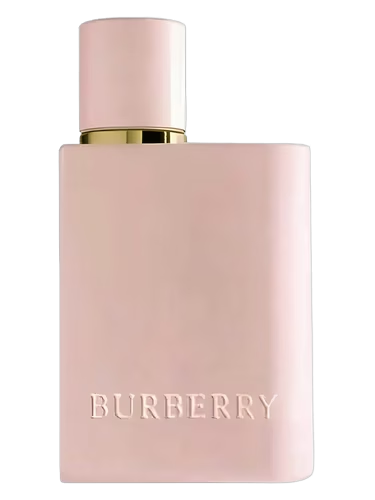
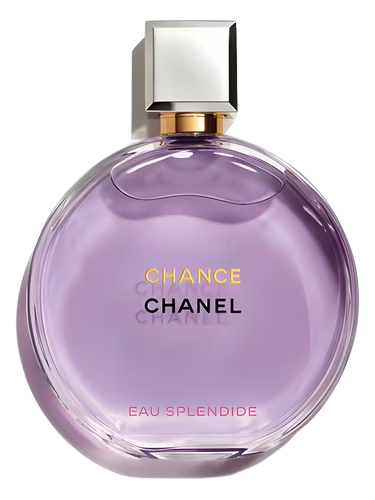
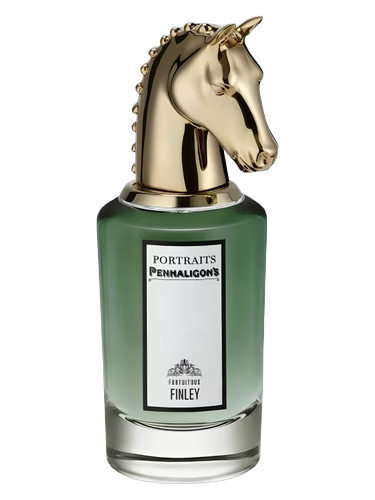
What is Lavender?
Lavender is a Mediterranean flowering plant from the mint family (Lamiaceae), historically used by ancient Romans for bathing and widely celebrated in perfumery as the foundation of the aromatic fougere family.What does Lavender smell like?
It offers a clean, fresh, and aromatic-floral scent that blends herbaceous sweetness with camphoraceous, slightly spicy facets and subtle notes of fresh hay or mint.How is Lavender essence extracted?
The essential oil is primarily obtained through steam distillation of the flowering tops, though modern techniques like supercritical CO2 extraction are also used to capture a scent closer to the living plant.What are some top perfumes featuring Lavender?
Iconic and modern fragrances include YSL Libre, Dior Sauvage, Guerlain Mon Guerlain, Caron Pour Un Homme, and Le Labo Lavande 31.Is Lavender considered a masculine or feminine scent?
While traditionally the backbone of masculine fougere fragrances and barbershop scents, lavender is a versatile unisex note that is increasingly featured in modern feminine and gender-neutral compositions.