Fragrance Notes Are Layers Of Scent That Are Layered To Form The Final Fragrance. Fragrance Notes Are Categorised Into Three Main Elements Based On How Long They Take To Evaporate, And How Long They Typically Last Following Application: Top Notes, Heart Notes And Base Notes.
Larkspur
Larkspur in perfumery often features a delicate, slightly sweet floral profile blended with fruity and gourmand nuances. Its aroma is complex, incorporating hints of tart red fruit (cherry, red currant), soft florals, and a warm, sweet base of vanilla and tonka. It is used to create unique, sometimes sour/sweet, Floral Fruity Gourmand compositions.

Origin & Extraction Of Larkspur
Larkspur, or Delphinium, is a note interpreted in perfumery as a delicate, multi-faceted floral accord. Due to its complex profile, which includes soft sweetness, floralcy, and tart, cherry-like fruity nuances, it rarely serves as a dominant note. Instead, its use is tied to modern perfumery trends, where it functions as a sophisticated layering element. It helps support the development of complex Floral Fruity Gourmand compositions and is prized in niche creations for introducing a slightly sour, invigorating edge that complements sweetness.
The abstract nature of the Larkspur note means it enhances larger olfactory stories in contemporary fragrances, providing depth and novelty. Its hints of tart red fruit and a warm vanilla/tonka undertone allow it to bridge the scent pyramid smoothly, moving seamlessly between sparkling top notes and deeper bases. This subtle contribution is essential in modern compositions, such as those with a sweet-tart character like Guerlain's La Petite Robe Noire, ensuring the resulting fragrance is vibrant, long-lasting, and refined, without relying on traditional, single-note floral simplicity.
Extraction Methods of Larkspur
Historically, the extraction of larkspur (Delphinium spp.) primarily focused on isolating its potent norditerpenoid alkaloids for medicinal and toxicological research. This was traditionally achieved through labor-intensive manual processes, including air-drying the plant material in direct sunlight followed by coarse grinding. The ground material was then subjected to a multi-day maceration in solvents such as 95% ethanol, with the resulting fraction being filtered and evaporated to a tarlike residue. Early methods also utilized secondary extractions involving mixtures of chloroform, benzene, and sulfuric acid to isolate specific alkaloid groups.
In modern practice, extraction methods have evolved to emphasize both efficiency and the capture of diverse compounds, such as pigments. For color extraction, acidified aqueous solvents are used to stabilize blue-to-violet anthocyanins, often enhanced by advanced techniques like ultrasound-assisted extraction (UAE) or simple maceration to improve pigment yield and color retention. For toxicological analysis, current laboratory standards utilize rapid flow injection-electrospray ionization-mass spectrometry (FI-ESI-MS) and Fourier transform infrared spectroscopy (FTIR) to quantify total alkaloid content. For home gardeners and seed collection, extraction is a simple physical process involving harvesting mature seed pods and gently rubbing or peeling the outer layer to release the seeds for future planting.
Larkspur, or Delphinium, is a note that is often interpreted in perfumery as a delicate, multi-faceted floral accord. Due to its complex profile—which ranges from soft, sweet floralcy to tart, cherry-like fruity nuances—it rarely stands as the single dominant note. Instead, it serves as a sophisticated layering element, supporting the development of Floral Fruity Gourmand compositions. Its ability to introduce both sweetness and a slightly sour, invigorating edge makes it prized in niche and artisanal creations designed to evoke whimsical, garden-fresh complexity.
- One notable example that is often cited for its complex floral structure, where notes like Larkspur would subtly reside, is the renowned **Flowerbomb** by Viktor & Rolf. Although not explicitly listed, the dense, sweet, and slightly tart floral-gourmand heart of this fragrance requires numerous secondary florals to achieve its signature rich texture, allowing notes like Larkspur to contribute to the overall sweet-and-sour effect.
The delicate and sometimes abstract nature of the Larkspur note means it is frequently blended to enhance a larger olfactory story, particularly in modern fragrances seeking a natural yet refined garden feel. Its contribution of tart red fruit hints (cherry/red currant) and a warm vanilla/tonka undertone allows it to seamlessly bridge the gap between sparkling top notes and deeper, lasting base accords. This functionality is essential in high-end fragrances that require a smooth transition across the scent pyramid.
- A fragrance where a similar sweet-tart floral complexity is paramount is **La Petite Robe Noire** by Guerlain. While focused on cherry, licorice, and rose, the structure demands a blend of delicate, slightly acidic florals to provide lift and prevent the gourmand notes from becoming too heavy. Larkspur's described profile aligns perfectly with this requirement, contributing to the perfume's playful yet sophisticated sour-sweet character.
Ultimately, Larkspur is most influential in contemporary perfumery where depth and novelty are desired over traditional single-note simplicity. It is an ingredient that helps define the modern genre of fragrances that smell both natural (green/floral) and delectable (gourmand). While rarely advertised prominently, its subtle contribution ensures the resulting composition, particularly those leaning toward a fruity-gourmand character, is vibrant, long-lasting, and truly unique.
Sustainability Of Larkspur
Sustainability of Larkspur
- Implementing the Larkspur Climate Action Plan 2030 to reduce greenhouse gas emissions by 40% below 1990 levels
- Engaging residents through the Climate Action Forum to discuss and support local sustainability initiatives
- Promoting 100% renewable electricity through Marin Clean Energy’s Deep Green Program for energy-resilient homes
- Adopting water conservation technologies, including smart irrigation systems and drought-tolerant native landscaping
- Encouraging the transition to zero-emissions vehicles by building out electric vehicle charging infrastructure
- Supporting eco-friendly building practices by using reclaimed materials and energy-efficient home designs
Trivia
According to Greek mythology, larkspur flowers are said to have emerged from the blood of Ajax, a heroic figure of the Trojan War, springing up wherever his blood spilled on the ground.
Most Popular Scents Using Larkspur
What is Larkspur in perfumery?
Larkspur, or Delphinium, is a delicate floral note used in modern perfumery to create complex Floral Fruity Gourmand compositions with a sophisticated, garden-fresh appeal.What does Larkspur smell like?
It features a multi-faceted profile of soft sweetness and light florals blended with tart, cherry-like red fruit nuances and a warm base of vanilla and tonka.How is the Larkspur scent extracted?
In commercial perfumery, the scent is typically a fantasy note recreated synthetically, as no natural essential oil or absolute currently exists for industrial use.What are some top perfumes featuring Larkspur?
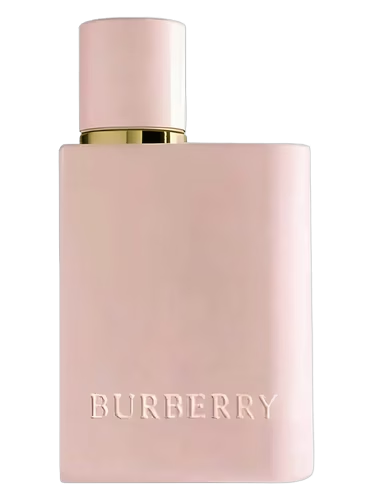
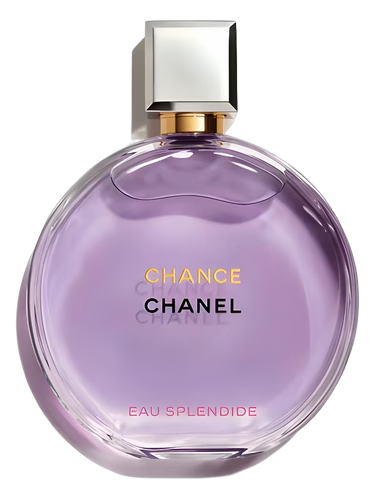
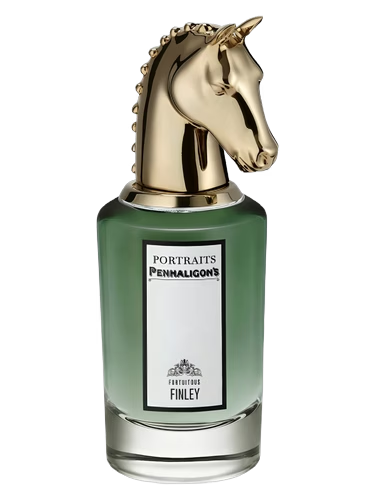
Notable fragrances that utilize or align with the Larkspur profile include Ineke Scarlet Larkspur, Guerlain La Petite Robe Noire, and Viktor & Rolf Flowerbomb.When is Larkspur in season?
Larkspur is a cool-season plant that typically blooms in early spring through early summer, though some varieties can extend their blooming phase into September.What does Larkspur symbolize?
The flower traditionally represents an open heart, strong bonds of love, lightheartedness, and a carefree spirit.