Fragrance Notes Are Layers Of Scent That Are Layered To Form The Final Fragrance. Fragrance Notes Are Categorised Into Three Main Elements Based On How Long They Take To Evaporate, And How Long They Typically Last Following Application: Top Notes, Heart Notes And Base Notes.
Lamprocapnos
Lamprocapnos (Bleeding Heart) is delicate and airy, offering subtle, fresh green notes combined with a dewy, watery floral sweetness, reminiscent of lily-of-the-valley and cyclamen. It is a soft, slightly powdery scent used to add a quiet, luminous, and ethereal quality to springtime compositions.

Origin & Extraction Of Lamprocapnos
Lamprocapnos, commonly known as Bleeding Heart, is not a traditional historical note in classical perfumery, which typically relied on more robust and easily extractable oils from Mediterranean flowers and citruses. Due to the delicate, subtle, and ephemeral nature of its scent—a gentle, dewy, green-floral sweetness—it resists conventional essential oil extraction. Therefore, its inclusion in fine fragrance compositions relies almost entirely on modern headspace technology and synthetic reconstruction. This places the note firmly in the modern era of perfumery, primarily gaining recognition from the late 20th century onwards as perfumers developed the technical ability to capture and recreate very light, airy, and photorealistic floral profiles.
The significance of Lamprocapnos in contemporary perfumery lies in its ability to add a luminous, ethereal, and 'watery' quality to compositions, differentiating modern sheer florals from traditional heavy bouquets. It is predominantly used in niche and artistic perfumery, often alongside transparent notes like lily-of-the-valley or cyclamen, to evoke scenes of delicate, dewy gardens and springtime freshness. Its modern usage reflects a trend toward sophisticated, understated floralcy and is key in creating soft, contemporary fragrances that prioritize transparency and a quiet, non-obtrusive luxury.
Extraction Methods of Lamprocapnos
Historically, Lamprocapnos (bleeding heart) has been primarily propagated and its essences obtained through traditional root division and simple maceration techniques. For medicinal and horticultural use, the most common method involved manual crown division in the early spring or autumn, where the tuberous roots were carefully sliced into sections. Traditional herbal preparations utilized the roots and herbs by steeping them in solvents to extract isoquinoline alkaloids like protopine and coptisine for treating pain and inflammation.
Modern extraction and propagation have evolved to include advanced laboratory techniques such as micropropagation via axillary bud activation and tissue culture. Recent research highlights the use of sophisticated cryopreservation methods, including encapsulation-vitrification and droplet-vitrification, which involve treating plant shoot tips with vitrification solutions and plunging them into liquid nitrogen (-196 °C) for long-term genetic storage. Additionally, high-performance liquid chromatography (HPLC) is now standard for the precise extraction and analysis of the plant's cytotoxic compounds for pharmaceutical research.
The Lamprocapnos (Bleeding Heart) note, celebrated for its delicate, dewy, and ethereal floral sweetness, remains a relatively specialized and rare ingredient in mainstream perfumery. Due to its subtle, light, and airy profile, it is primarily sought after by niche and artistic fragrance houses looking to capture the transient beauty of springtime and delicate garden scents. Rather than serving as a heavy anchor, Lamprocapnos functions as a luminous accent, often paired with green notes and other sheer florals like lily-of-the-valley (Muguet) or cyclamen to amplify a sense of freshness and innocence.
- The inclusion of Lamprocapnos is often a defining feature in modern compositions aiming for a watery, slightly melancholy floral heart. One fragrance that captures this spirit is L’Eau d’Issey Pure Petale de Nectar, which uses a watery floral note reminiscent of Lamprocapnos to create a gentle, transparent sweetness that isn't overpowering. While the note itself may not be explicitly listed by all houses, its characteristic dewy, green, and sweet-floral effect is prized for creating a delicate, luminous veil.
In contemporary perfumery, particularly within Asian and European niche markets, Lamprocapnos is being used to add sophisticated complexity to green and aquatic genres. It often appears in limited-edition or conceptual fragrances, such as certain collections by brands like Jo Malone or Diptyque, where the focus is on photorealistic single-flower or garden themes. The note helps bridge the gap between fresh, green sap and a subtle, honeyed floralcy, distinguishing these scents from more traditional, heavier bouquets and contributing to the growing trend of quiet luxury in fragrance. For instance, the sheer, sweet-green impression found in some formulations of Gucci Bloom Acqua di Fiori utilizes this type of delicate, fresh floral architecture.
Sustainability Of Lamprocapnos
Sustainability of Bleeding Heart
- Promoting biodiversity by providing critical early-season nectar sources for native pollinators, including bees, butterflies, and hummingbirds
- Adoption of low-intervention gardening practices due to the plant's natural resistance to deer and rabbits, reducing the need for chemical deterrents
- Enhancing soil health through the use of organic amendments like compost and aged manure, which improve soil structure and nutrient cycling
- Supporting water conservation by utilizing mulch to maintain consistent soil moisture and buffer ground temperatures during summer dormancy
- Encouraging sustainable plant propagation through natural self-seeding and rhizome division, which minimizes the environmental impact of commercial nursery production
Trivia
According to Japanese folklore, the petals of the bleeding heart represent 20 lavish gifts offered by a prince to a maiden who rejected him, and the flower's distinct shape is said to have formed when he finally pierced his own heart in despair.
Most Popular Scents Using Lamprocapnos
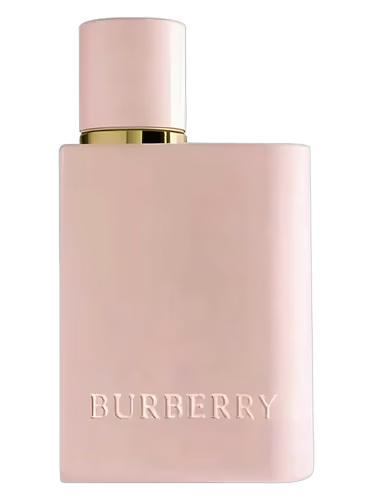
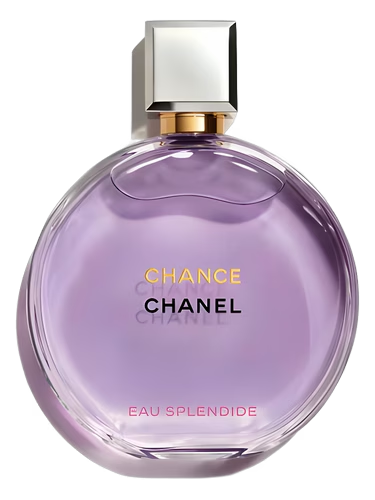
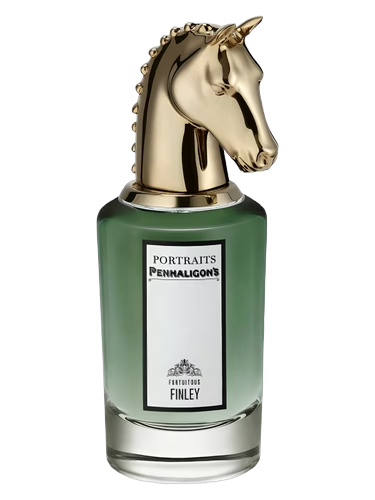
What is Lamprocapnos?
Commonly known as Bleeding Heart, Lamprocapnos is a delicate flower native to Northeast Asia that is used in modern perfumery for its ethereal, dewy, and fresh green-floral scent.What does Lamprocapnos smell like?
It offers a soft, airy fragrance with subtle green notes and a watery floral sweetness similar to lily-of-the-valley and cyclamen.How is the Lamprocapnos note extracted?
Because the flower's scent is too delicate for traditional extraction, its profile is typically recreated in perfumery using headspace technology or synthetic reconstruction.What are some top perfumes featuring Lamprocapnos?
Fragrances that utilize or evoke this note include Chloë Sevigny Little Flower, L’Eau d’Issey Pure Petale de Nectar, and Gucci Bloom Acqua di Fiori.When is Lamprocapnos in season?
It is a spring ephemeral that typically reaches peak bloom between April and June, often entering dormancy by mid-summer.