Fragrance Notes Are Layers Of Scent That Are Layered To Form The Final Fragrance. Fragrance Notes Are Categorised Into Three Main Elements Based On How Long They Take To Evaporate, And How Long They Typically Last Following Application: Top Notes, Heart Notes And Base Notes.
Laburnum
Laburnum, often referred to as Golden Chain, offers a sweet, honeyed floral scent reminiscent of sweet pea and broom flowers. It has a slightly powdery and green-almond undertone, providing a luminous, delicate, and intoxicating heart note that adds an innocent yet rich solar warmth to floral compositions.

Origin & Extraction Of Laburnum
Laburnum, often referred to as Golden Chain, does not possess a long, documented history as a traditional, extractable ingredient in classic perfumery, unlike foundational notes such as rose or jasmine. The primary reason for this is the plant's inherent toxicity. Historically, perfumery utilized natural extracts, and since Laburnum flowers contain toxic alkaloids, direct extraction for scent was avoided. Therefore, its application in fine fragrance has emerged almost entirely through modern synthesis and headspace technology, allowing perfumers to safely and accurately recreate its distinctive sweet, honeyed, and slightly green-almond aroma.
The use of the Laburnum note is predominantly a feature of contemporary and niche perfumery, reflecting a trend toward incorporating unusual or photorealistic floral scents. Since it is not a volatile oil derived from a historical cultivation process for scent (like lavender or bergamot), its relevance is tied to the 20th and 21st-century pursuit of expanding the floral palette. Today, Laburnum contributes a luminous, solar warmth and a touch of sophisticated sweetness, serving as an unusual supporting heart note that adds complexity and brightness to modern floral and woody compositions.
Extraction Methods of Labnum
Historically, labdanum resin was collected through a unique and labor-intensive manual process involving livestock. Shepherds would gather the sticky gum from the beards and thighs of goats and sheep that had grazed on Cistus shrubs, as the resin naturally adhered to their coats. In regions like Crete, traditional tools called "ladanisterion" or "lambadistrion"—rakes with leather thongs instead of teeth—were used to sweep the shrubs and collect the resin, which was then softened in the sun for separation.
In modern commercial production, the extraction process has evolved into more efficient chemical and mechanical methods. Labdanum gum is primarily obtained by boiling the harvested leaves and twigs in water or an alkaline solution to release the resin. To produce the aromatic materials used in perfumery, this raw gum or the plant material itself is processed via solvent extraction to create a concentrated absolute, or through steam distillation to produce labdanum essential oil. Recent refinements include the use of alkaline treatments to remove organic acids and improve the odor profile, as well as fractional distillation to enhance the purity and clarity of the oil.
The Laburnum note, known for its delicate, sweet, and honeyed floral scent, is an elegant and somewhat rare component in modern fine perfumery, adding a bright, luminous warmth. While Laburnum (Golden Chain) itself can be toxic, its aroma is masterfully recreated synthetically to capture its innocent yet rich floral profile. Its usage is typically found in high-end, sophisticated floral compositions where it serves to uplift and brighten the heart, often blending seamlessly with notes like sweet pea, broom, or linden blossom to evoke a radiant springtime garden.
- A notable example of a fragrance utilizing a Laburnum accord to great effect is **Jo Malone London’s Golden Needle Tea**, which, while centered on tea, uses the flower's golden scent to introduce a solar, luminous floralcy into the composition.
- Another fragrance that explores this sunny floral facet is **Ormonde Jayne's Ormonde Man**, where the Laburnum note contributes a subtle, unusual green-almond undertone and a sophisticated sweetness to an otherwise woody and exotic blend.
Due to its distinctive profile—reminiscent of yellow flowers with an unusual, slightly powdery almond facet—Laburnum is rarely the centerpiece but acts as a brilliant supporting character. Its delicate complexity means it is frequently reserved for niche and artisanal fragrances that seek a photorealistic or unusual floral bouquet. These fragrances often aim for a sense of transient, intoxicating beauty, utilizing Laburnum to convey the feeling of warm, dappled sunlight filtering through flowering branches.
- In the broader context of perfumery, while a specific perfume explicitly named for its Laburnum note might be scarce, its luminous qualities are sought after in many "golden" or solar floral scents. The effect often produced by a high-quality Laburnum accord is one of sheer, sparkling elegance, preventing heavier floral or gourmand notes from becoming too dense.
Contemporary perfumers appreciate the Laburnum note for its ability to introduce a delicate, sweet floralcy that stands apart from more common notes like rose or jasmine. Its underlying green-almond facet ensures it maintains an air of natural complexity and sophistication, making it a valuable tool for creating modern, multidimensional floral perfumes that feel both luminous and grounding. It continues to be an intriguing, subtle element for those seeking truly unique floral signature scents.
- Blooming occurs in late spring to early summer, typically between May and June, producing magnificent cascades of vibrant yellow flowers
- Fresh foliage emerges in the spring alongside the appearance of striking flower racemes
- The tree is deciduous, with leaves traditionally turning yellow in September due to natural senescence before falling in the autumn
- Seed pods develop after the flowering period and remain on the tree through the late summer and autumn
- Dormancy takes place during the winter months, which is also the recommended time for hard pruning and planting
Sustainability Of Laburnum
Sustainability of Laburnum
- Enhancing soil fertility through nitrogen fixation, contributing up to 50 kg of nitrogen per hectare annually to benefit surrounding flora and agricultural systems
- Improving ecosystem resilience by providing critical habitats and nectar-rich food sources for diverse pollinators, birds, and beneficial insects
- Preventing soil erosion and stabilizing slopes in forestry management through extensive and deep root systems
- Promoting sustainable urban forestry by integrating resilient trees into city landscapes to improve air quality, provide shade, and enhance climate adaptation
- Fostering a circular economy by utilizing hard, durable, and naturally oily wood for long-lasting woodworking and high-end artisanal products
- Supporting biodiversity conservation through community engagement and educational programs that emphasize the ecological value of native species
Trivia
Also known as the "golden chain tree" for its vibrant yellow flowers, laburnum produces seeds that are highly poisonous and can be lethal if consumed in large quantities.
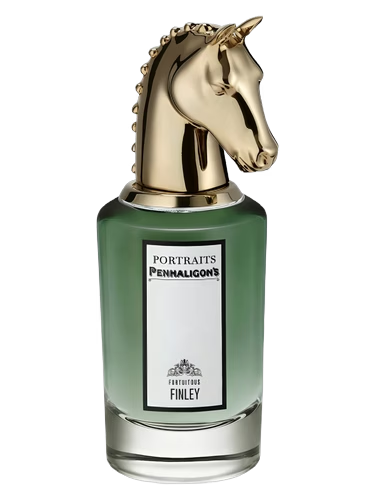
Most Popular Scents Using Laburnum


What is Laburnum?
Laburnum, also known as Golden Chain, is a deciduous tree native to southern Europe and Asia Minor, recognized in perfumery for its sweet, honeyed floral aroma and vibrant yellow flower cascades.What does Laburnum smell like?
It offers a delicate, luminous, and intoxicating scent reminiscent of sweet pea and broom, characterized by a honeyed floral profile with unique green-almond and slightly powdery undertones.How is the Laburnum note created for perfumes?
Since the plant is toxic, the scent is masterfully recreated using modern synthesis and headspace technology to safely mimic its distinctive aromatic profile.What are some top perfumes featuring Laburnum?
Fragrances featuring this note include Jo Malone London Golden Needle Tea, Ormonde Jayne Ormonde Man, Profumum Roma Acqua Viva, and Parco 1923.When is Laburnum in season?
The tree typically blooms in late spring and early summer, specifically between May and June, when it produces its iconic vibrant yellow flowers.