Fragrance Notes Are Layers Of Scent That Are Layered To Form The Final Fragrance. Fragrance Notes Are Categorised Into Three Main Elements Based On How Long They Take To Evaporate, And How Long They Typically Last Following Application: Top Notes, Heart Notes And Base Notes.
Kiwi blossom
Kiwi Blossom offers a unique, tropical fruity-floral profile. It starts with a tangy, slightly sour watermelon-like zest, evolving into a sophisticated and uplifting sweetness. This exotic note provides a soft, green, and subtly complex lift, ideal for contemporary and bright floral compositions.

Origin & Extraction Of Kiwi blossom
Kiwi blossom, while a relatively niche note in classical perfumery, has been embraced by modern fragrance houses seeking a unique, tropical, and slightly green floral accent. It is typically used to introduce a luminous top or heart note, enhancing compositions that lean towards fresh, aquatic, and fruity-floral categories. The note’s zesty, watermelon-like tang and subtle sweetness prevent it from becoming overly heavy, making it an excellent component for spring and summer scents. While difficult to isolate, it is often synthesized to deliver a bright, uplifting complexity.
The rise of the Kiwi blossom note is tied to the broader trend of incorporating sophisticated, exotic fruit and floral hybrids into mainstream perfumery. Designers utilize this note when crafting fragrances that evoke island paradises or vibrant, wet gardens, providing a contemporary twist on traditional floral bouquets. Its complexity—ranging from tangy zest to a soft, sophisticated sweetness—allows it to bridge the gap between initial bright, citrus-like top notes and the softer, more sustained floral heart of a perfume.
Extraction Methods of Kiwi Blossom
The primary method for extracting essential oil from kiwi fruit flowers involves a specialized process of reduced-pressure steam distillation. Historically, essential oils from botanical sources were obtained through traditional steam distillation, squeezing, or absorption methods. For kiwi blossoms, modern techniques involve crushing the flowers into a pulp and utilizing a multifunctional extraction device that performs water vapor distillation and solvent extraction in a continuous, seamless manner. To protect the delicate active ingredients, the distillation is conducted at low temperatures, typically not exceeding 40°C.
Recent advancements have introduced more sophisticated technologies to improve efficiency and purity. These include vacuum low-temperature distillation and the use of multi-enzyme methods to break down plant material before extraction. Beyond the blossoms, the kiwi plant's seeds are often processed using supercritical fluid extraction with liquid carbon dioxide or compressed propane, which preserves the oil's nutritional profile without the use of high heat or harsh chemical solvents.
Kiwi blossom, while a relatively niche note in classical perfumery, has been embraced by modern fragrance houses seeking a unique, tropical, and slightly green floral accent. It is typically used to introduce a luminous top or heart note, enhancing compositions that lean towards fresh, aquatic, and fruity-floral categories. The note’s zesty, watermelon-like tang and subtle sweetness prevent it from becoming overly heavy, making it an excellent component for spring and summer scents. While difficult to isolate, it is often synthesized to deliver a bright, uplifting complexity.
- One notable example of a fragrance leveraging a similar bright, exotic floral-fruit accord is **L’Eau d’Issey Pure Nectar de Parfum** by Issey Miyake, which captures a fresh, petal-like sweetness that complements the Kiwi Blossom profile.
- Another composition where a tropical floral-fruit note contributes significantly to the overall freshness is **Acqua di Gioia** by Giorgio Armani, with its sparkling, juicy, and green facets echoing the bright start of Kiwi Blossom.
- The playful and vibrant nature of the note also aligns well with fragrances like **Ralph Lauren’s Ralph**, a quintessential fruity-floral where bright, zesty top notes are paramount to the composition's success.
The rise of the Kiwi blossom note is tied to the broader trend of incorporating sophisticated, exotic fruit and floral hybrids into mainstream perfumery. Designers utilize this note when crafting fragrances that evoke island paradises or vibrant, wet gardens, providing a contemporary twist on traditional floral bouquets. Its complexity—ranging from tangy zest to a soft, sophisticated sweetness—allows it to bridge the gap between initial bright, citrus-like top notes and the softer, more sustained floral heart of a perfume.
In contemporary niche perfumery, the Kiwi blossom accord is valued for its ability to convey a sense of natural, almost hyper-real freshness without resorting to generic citrus or aquatic notes. It serves as a subtle yet effective differentiator. Although the specific use of a declared "Kiwi Blossom" note might be exclusive to certain limited-edition or hard-to-find fragrances, its effect—a buoyant, slightly sour, and sophisticated fruity-floral lift—is a coveted element in high-end compositions aimed at capturing unique, luminous freshness.
Sustainability Of Kiwi blossom
Sustainability of Kiwi Blossom
- Adopting precision irrigation and drip systems equipped with soil moisture sensors to reduce water consumption by up to 20% in commercial orchards
- Implementing integrated pest management (IPM) strategies, such as using natural predators like ladybugs and lacewings and installing owl boxes to control rodent populations without chemical interventions
- Promoting soil health and biodiversity through the use of organic cover crops, composting programs, and the maintenance of pollinator corridors and beneficial insect habitats
- Utilizing agroforestry principles and nutrient-dense floodplain deposits to enhance yields naturally while reducing reliance on synthetic fertilizers and herbicides
- Committing to zero-waste event practices in floral design, including the elimination of toxic floral foam and the composting of all botanical materials after use
- Investing in climate-resilient cultivation techniques, such as constructing specialized shade structures to create favorable microclimates and using satellite-based environmental monitoring to track carbon footprints
Trivia
The kiwi flower, or kiwi blossom, belongs to the Actinidia deliciosa vine, and while the plant is famous for its fruit, its fragrant blossoms undergo a dramatic color transformation, blooming as pure white flowers before gradually turning a deep golden yellow.
Most Popular Scents Using Kiwi blossom

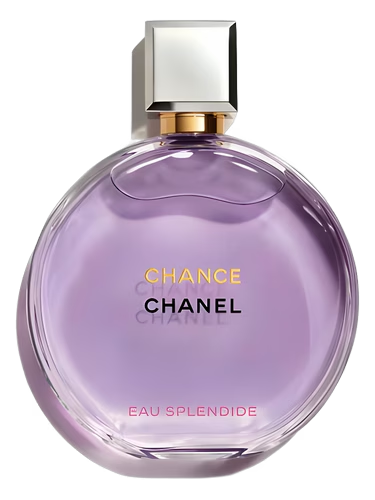

What is Kiwi Blossom?
Kiwi blossom is the fragrant flower of the Actinidia deliciosa vine, known for its unique tropical fruity-floral profile and its dramatic color transformation from pure white to deep golden yellow.What does Kiwi Blossom smell like?
It features a light, sparkling, and zesty aroma often compared to watermelon, combined with soft floral sweetness and refreshing green nuances similar to blooming flowers in a sunny garden.How is Kiwi Blossom essence extracted?
The essence is primarily obtained through reduced-pressure steam distillation at low temperatures or through the creation of a reconstructed accord, as traditional commercial extraction is rare.What are some top perfumes featuring Kiwi Blossom?
Popular fragrances containing this note include Bath & Body Works Tahiti Island Dream, Skylar Rainforest Mist, and Britney Spears Fantasy.When is Kiwi Blossom in season?
The vines typically bloom during the spring and early summer months, with the flowers appearing briefly before giving way to the development of the kiwi fruit.